Indian Startups Build Sovereign AI Models
Source:The Hindu ↗
Why It Matters
Sovereign AI development is critical for India to reduce reliance on foreign tech monopolies, safeguard data sovereignty, and bridge the linguistic digital divide for inclusive growth.
Summary
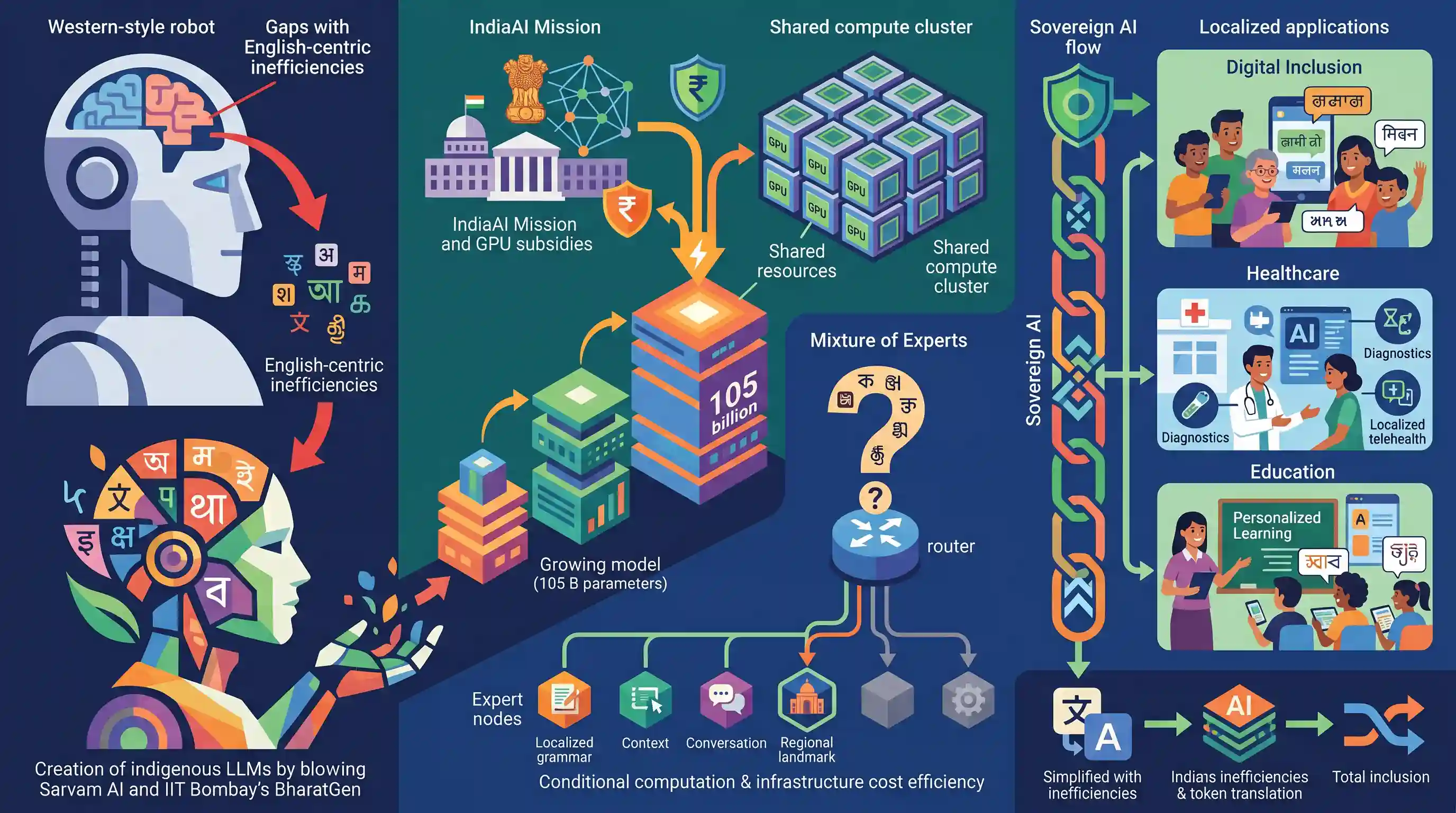
Indian artificial intelligence startups are making significant strides in developing indigenous Large Language Models (LLMs) tailored for Indian languages. Companies like Sarvam AI and IIT Bombay-incubated BharatGen are creating models ranging up to 105 billion parameters, addressing a critical gap left by English-centric Western models. Training such massive models requires substantial computational power and energy, which is being supported by the government's IndiaAI Mission through GPU subsidies and shared compute clusters. To overcome high infrastructure costs, Indian researchers are deploying architectural innovations like the 'Mixture of Experts' (MoE) framework. Developing sovereign AI capabilities is crucial for reducing token-translation inefficiencies, expanding digital inclusion, and deploying localized AI applications in sectors like healthcare and education.
Key Points
- Indian AI startups like Sarvam AI and BharatGen are developing indigenous Large Language Models (LLMs) to natively support diverse Indian languages and reduce reliance on Western tech giants.
- Training LLMs is computationally expensive. To bridge the hardware gap, the government's IndiaAI Mission is subsidizing compute infrastructure by procuring tens of thousands of GPUs and offering financial support to startups.
- Startups are leveraging the 'Mixture of Experts' (MoE) architecture to reduce operational costs, making LLMs run faster and cheaper by activating only specific parameter networks per query.
- Developing localized LLMs removes the inefficiency of 'burning tokens'—a process where foreign models waste computational resources translating Indian language prompts into English before processing them.
Important Terms
IndiaAI Mission

A comprehensive national program by MeitY with a ₹10,372 crore outlay to build a self-reliant AI ecosystem through compute capacity (GPUs), datasets (AIKosh), and startup funding.
UPSC context
GS Paper 3: Science & Tech. Tests knowledge of government policies for technological self-reliance and digital infrastructure development.
BharatGen
India's first government-funded Multimodal Large Language Model (LLM) initiative led by IIT Bombay, designed to create inclusive AI solutions across 22 Indian languages for healthcare and agriculture.
UPSC context
GS Paper 3: Indigenization of Technology. Tests understanding of academic-industry collaboration in building indigenous high-tech capabilities.
Sarvam AI
A leading Indian AI startup selected under the IndiaAI Mission to develop indigenous foundational models like Sarvam-105B, specifically optimized for Indian languages and voice-first applications.
UPSC context
GS Paper 3: IT & Computers. Relevant for topics on the startup ecosystem and private-sector contributions to technological sovereignty.
C-DAC (Centre for Development of Advanced Computing)
The premier R&D organization under MeitY leading the National Supercomputing Mission and the development of indigenous AI hardware, including India's first 2-nanometre GPU project.
UPSC context
GS Paper 3: Digital Infrastructure. Tests knowledge of institutional roles in building critical computing infrastructure for national security and research.
Mixture of Experts (MoE)
An AI architecture that activates only a subset of a model's total parameters for specific tasks, significantly reducing computational power and energy costs for training large models.
UPSC context
GS Paper 3: Science & Tech. Tests awareness of technical innovations that enable resource-efficient AI development in emerging economies.
Sovereign AI
AI developed using local data, infrastructure, and expertise to ensure strategic autonomy, data security, and cultural relevance, reducing dependence on foreign-controlled technology.
UPSC context
GS Paper 3: Internal Security/S&T. Tests understanding of technological independence and the geopolitical implications of artificial intelligence.
Prelims Trap
"BharatGen is a government-funded initiative for indigenous human genome sequencing."
Aspirants easily confuse the "Gen" suffix with genetics/genomics. BharatGen is actually a Generative AI and Multimodal Large Language Model initiative, not biological.
Static Concepts Connected
What are the core components of the IndiaAI Mission?
- Compute Capacity: Subsidizing the procurement of over 10,000 GPUs to provide compute access to startups and researchers.
- Datasets Platform: Creating a unified platform to provide access to high-quality, non-personal datasets for training AI models.
- Application Development: Funding AI projects targeting critical sectors like agriculture, healthcare, and governance.
- FutureSkills: Expanding AI courses at undergraduate and postgraduate levels to build a specialized workforce.
How does the 'Mixture of Experts' (MoE) AI architecture work?
- Sub-networks: Instead of a single massive network, it contains multiple smaller sub-networks (experts) specialized in different tasks.
- Selective Routing: A router mechanism directs each query only to the most relevant expert rather than activating the entire model.
- Compute Efficiency: It drastically cuts down the computational power, time, and energy required to run massive Large Language Models.
Cross-Topic Patterns
Sovereign AI as Digital Public Infrastructure
India is treating foundational AI models like BharatGen as Digital Public Infrastructure (DPI), mirroring the philosophy behind UPI and Aadhaar, to prevent data colonization and ensure equitable access.
GPU dependency + Semiconductor Mission
The bottleneck of subsidizing 10,000+ GPUs for the IndiaAI Mission directly emphasizes the urgency of the India Semiconductor Mission to build domestic fabrication and reduce dependence on Nvidia/TSMC.

A 2026 Prelims multi-statement question will likely mix 'BharatGen' (AI), 'IndiGen' (Genomics), and 'Bhashini' (Translation) to test exact domain knowledge.
Linked PYQs · 4
Linked PYQs · 4
- 2023MainsGS3
Introduce the concept of Artificial Intelligence (AI). How does Al help clinical diagnosis? Do you perceive any threat to privacy of the individual in the use of Al in healthcare?
- 2025PrelimsGS1
Consider the following statements: I. It is expected that Majorana 1 chip will enable quantum computing. II. Majorana 1 chip has been introduced by Amazon Web Services (AWS). III. Deep learning is a subset of machine learning. Which of the statements given above are correct?
- 2025MainsGS3
India aims to become a semiconductor manufacturing hub. What are the challenges faced by the semiconductor industry in India? Mention the salient features of the India Semiconductor Mission.
- 2023MainsGS3
What is the status of digitalization in the Indian economy? Examine the problems faced in this regard and suggest improvements.
