AI Training Models and Data Privacy Challenges
Source:The Hindu ↗
Why It Matters
Understanding how AI training models compromise data privacy is critical for evaluating modern cybersecurity challenges, regulatory gaps, and governance frameworks like the Digital Personal Data Protection Act.
Summary
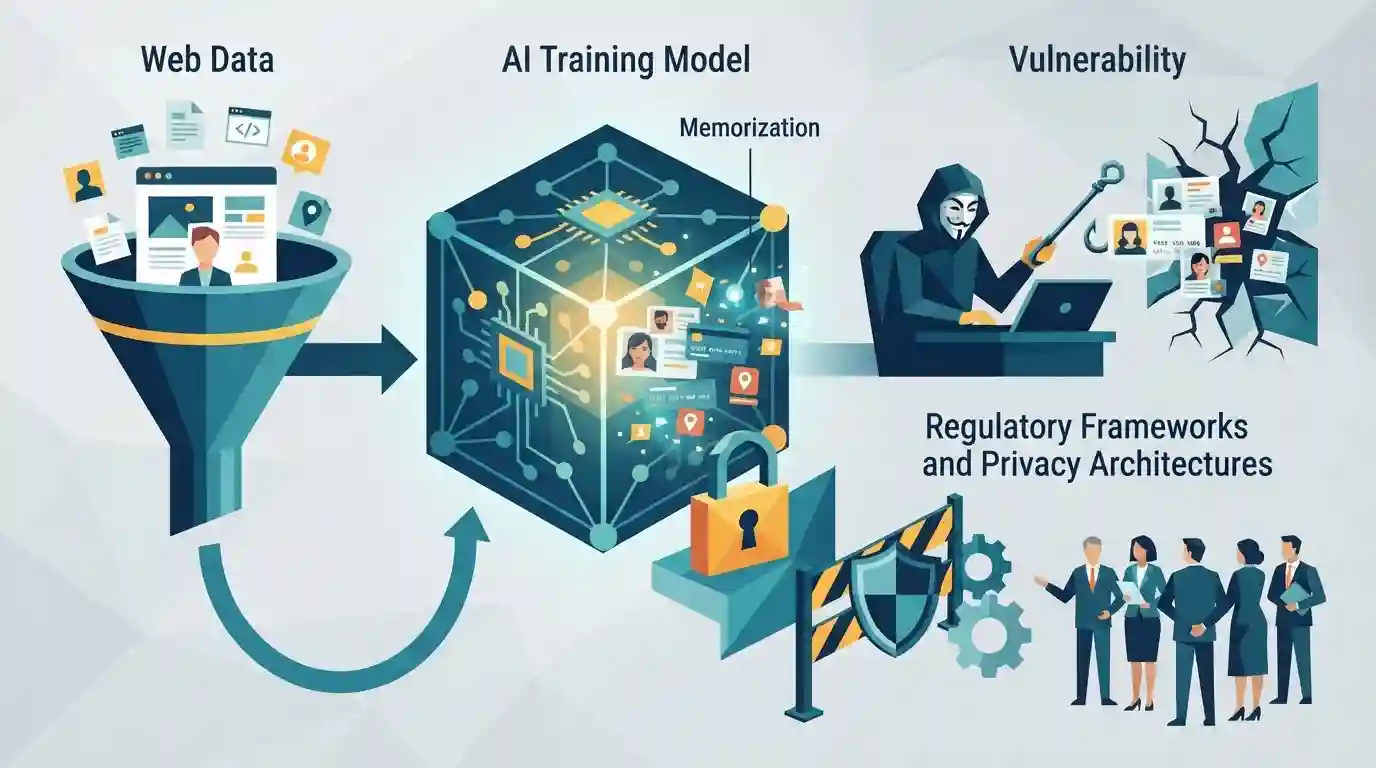
The article explores how artificial intelligence training models pose significant challenges to individual privacy. It highlights how machine learning models ingest large-scale web data, retain personal details through memorization, and expose vulnerabilities to data extraction attacks, demanding stricter regulatory frameworks and privacy-centric architectures.
Key Points
- AI training models rely heavily on scraping vast datasets from the internet, raising severe privacy concerns regarding personal data consumption.
- Memorization and inversion attacks allow malicious actors to extract training data, including personally identifiable information (PII), from trained neural networks.
- Current regulatory frameworks struggle to balance rapid technological advancement in machine learning with robust data privacy safeguards.
- There is an urgent need for privacy-preserving machine learning techniques such as differential privacy and federated learning.
Important Terms
Digital Personal Data Protection Act

India's comprehensive legislative framework for regulating the processing of digital personal data, balancing individual privacy rights with the lawful needs of data fiduciaries.
UPSC context
UPSC GS Paper III (Cybersecurity & Data Privacy); tests understanding of India's privacy laws and governance of AI data ingestion.
Prelims Trap
Differential privacy permanently anonymizes training datasets by completely removing personal identifiers prior to machine learning ingestion.
Differential privacy does not anonymize static datasets once and for all; instead, it mathematically limits the privacy loss from any single query or output generated by the model.
Static Concepts Connected
What are the core techniques used in privacy-preserving machine learning to prevent data leakage?
- Differential Privacy: Adds controlled, statistically calibrated noise to data or queries, ensuring an individual's presence in a dataset cannot be inferred.
- Federated Learning: Enables models to be trained across decentralized devices or servers holding local data samples without exchanging the raw data itself.
- Homomorphic Encryption: Allows computation on encrypted data without ever decrypting it, protecting sensitive inputs from third-party server exposure.
Cross-Topic Patterns
AI Web Scraping vs. DPDP Consent Norms
While the DPDP Act mandates explicit consent for data processing, large-scale web scraping for generative AI operates in a grey area of public-domain data harvesting, creating a regulatory enforcement gap.

Expect a multi-statement Prelims question pairing Differential Privacy techniques with model inversion attack definitions.
Linked PYQs · 3
Linked PYQs · 3
- 2023MainsGS3
Introduce the concept of Artificial Intelligence (AI). How does Al help clinical diagnosis? Do you perceive any threat to privacy of the individual in the use of Al in healthcare?
- 2024MainsGS3
Describe the context and salient features of the Digital Personal Data Protection Act, 2023.
- 2018MainsGS3
Data security has assumed significant importance in the digitized world due to rising cyber crimes. The Justice B. N. Srikrishna Committee Report addresses issues related to data security. What, in your view, are the strengths and weaknesses of the Report relating to protection of personal data in cyber space?
