Artificial Intelligence Impact on Employment and Skill Sets
Source:The Hindu ↗
Why It Matters
Understanding AI's impact on employment is crucial for civil servants to formulate effective labor, education, and economic policies. As India aims to leverage its demographic dividend, mitigating AI-induced job displacement through robust upskilling frameworks in major service sectors like retail and insurance is a pressing governance challenge.
Summary
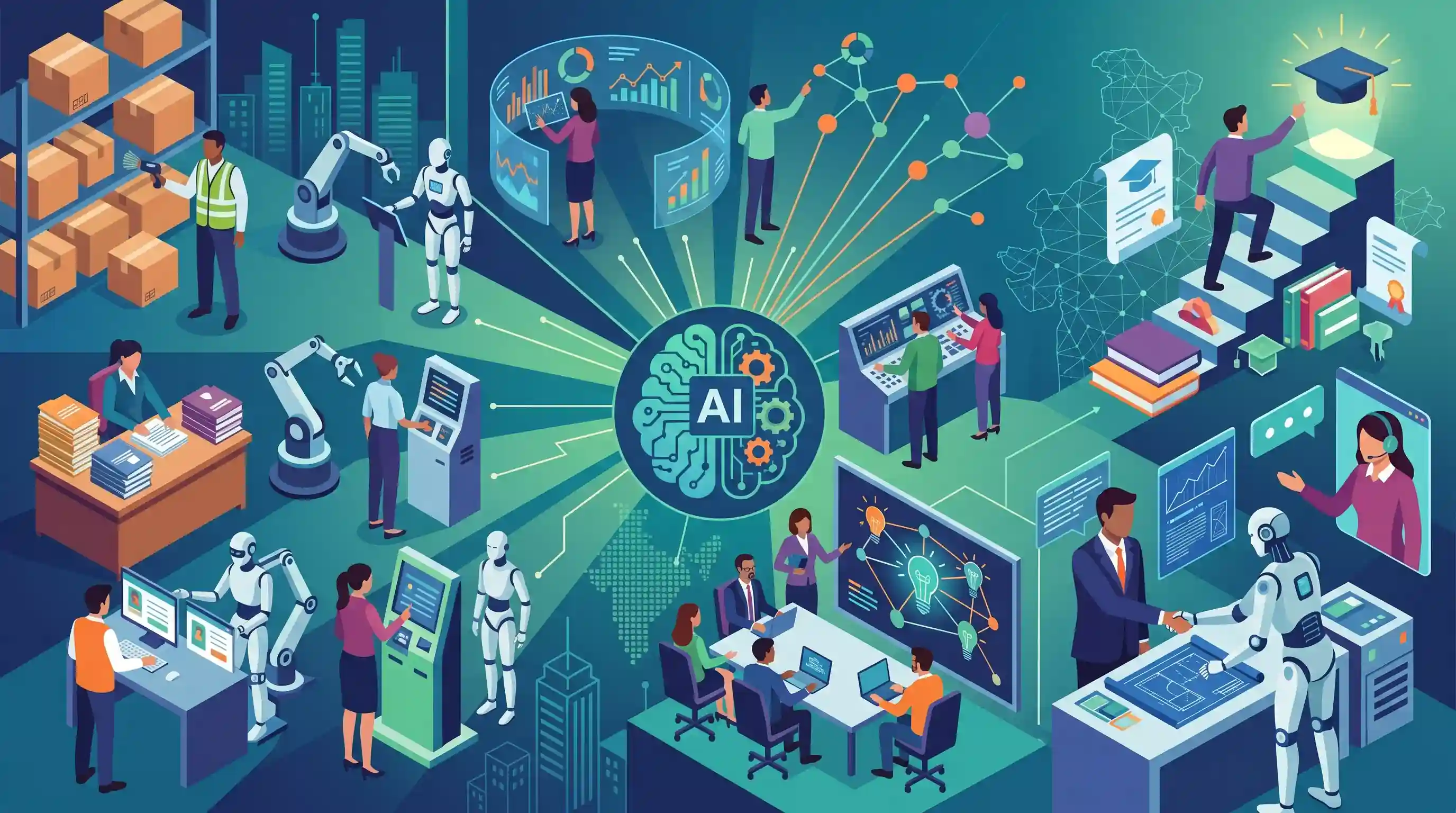
The integration of Artificial Intelligence (AI) is profoundly reshaping employment landscapes and skill requirements in the insurance and retail sectors. By automating routine operations such as basic underwriting, inventory management, and initial customer interactions, AI is displacing traditional manual roles. Concurrently, it is creating new demands for advanced skills in data analytics, AI supervision, and strategic decision-making. For the workforce, this technological shift dictates a transition toward Human-AI collaboration, where professionals leverage AI tools to enhance productivity while focusing on complex problem-solving and empathetic customer service. This trend underscores a critical need for continuous upskilling and modernizing vocational education to sustain employment growth amid the rapid digitalization of the Indian economy.
Key Points
- Artificial Intelligence (AI) is significantly disrupting traditional job profiles in the retail and insurance sectors by automating routine and administrative tasks.
- In the insurance industry, AI streamlines underwriting, algorithmic risk assessment, and fraud detection, shifting human roles toward complex claims resolution, data interpretation, and empathetic customer relations.
- In the retail sector, AI enables dynamic pricing, advanced inventory forecasting, and personalized customer recommendations, reducing manual store management jobs while increasing demand for AI-literate supply chain analysts.
- The integration of AI necessitates massive upskilling and re-skilling initiatives, shifting the focus of employment from task execution to strategic oversight and Human-AI collaboration.
- The transformation highlights the broader digitalization of the service sector in India, emphasizing the need to update educational and vocational training frameworks to protect the workforce from widespread job displacement.
Important Terms
National Strategy for Artificial Intelligence

A 2018 roadmap by NITI Aayog focusing on "#AIforAll." It aims to leverage AI for social inclusion and economic growth in sectors like healthcare, agriculture, and education.
UPSC context
GS3 (IT/Technology); crucial for discussing India's strategic and ethical framework for AI-led development.
Skill India Mission
A flagship government initiative launched in 2015 to empower youth with industry-relevant skill sets, addressing the gap between industrial demands and workforce capabilities to boost employability.
UPSC context
GS3 (Employment/Growth); central for questions on the demographic dividend and modernizing vocational training.
NITI Aayog
India's premier policy think tank that replaced the Planning Commission. It provides strategic advice and fosters cooperative federalism to drive national development and technological integration.
UPSC context
GS2 (Governance) and GS3 (Economy); vital for discussing policy formulation for emerging technologies and economic growth.
Industry 4.0
The Fourth Industrial Revolution characterized by the fusion of digital and physical technologies—like AI, IoT, and big data—to automate and transform manufacturing and service sectors.
UPSC context
GS3 (Economy/Industrial Policy); key for analyzing structural labor shifts and productivity gains in a digitalized economy.
Pradhan Mantri Kaushal Vikas Yojana (PMKVY)
The flagship outcome-based skill training scheme under the Skill India Mission. Its fourth phase (PMKVY 4.0) specifically targets "new-age" skills like AI, robotics, and 3D printing.
UPSC context
GS3 (Employment); tests knowledge of specific interventions for workforce readiness in the age of automation.
Prelims Trap
NITI Aayog's National Strategy for AI aims to completely automate the service sector to maximize GDP growth.
NITI Aayog's strategy is themed '#AIforAll', focusing on augmenting human capabilities and inclusive growth, rather than outright human replacement.
Static Concepts Connected
How do technological advancements like AI affect specific types of unemployment?
- Structural Unemployment: Occurs due to a mismatch between the skills workers possess (e.g., manual store management) and the skills employers need (e.g., AI supervision).
- Technological Unemployment: A specific subset of structural unemployment where jobs are lost directly due to automation and the introduction of labor-saving technologies like AI.
What are the core focus areas of NITI Aayog's National Strategy for Artificial Intelligence?
- Core Theme: Guided by the overarching theme of '#AIforAll', aiming to leverage AI for inclusive economic growth and social development.
- Priority Sectors: Identifies five primary sectors to apply AI: Healthcare, Agriculture, Education, Smart Cities and Infrastructure, and Smart Mobility and Transportation.
Cross-Topic Patterns
AI and India's jobless growth debate
India's service-led economy relies heavily on basic BPO and retail jobs, making it uniquely vulnerable to AI automation and exacerbating the existing 'jobless growth' phenomenon.
Demographic Dividend vs Industry 4.0
The demographic dividend risks becoming a demographic disaster if traditional skill programs aren't aggressively pivoted to PMKVY 4.0's emerging tech modules to counter structural unemployment.

Expect a GS3 Mains question in 2026 linking GenAI-driven service sector automation to India's demographic dividend and structural unemployment.
Linked PYQs · 3
Linked PYQs · 3
- 2023MainsGS3
Introduce the concept of Artificial Intelligence (AI). How does Al help clinical diagnosis? Do you perceive any threat to privacy of the individual in the use of Al in healthcare?
- 2023MainsGS3
What is the status of digitalization in the Indian economy? Examine the problems faced in this regard and suggest improvements.
- 2022MainsGS3
Economic growth in the recent past has been led by increase in labour productivity." Explain this statement. Suggest the growth pattern that will lead to creation of more jobs without compromising labour productivity.
