AI and Community-Led Development in Rural Rajasthan
Source:The Hindu ↗
Why It Matters
Provides a concrete case study for Mains GS-2 (e-Governance, Local Self Government) and GS-3 (Science & Technology, Environment) on how emerging technologies like AI can be harnessed for decentralized planning, climate resilience, and sustainable community development in vulnerable regions.
Summary
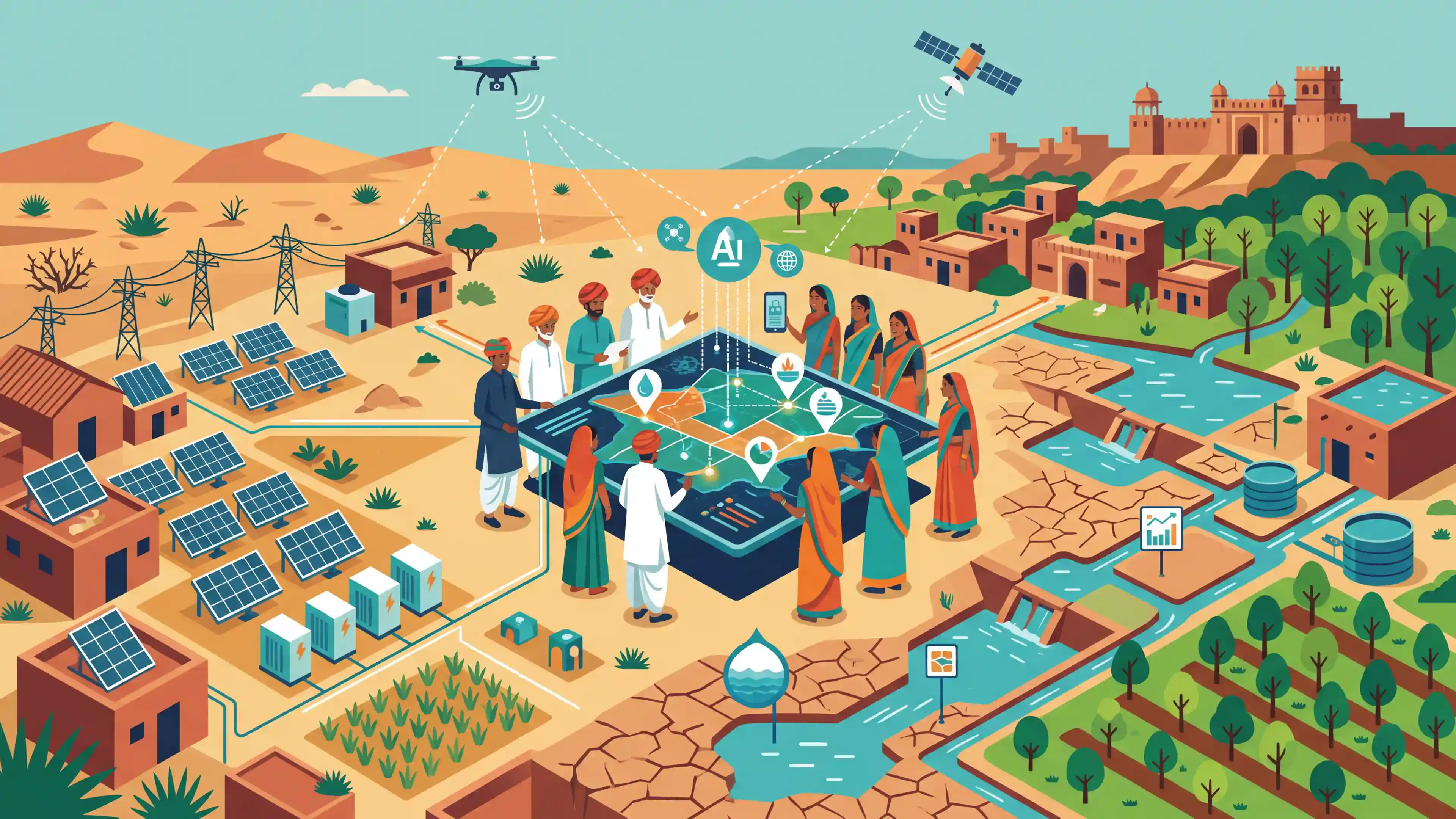
The article explores the integration of Artificial Intelligence (AI) in fostering community-led development in Rajasthan, particularly within the energy and environment domains. By leveraging AI tools, predictive analytics, and spatial mapping, local communities and grassroots institutions are empowered to manage natural resources more effectively. The initiative highlights how democratizing access to technological data aids in addressing local environmental challenges, such as water scarcity and land degradation, thereby enhancing climate resilience. This approach bridges the gap between advanced digital technologies and decentralized governance, serving as a model for sustainable, community-driven resource management.
Key Points
- Artificial Intelligence (AI) is being leveraged to empower local communities in Rajasthan, facilitating grassroots-led development in the energy and environment sectors.
- AI and satellite imagery are utilized to map and manage critical natural resources, such as water bodies, pasture lands (commons), and renewable energy potential.
- The technological intervention democratizes access to complex environmental data, enabling Gram Panchayats and local groups to make informed, data-driven decisions.
- Enhances climate resilience in arid regions by supporting localized planning, optimizing resource allocation, and promoting sustainable environmental conservation practices.
- Demonstrates a successful model of integrating advanced emerging technologies with decentralized governance and traditional community wisdom.
Important Terms
Gram Panchayats

Grassroots-level local government bodies in India’s villages, mandated by the 73rd Constitutional Amendment to manage local administration and rural development.
UPSC context
GS-II (Polity/Governance); tests understanding of decentralized democracy and the devolution of powers under Schedule 11.
Artificial Intelligence (AI) in Governance
The integration of machine learning and data analytics by state institutions to enhance service efficiency, predictive decision-making, and last-mile citizen engagement.
UPSC context
GS-III (Science & Tech); tests the application of emerging technology to solve public policy challenges and improve transparency.
Natural Resource Management (NRM)
The sustainable management of land, water, and soil to ensure ecological balance while securing the livelihoods of local communities.
UPSC context
GS-III (Environment); tests knowledge of conservation strategies and community-led models for climate resilience.
Pani Mitras
Community volunteers ('Water Friends') trained to monitor resources, manage local water assets, and facilitate communication between villagers and administrative bodies.
UPSC context
GS-II/III (Governance/Environment); a vital case-study term for participatory water management and grassroots human capital.
Decentralized Governance
The devolution of powers and decision-making from central or state authorities to local bodies to ensure more responsive and participatory development.
UPSC context
GS-II (Polity); core to questions on democratic decentralization and the effectiveness of Panchayati Raj Institutions.
Last-Mile Delivery
The final stage of public service delivery, ensuring that government schemes and digital benefits effectively reach citizens in remote or marginalized areas.
UPSC context
GS-II (Governance); tests the ability to evaluate welfare scheme effectiveness and address challenges like the digital divide.
Prelims Trap
AI tools for rural water management operate solely as top-down Central compliance monitors.
AI tools in Indian e-governance are increasingly decentralized (Grammanchitra, AI4WaterPolicy), enabling bottom-up planning, community listening, and local resource mapping by Gram Panchayats.
Static Concepts Connected
What are the statutory mandates of Panchayats in Natural Resource Management?
- Article 243G: Empowers Panchayats to prepare plans for economic development, covering minor irrigation, watershed development, and social forestry under the Eleventh Schedule.
- PESA Act 1996: Empowers Gram Sabhas specifically to manage community resources and prevent land alienation in Scheduled Areas.
- MGNREGA Asset Tracking: Requires spatial mapping of created rural assets (e.g., Amrit Sarovars) to ensure transparency and combat local freshwater crises.
How is GIS and spatial technology utilized in local governance?
- Grammanchitra Portal: A Ministry of Panchayati Raj portal using GIS/satellite imagery to map shared resources and formulate data-driven Gram Panchayat development plans.
- High-resolution Mapping: ISRO provides 1:10,000 scale imagery to empower local groups to assess surface water storage, pasture commons, and renewable energy potential.
Cross-Topic Patterns
Local AI + National Language Mission
Voice-based AI in local dialects (like SabhaSaar) directly connects to the digital inclusion goals of the Bhashini mission, crossing emerging technology with rural governance.
AI in MGNREGA Asset Tracking
Integrating AI and GIS through platforms like BhuPRAHARI addresses the persistent UPSC Mains theme of transparency, accountability, and verifiable asset-durability under MGNREGA.

Expect a multi-statement Prelims question linking emerging tech (AI/GIS), localized e-governance (Grammanchitra), and bottom-up planning.
Linked PYQs · 3
Linked PYQs · 3
- 2024MainsGS2
e-governance is not just about the routine application of digital technology in service delivery process. It is as much about multifarious interactions for ensuring transparency and accountability. In this context evaluate the role of the 'Interactive Service Model' of e-governance.
- 2023MainsGS3
Introduce the concept of Artificial Intelligence (AI). How does Al help clinical diagnosis? Do you perceive any threat to privacy of the individual in the use of Al in healthcare?
- 2025MainsGS2
e-governance projects have a built-in bias towards technology and back-end integration than user-centric designs. Examine.
