Generative AI Tools Enhance Health Literacy and Medical Record Access
Source:The Hindu ↗
Why It Matters
The intersection of Generative AI and public health highlights both the potential of technology to democratize health literacy and the regulatory/ethical challenges of preventing AI-enabled self-medication and misdiagnosis. It directly applies to UPSC topics on AI applications, healthcare accessibility, and public service delivery.
Summary
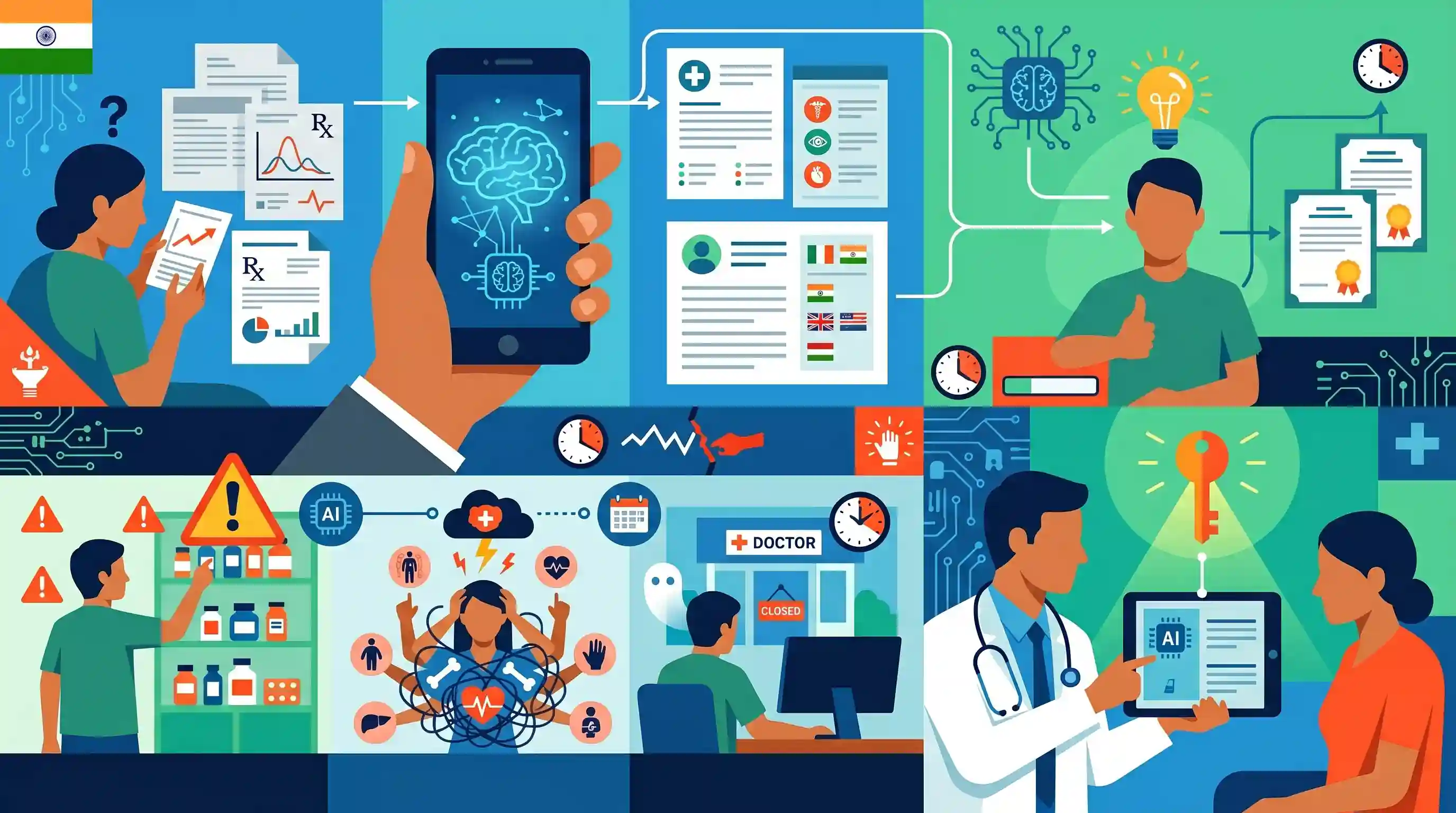
Artificial Intelligence tools are increasingly being used by Indians to decipher complex medical reports, prescriptions, and health data. Driven by short doctor consultation times and a desire for better health literacy, patients are turning to generative AI for plain-language, localized explanations. While this empowers patients and improves health literacy, medical professionals caution against the risks of self-diagnosis and self-medication, which already have a high prevalence in India. Improper use of AI can lead to severe health anxiety ("cyberchondria") or delayed medical care, emphasizing that AI must serve as an interpretive aid rather than a replacement for clinical consultation.
Key Points
- India's strained public health system, characterized by low doctor-patient ratios and brief consultation times, often leaves patients lacking a clear understanding of their medical conditions and treatment plans.
- Generative AI tools like ChatGPT are bridging this health literacy gap by translating complex medical jargon, lab reports, and prescriptions into simple, localized languages.
- India faces a high prevalence of self-medication (53.57%), which can be dangerous; doctors warn that AI should be used strictly for interpreting reports, not for self-diagnosis or prescribing treatments.
- Over-reliance on AI for symptom checking can induce health anxiety (cyberchondria) by suggesting rare, severe conditions for common symptoms, or conversely, delay critical care if patients incorrectly self-interpret AI outputs.
Prelims Trap
India is far from achieving the WHO-recommended doctor-patient ratio of 1:1000, driving patients to rely on AI.
India has technically achieved the 1:1000 ratio (currently ~1:836) when registered AYUSH practitioners are included. The crisis is severe urban-rural maldistribution, not an absolute statistical shortfall.
Static Concepts Connected
What constitutes Out-of-Pocket Expenditure (OOPE) in healthcare?
- Definition: Direct payments made by individuals to healthcare providers at the time of service use, excluding insurance prepayments or reimbursements.
- India's Status: It accounts for roughly 47.1% of Total Health Expenditure in India (NHA estimates), acting as a major barrier to formal clinical care and driving patients toward AI self-diagnosis.
- Mitigation: Schemes like Ayushman Bharat (PM-JAY) aim to reduce OOPE by providing cashless secondary and tertiary care for vulnerable populations.
How does self-medication contribute to Antimicrobial Resistance (AMR)?
- Mechanism: Using antibiotics without a doctor's prescription or halting courses prematurely exposes pathogens to sub-lethal doses, which actively selects for and breeds resistant bacterial strains.
- Red Line Campaign: India mandates a red vertical line on the packaging of prescription-only antibiotics to deter over-the-counter sales and self-medication.
Cross-Topic Patterns
AI + Digital Public Infrastructure (DPI)
GenAI interpreting medical reports directly overlaps with the Ayushman Bharat Digital Mission (ABDM). Integrating AI into Personal Health Records (PHR) enhances patient agency but intensifies data privacy and algorithmic bias concerns.
Unregulated AI driving AMR risks
The spike in self-medication fueled by AI bots diagnosing symptoms threatens India’s National Action Plan on AMR by bypassing Schedule H prescription drug regulations.

A 2026 mains question will likely intersect AI e-health tools (like ABDM) with unintended public health risks like cyberchondria and AMR.
Linked PYQs · 3
Linked PYQs · 3
- 2023MainsGS3
Introduce the concept of Artificial Intelligence (AI). How does Al help clinical diagnosis? Do you perceive any threat to privacy of the individual in the use of Al in healthcare?
- 2024MainsGS2
In a crucial domain like the public healthcare system the Indian State should play a vital role to contain the adverse impact of marketisation of the system. Suggest some measures through which the State can enhance the reach of public healthcare at the grassroots level.
- 2020PrelimsGS1
With the present state of development, Artificial Intelligence can effectively do which of the following? 1. Bring down electricity consumption in industrial units 2. Create meaningful short stories and songs 3. Disease diagnosis 4. Text-to-Speech Conversion 5. Wireless transmission of electrical energy Select the correct answer using the code given below:
