Agricultural Engineering Drives Climate Resilience in Indian Farms
Source:The Hindu ↗
Why It Matters
Modernizing agriculture through engineering and emerging technologies is crucial for achieving sustainable agricultural growth, ensuring national food security, and improving farmers' livelihoods amidst the escalating challenges of climate change and labor scarcity.
Summary
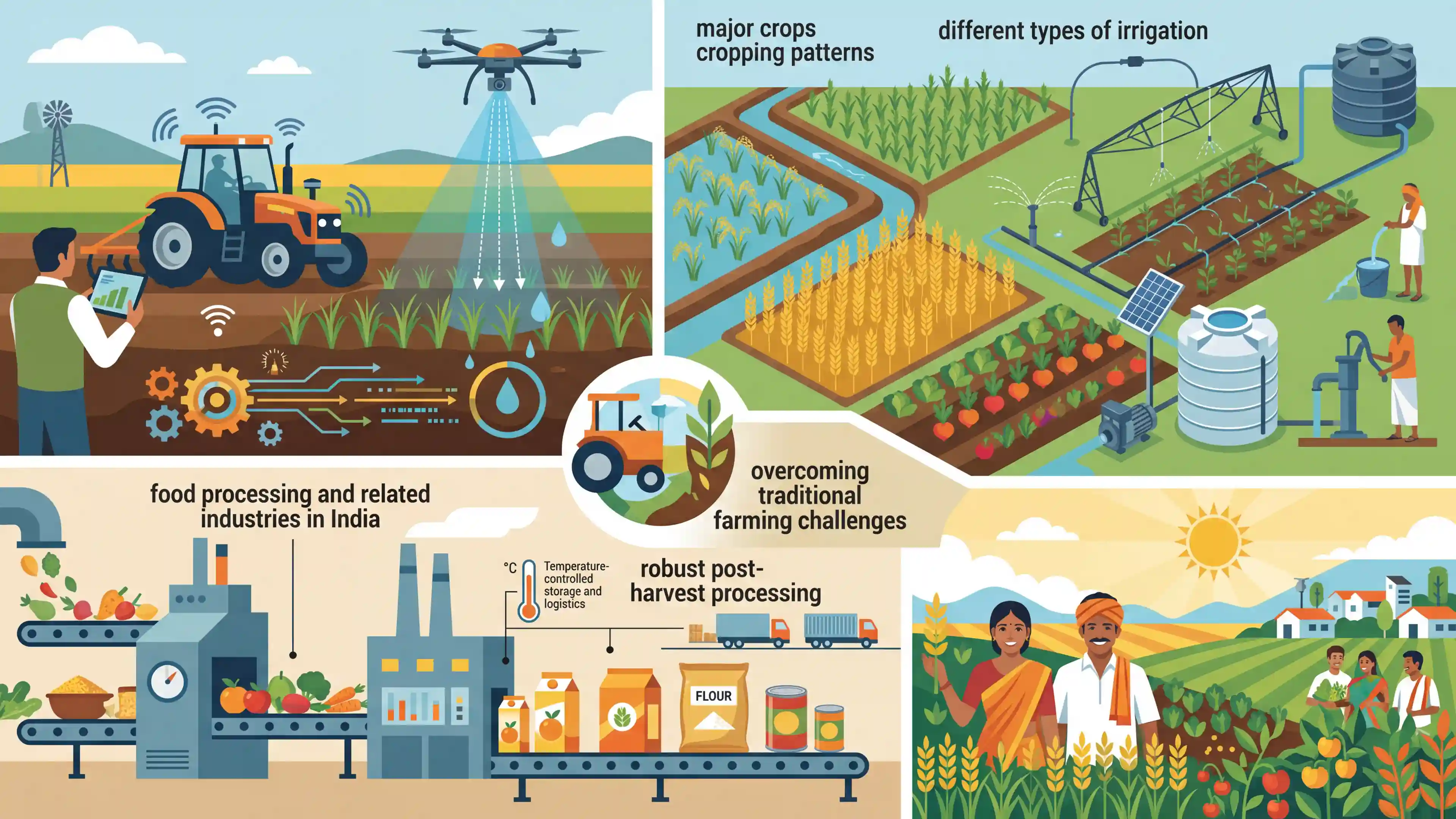
The article highlights the indispensable role of agricultural engineering in transforming Indian agriculture to be future-ready. It emphasizes a multi-dimensional approach encompassing farm mechanization, precision agriculture driven by IoT and drones, advanced irrigation engineering, and robust post-harvest processing. By leveraging these modern technological interventions, India can overcome traditional farming challenges such as labor shortages and resource inefficiency. Ultimately, agricultural engineering is presented as the key to ensuring food security, building climate resilience, and uplifting the socio-economic status of Indian farmers through sustainable and profitable farming practices.
Key Points
- The integration of advanced technologies like AI, IoT, and drones is crucial for precision farming, which optimizes the use of water, fertilizers, and pesticides, thereby increasing crop yields and reducing environmental impact.
- Farm mechanization is essential to address agricultural labor shortages, enhance operational efficiency, and reduce the physical drudgery associated with traditional farming methods.
- Agricultural engineering plays a critical role in developing modern micro-irrigation systems (such as drip and sprinkler irrigation) to ensure efficient water management in the face of climate change.
- Advancements in post-harvest technology and food processing are necessary to minimize crop spoilage, add economic value to raw agricultural produce, and substantially improve farmers' incomes.
- The future of Indian agriculture depends on building climate-resilient farming models through sustainable engineering solutions that lower the sector's carbon footprint.
Prelims Trap
"Micro-irrigation under PMKSY now covers the majority of India's total irrigated land."
Despite the heavy push from PMKSY, micro-irrigation (drip/sprinkler) currently covers only about 20% of India's total irrigated land. Flood irrigation still dominates.
Static Concepts Connected
What are the core components of Pradhan Mantri Krishi Sinchayee Yojana (PMKSY)?
- AIBP: Focuses on the faster completion of ongoing major and medium irrigation projects.
- Har Khet Ko Pani: Enhances physical access to water on farms and expands cultivable areas under assured irrigation.
- Per Drop More Crop: Promotes micro-irrigation technologies like drip and sprinkler systems at the farm level to optimize water use.
- Watershed Development: Focuses on runoff management, improved soil moisture conservation, and water harvesting structures.
What are the structural bottlenecks in India's food processing sector?
- Supply Chain Gaps: Severe deficits in cold chain infrastructure, pack-houses, and refrigerated transport lead to massive post-harvest losses.
- Scale & Fragmentation: The sector is dominated by unorganized, small-scale units lacking the capital for modern technological upgrades.
- Quality Compliance: Frequent struggles to meet stringent international Sanitary and Phytosanitary (SPS) standards heavily restrict export potential.
Cross-Topic Patterns
Agritech meets SHG Empowerment
The NAMO Drone Didi scheme trains women Self-Help Groups to operate Kisan Drones, seamlessly bridging GS3 agricultural e-technology with GS2 rural women's empowerment and grassroots governance.
Precision farming as climate mitigation
AI and IoT optimize fertilizer use (reducing nitrous oxide emissions) while micro-irrigation conserves groundwater. This directly links agricultural modernization to India's NDC climate mitigation commitments.

Expect a multi-statement Prelims question combining PMKSY micro-irrigation coverage stats, Kisan Drone applications, and mechanization data.
Linked PYQs · 3
Linked PYQs · 3
- 2023MainsGS3
How does e-Technology help farmers in production and marketing of agricultural produce? Explain it.
- 2021MainsGS3
What are the present challenges before crop diversification? How do emerging technologies provide an opportunity for crop diversification?
- 2025MainsGS3
How does nanotechnology offer significant advancements in the field of agriculture? How can this technology help to uplift the socio-economic status of farmers?
