Bengaluru AI Traffic Enforcement Highlights Urban Policing Challenges
Source:The Hindu ↗
Why It Matters
As Indian cities increasingly adopt AI for urban management and policing, understanding the accuracy, limitations, and civil liberty concerns of automated systems is critical for transparent and accountable e-governance.
Summary
An analysis of Bengaluru's AI-driven traffic enforcement system, exploring its accuracy, technical limitations, and the broader implications of deploying automated artificial intelligence tools in urban traffic governance.
Key Points
- Bengaluru has deployed an AI-powered traffic enforcement system using automated cameras to detect traffic violations such as not wearing helmets, using mobile phones while driving, and seatbelt violations.
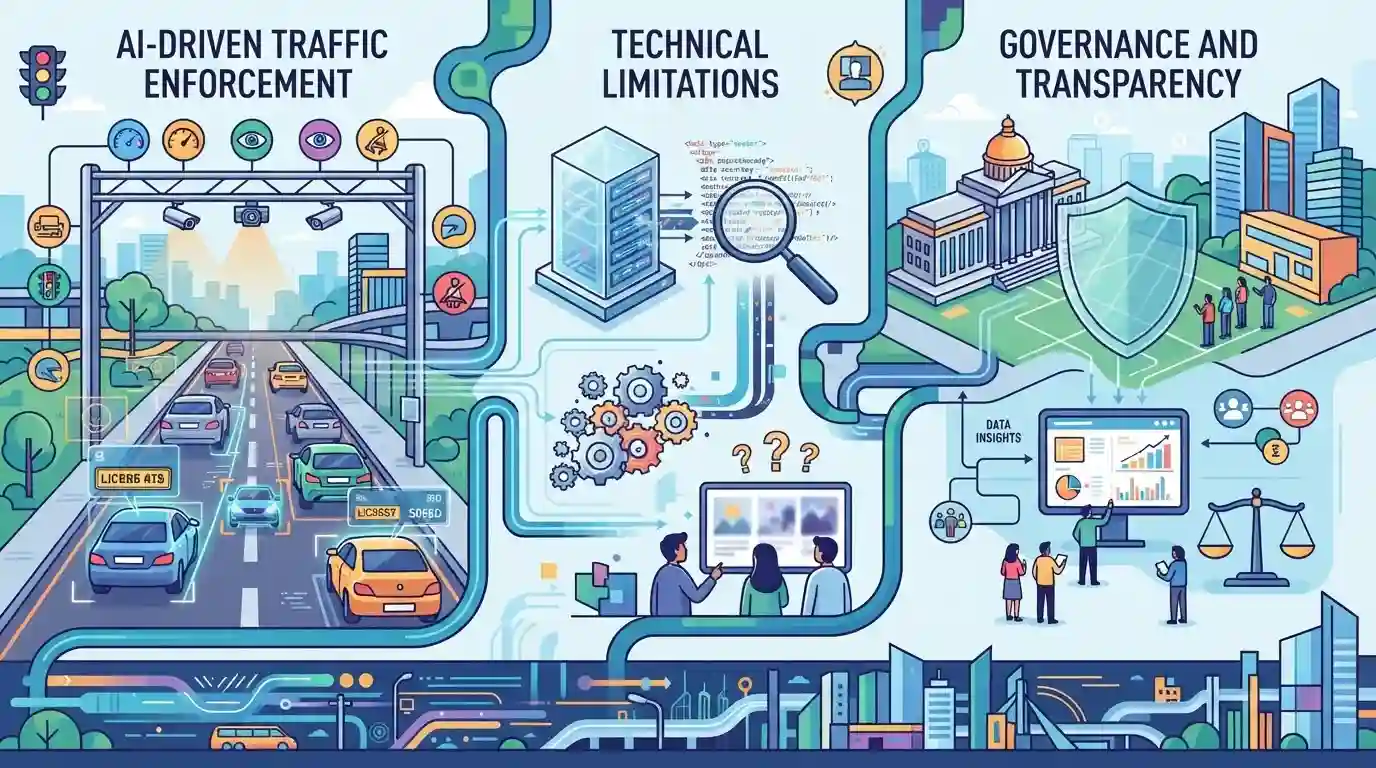
- The article evaluates the accuracy, operational challenges, and reliability of AI-driven challan issuance systems, noting technical limitations, false positives, and environmental/angle obstructions.
- Balances the utility of automated enforcement in handling urban congestion and manpower shortages with concerns regarding transparency, citizen grievance redressal, and algorithmic bias.
- Highlights the need for robust auditing, calibration, and human-in-the-loop oversight to ensure fairness in automated policing.
Important Terms
Bengaluru Traffic Police

A specialized police wing utilizing AI-powered cameras, ANPR technology, and automated software to detect violations, issue electronic challans, and manage urban traffic governance with minimal human intervention.
UPSC context
Relevant for GS Paper III (Technology/AI Applications) and GS Paper II (E-governance, smart policing, accountability in administration).
Intelligent Traffic Management System (ITMS)
An automated urban traffic framework employing AI and deep learning to monitor junctions, detect multiple violation types, and streamline enforcement through computer vision and electronic challan generation.
UPSC context
Important for GS Paper III (Infrastructure, Urban Management, Artificial Intelligence) and GS Paper II (E-governance tools).
Prelims Trap
AI traffic enforcement systems issue challans with 100% precision without requiring manual verification or grievance redressal mechanisms.
Aspirants often assume automated AI systems in policing are infallible and legally absolute, overlooking issues of false positives and the mandatory requirement for human-in-the-loop validation.
Static Concepts Connected
What are the key governance challenges and principles of deploying Artificial Intelligence in public administration?
- Algorithmic Transparency: Algorithmic transparency ensures that citizens understand how automated decisions (e.g., e-challans) are computed and challenged.
- Human Oversight: Human-in-the-loop systems mandate manual oversight and verification before punitive state action is finalized against citizens.
- Auditing & Calibration: Regular auditing and sensor calibration minimize false positives caused by environmental factors or sub-optimal camera angles.
Cross-Topic Patterns
AI Traffic Policing and Right to Privacy
AI-based urban surveillance systems intersect with fundamental rights, specifically the right to privacy under Article 21 and procedural due process in administrative actions.

Expect a multi-statement Prelims question on challenges of AI governance in urban administration, focusing on false positives and grievance redressal.
Linked PYQs · 3
Linked PYQs · 3
- 2023MainsGS3
Introduce the concept of Artificial Intelligence (AI). How does Al help clinical diagnosis? Do you perceive any threat to privacy of the individual in the use of Al in healthcare?
- 2024MainsGS2
e-governance is not just about the routine application of digital technology in service delivery process. It is as much about multifarious interactions for ensuring transparency and accountability. In this context evaluate the role of the 'Interactive Service Model' of e-governance.
- 2023MainsGS2
e-governance, as a critical tool of governance, has ushered in effectiveness, transparency and accountability in governments. What inadequacies hamper the enhancement of these features ?
