Gold Loan Growth Trends and Retail Credit Shifts in India
Source:Indian Express ↗
Why It Matters
This development serves as an excellent case study of structural shifts in India's retail credit markets, the displacement of high-risk unsecured credit with secured lending, and the macroprudential challenges faced by the RBI in managing systemic risks associated with commodity price volatility.
Summary
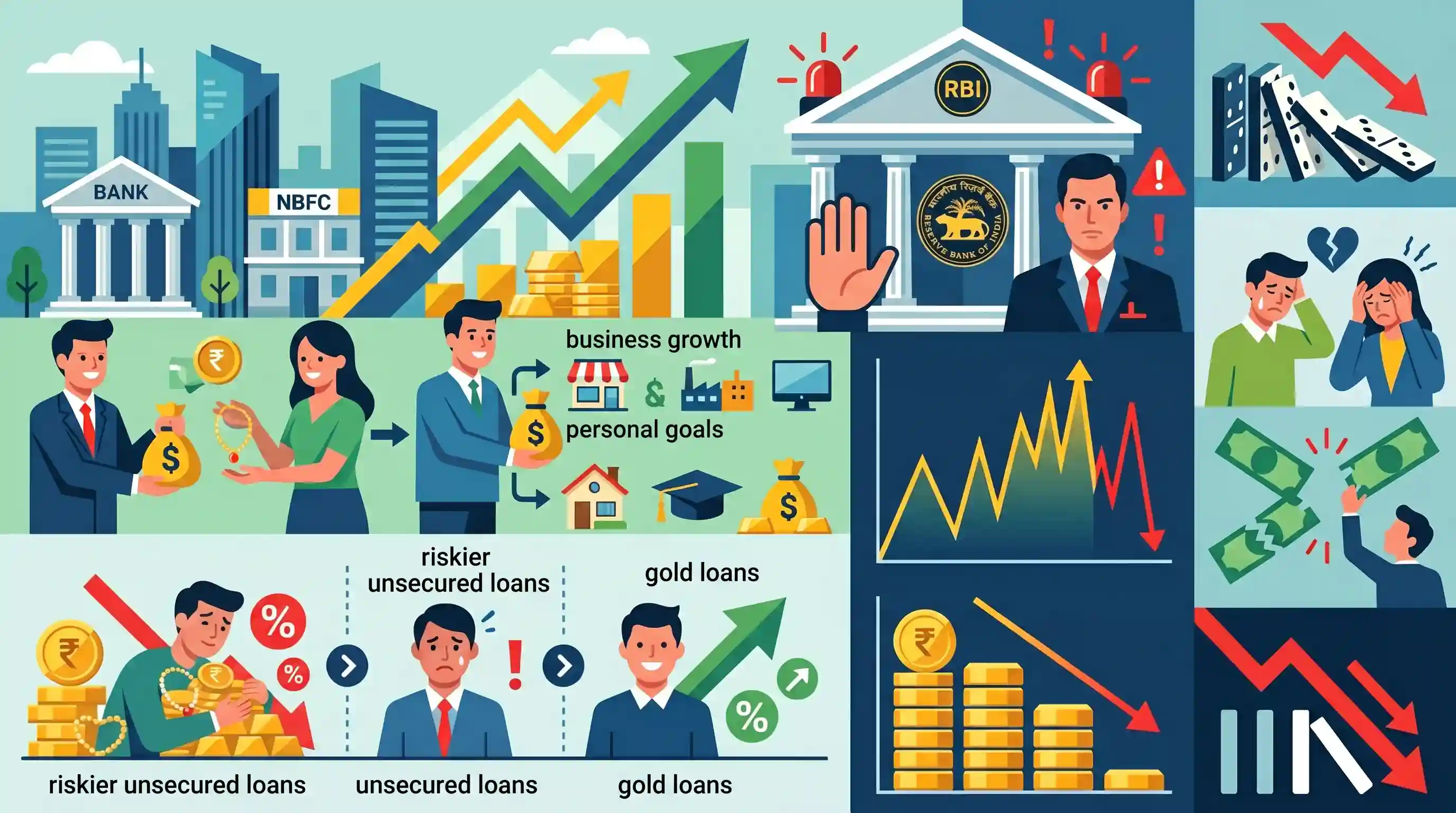
The article analyzes a massive surge in gold loans across Indian banks and NBFCs, driven by rising gold prices and a structural shift in borrower behavior. Gold loans are increasingly being leveraged by prime borrowers as a mainstream, cheaper financial tool for business and personal goals, displacing riskier unsecured personal loans. However, the Reserve Bank of India (RBI) warns of macroprudential risks, noting that high gold price volatility and potential downward price corrections could weaken collateral protection (LTV ratios) and escalate loan delinquencies.
Key Points
- Gold loans from Non-Banking Financial Companies (NBFCs) grew 70% year-on-year, reaching Rs 3.3 lakh crore (6% of non-bank loans) as of May.
- Bank credit against gold jewellery grew by 105% year-on-year, reaching Rs 5.1 lakh crore (2.4% of total bank credit).
- A key behavioral shift is underway, with prime and above-prime borrowers increasing their share from 43% to 52%, choosing gold loans as a mainstream financial leveraging tool rather than an emergency option of last resort.
- The rapid expansion of gold loans has coincided with a drop in outstanding unsecured personal loans, particularly among sub-prime borrowers, which supports retail loan credit-mix safety.
- The surge in gold loans was highly accelerated by gold prices peaking at around $5,500/oz in January 2026, though prices have since moderated back to around $4,000/oz.
- The RBI has cautioned in its Financial Stability Report that gold price volatility warrants close monitoring; a prolonged correction in prices could erode collateral margins, stress borrowers, and trigger delinquencies due to Loan-to-Value (LTV) ratio breaches.
Important Terms
Reserve Bank of India (RBI)

India's central bank and monetary authority, established in 1935. It regulates the banking system, manages monetary policy, issues currency, and maintains financial stability.
UPSC context
GS Paper III (Indian Economy). Crucial for understanding monetary policy, banking regulation, inflation control, and financial system stability.
Non-Banking Financial Companies (NBFCs)
Financial institutions registered under the Companies Act that provide banking-like services such as loans and advances, but cannot accept demand deposits or issue checks.
UPSC context
GS Paper III (Indian Economy). Tested under resource mobilization, financial inclusion, and regulation of shadow banking.
Loan-to-Value (LTV) Ratio
The financial ratio of a loan amount to the appraised value of the asset serving as collateral, used by lenders to limit risk exposure.
UPSC context
GS Paper III (Indian Economy). Important for regulatory caps on credit, retail asset quality, and systemic financial risk.
Macroprudential Regulation
A financial regulatory approach designed to mitigate systemic risks and maintain the stability of the entire financial system, rather than individual institutions alone.
UPSC context
GS Paper III (Indian Economy). Vital for financial stability, crisis prevention, and systemic risk oversight by RBI.
Commercial Banks
Financial institutions that accept public deposits and make loans for consumption and investment, acting as primary conduits of credit in the formal economy.
UPSC context
GS Paper III (Indian Economy). Essential for banking sector reforms, monetary policy transmission, and asset quality analysis.
Prelims Trap
The RBI mandates a flat, uniform Loan-to-Value (LTV) cap of 75% for all gold loans across lenders.
Effective April 2026, the RBI replaced the uniform 75% cap with a tiered LTV structure, allowing up to 85% leverage for smaller gold loans.
Static Concepts Connected
What are the key regulatory differences between Banks and NBFCs in India?
- Demand deposits: NBFCs cannot accept demand deposits (repayable on demand), unlike commercial banks.
- Payment systems: NBFCs are not part of the payment system and cannot issue cheques drawn on themselves.
- Deposit insurance: NBFC depositors do not get the ₹5 lakh safety cover provided by the DICGC.
What is the Sovereign Gold Bond (SGB) Scheme and its macroeconomic objective?
- Alternative to physical: SGBs are government securities denominated in grams of gold, acting as substitutes for physical gold holdings.
- Macroeconomic impact: By shifting investment demand to paper gold, SGBs curb imports and narrow the Current Account Deficit.
- Investor benefits: Investors receive a fixed annual interest rate, with capital gains tax exempted upon maturity.
Cross-Topic Patterns
Household savings shift + Capital formation
A surge in gold-backed borrowing indicates households financializing physical assets, reflecting structural shifts in India's net household financial savings and domestic capital formation.
Gold imports + Current Account Deficit
Surging domestic gold demand for collateral can trigger import spikes, directly impacting India's trade balance, current account deficit (CAD), and rupee volatility.

RBI's tiered LTV framework and operational differences between NBFCs and banks are highly likely to feature in 2026 economy MCQs.
Linked PYQs · 2
Linked PYQs · 2
- 2026PrelimsGS1
Consider the following statements about the Non-Banking Financial Companies (NBFCs) in India : 1. NBFCs cannot accept demand deposits. 2. All the NBFCs operating in India have to be registered with the RBI. 3. NBFCs form part of the payment and settlement system and can issue cheque drawn on itself. 4. Deposit insurance facility of Deposit Insurance and Credit Guarantee Corporation (DICGC) is not available to the depositors of deposit taking NBFCs. Which of the statements given above is/are correct ?
- 2016PrelimsGS1
What is/are the purpose/purposes of Government's 'Sovereign Gold Bond Scheme' and 'Gold Monetization Scheme'? 1. To bring the idle gold lying with Indian households into the economy 2. To promote FDI in the gold and jewellery sector 3. To reduce India's dependence on gold imports Select the correct answer using the code given below.
