Landmark Supreme Court Ruling on Bihar Assembly Dissolution Examined
Source:Indian Express ↗
Why It Matters
The 2005 Bihar assembly dissolution is a textbook case study for UPSC aspirants on the misuse of Article 356, the discretionary powers of the Governor, and the vital role of judicial review in upholding constitutional democracy. Understanding the Rameshwar Prasad judgment is crucial for answering questions on federalism, state executive powers, and the Supreme Court's checks on arbitrary executive actions.
Summary
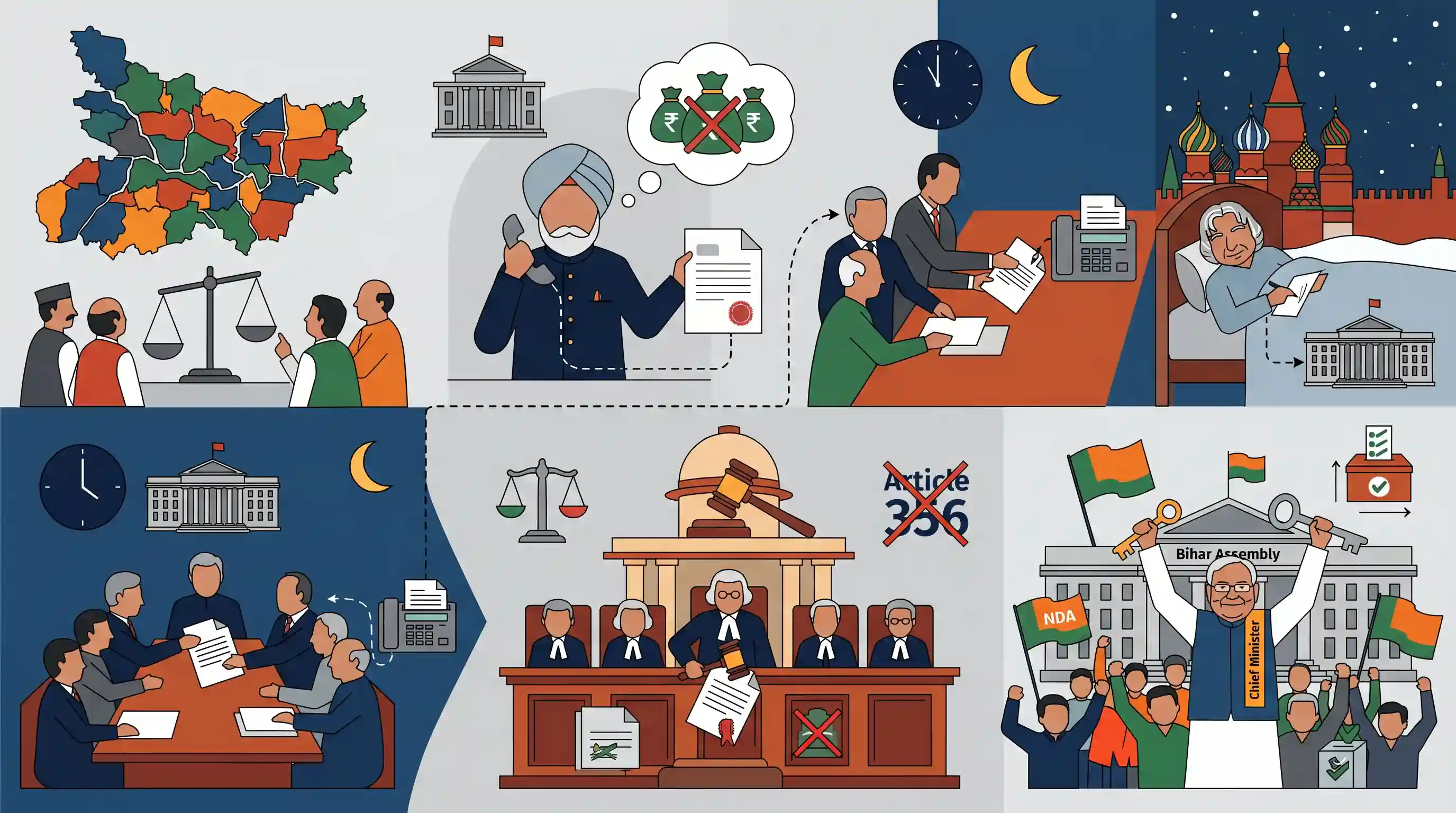
The article recounts the dramatic political events of 2005 in Bihar, highlighting how a controversial midnight decision involving a phone call to President APJ Abdul Kalam in Moscow led to the dissolution of the state assembly. Following a hung assembly in February 2005, Governor Buta Singh recommended dissolution to prevent alleged horse-trading, a move the Union Cabinet approved and hastily forwarded to the President abroad. The Supreme Court later struck down this dissolution as unconstitutional in the landmark Rameshwar Prasad case, condemning the misuse of Article 356 and establishing that a Governor cannot bypass a floor test based on subjective fears of political realignment. Though the assembly was not restored due to impending fresh elections, the resulting political fallout and subsequent polls handed Nitish Kumar and the NDA a decisive mandate, initiating his first full term as Chief Minister of Bihar.
Key Points
- The February 2005 Bihar Assembly elections resulted in a hung assembly, with no alliance securing a clear majority to form the government.
- Governor Buta Singh controversially recommended the dissolution of the newly elected assembly before its first meeting, citing the need to prevent 'horse-trading'.
- The Union Cabinet approved the recommendation and secured the signature of President A.P.J. Abdul Kalam at midnight while he was on a state visit to Moscow, Russia.
- The Supreme Court of India, in the landmark Rameshwar Prasad v. Union of India case, declared the dissolution unconstitutional, stating that the Governor's subjective assessment cannot preempt a floor test.
- Although the dissolution was ruled unconstitutional, the assembly was not revived as fresh elections were already underway; these subsequent elections gave Nitish Kumar's NDA alliance a clear majority, starting his first full stint as Chief Minister.
Important Terms
Article 356 of the Indian Constitution

Constitutional provision allowing the Union to impose President's Rule in a state due to the 'failure of constitutional machinery'. It transfers state executive and legislative powers to the Centre.
UPSC context
GS Paper 2: Federalism and Emergency Provisions. Tests knowledge of Centre-State relations and limits on executive power.
Rameshwar Prasad v. Union of India (2006)
A landmark 2006 Supreme Court judgment that declared the dissolution of the Bihar Assembly unconstitutional. It established that a Governor cannot dissolve a House based on subjective fears of horse-trading.
UPSC context
GS Paper 2: Significant Judgments. Tests understanding of judicial review and the constitutional limits of gubernatorial discretion.
Role of the Governor
A constitutional office serving as the state's nominal head and the Union's representative. They must act on aid and advice, especially regarding government formation and assembly dissolution.
UPSC context
GS Paper 2: Appointment and Powers of the Governor. Focuses on neutrality and the 'agent of the centre' controversy.
Floor Test
The constitutional mechanism used in the legislature to determine if the executive (Council of Ministers) enjoys the confidence of the House. It is the mandatory method to prove a majority.
UPSC context
GS Paper 2: Parliament and State Legislatures. Tests knowledge of legislative procedures and democratic accountability.
Union Cabinet
The core decision-making body of the Union executive, consisting of the Prime Minister and senior ministers. It advises the President on the exercise of powers like Article 356.
UPSC context
GS Paper 2: Executive. Tests the collective responsibility of the cabinet and its role in the dissolution of state assemblies.
National Democratic Alliance (NDA)
A big-tent political coalition in India led by the Bharatiya Janata Party (BJP). It came to power in Bihar in late 2005 following the controversial dissolution.
UPSC context
GS Paper 2: Evolution of Coalition Politics. Tests understanding of alliance systems and their impact on federal governance.
United Progressive Alliance (UPA)
A centre-left political coalition led by the Indian National Congress. It was the ruling alliance at the Centre during the 2005 Bihar political crisis.
UPSC context
GS Paper 2: Political Parties and Pressure Groups. Contextualizes the central government's role in state-level interventions.
Prelims Trap
A newly elected State Legislative Assembly cannot be dissolved under Article 356 before holding its first meeting.
A newly constituted Assembly can be dissolved immediately upon constitution. The Supreme Court in Rameshwar Prasad ruled there is no constitutional mandate requiring it to meet before dissolution.
Static Concepts Connected
What are the limits on the Governor's power under Article 356?
- Floor Test Mandatory: The majority of a coalition or party must be tested on the floor of the House, not based on the Governor's subjective assessment of 'horse-trading'.
- Suspended Animation: Upon recommending President's Rule, the assembly should be kept in suspended animation, rather than immediately dissolved, pending Parliamentary approval.
- Judicial Review: The Governor's report and the subsequent Presidential proclamation are subject to judicial review and can be struck down for mala fide intentions.
What is the scope of the Governor's immunity under Article 361?
- Personal Immunity: The Governor enjoys complete personal immunity from criminal proceedings, arrest, or imprisonment during their term of office.
- Official Acts Reviewable: This immunity does not restrict constitutional courts from examining the constitutional validity of a Governor's official actions, such as recommending assembly dissolution.
Cross-Topic Patterns
Speaker vs Governor: Anti-Defection
By preventing Governors from using subjective fears of 'horse-trading' to block government formation, the Supreme Court shifted the burden of policing defections entirely to the Speaker post-government formation.
Article 74 and Extraterritorial Assent
President Kalam signing the dissolution order in Moscow highlights the binding nature of Cabinet advice under Article 74, proving a President's constitutional duties persist regardless of geographic location.

Expect a 2026 Prelims statement contrasting a Governor's personal immunity under Article 361 with the judicial reviewability of their acts.
Linked PYQs · 3
Linked PYQs · 3
- 2023MainsGS2
Account for the legal and political factors responsible for the reduced frequency of using Article 356 by the Union Governments since mid 1990s.
- 2018PrelimsGS1
If the President of India exercises his power as provided under Article 356 of the Constitution in respect of a particular State, then
- 2017PrelimsGS1
Which of the following are not necessarily the consequences of the proclamation of the President's rule in a State? 1. Dissolution of the State Legislative Assembly 2. Removal of the Council of Ministers in the State 3. Dissolution of the local bodies Select the correct answer using the code given below:
