Mountain Collapse Triggers Flash Floods Highlight Himalayan Fragility
Source:The Hindu ↗
Why It Matters
This incident underscores the compounding risks of climate change and fragile mountain geology in the Himalayan region, emphasizing the urgent need for robust disaster preparedness, hazard zonation, and rapid early-warning systems for sudden-onset disasters.
Summary
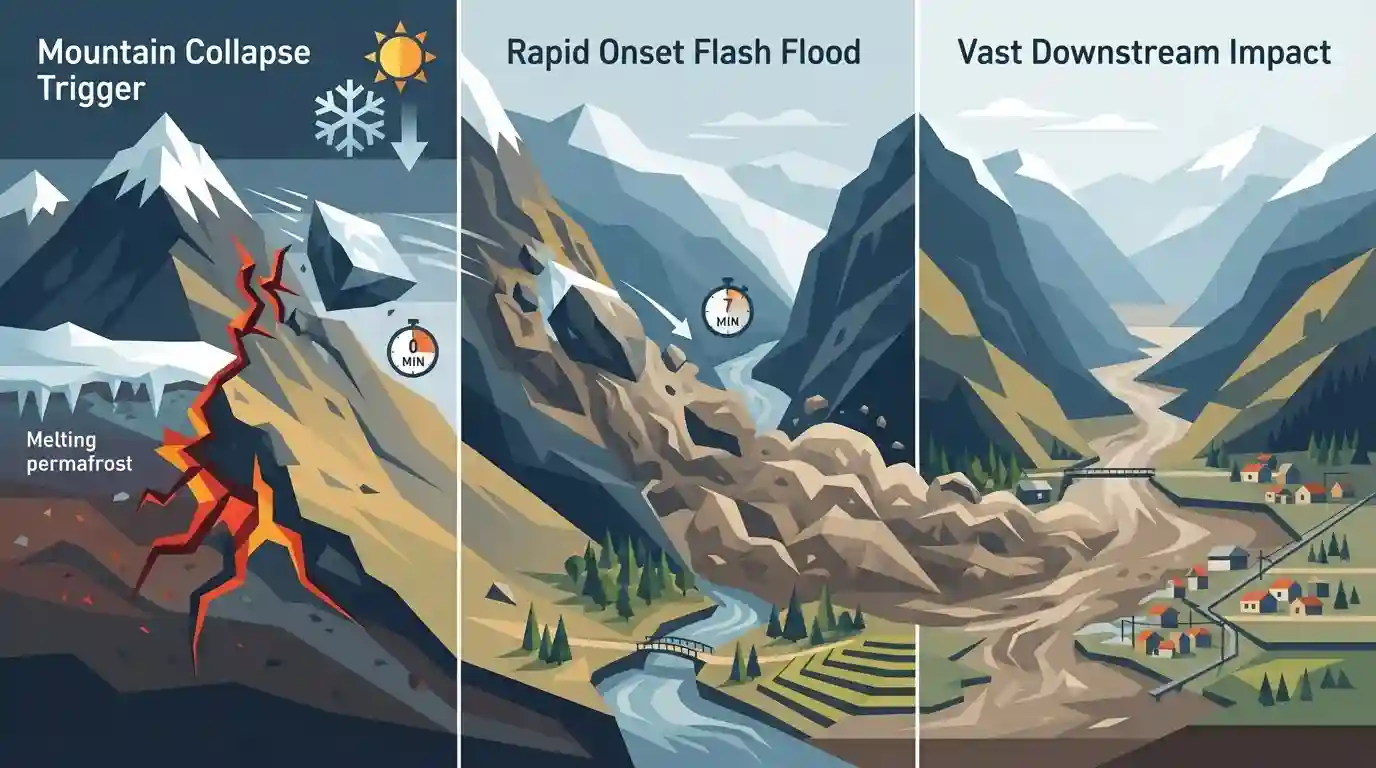
The article examines how a mountain collapse in Nepal triggered a devastating flash flood in only seven minutes, highlighting the severe vulnerability of the Himalayan ecosystem to rapid-onset climate and geological disasters.
Key Points
- A sudden mountain collapse in Nepal triggered a catastrophic flash flood in a matter of just 7 minutes.
- Demonstrates the extreme fragility of the Himalayan ecosystem under changing climatic and geological stress.
- Highlights the growing threat of rapid-onset natural disasters and the challenges they pose to early warning systems and disaster management.
Important Terms
Flash Flood

A sudden, violent flow of water, rock, ice, and debris triggered by events like mountain collapses or glacial breaches, moving down steep terrain with immense destructive force.
UPSC context
Important for GS Paper III (Disaster Management – causes, vulnerability, and early warning systems for rapid-onset natural hazards).
Hindu Kush Himalaya Region
A vast mountain system in Asia containing the largest ice reserves outside the poles, highly vulnerable to rapid warming, glacier retreat, and cascading climate risks.
UPSC context
Relevant for GS Paper I (Geography of the Himalayas) and GS Paper III (Environment, Climate Change Impacts, and Disaster Resilience).
Permafrost degradation
Subsurface material that remains frozen for two or more consecutive years, acting as structural glue for steep mountain slopes and rock faces.
UPSC context
Tested in GS Paper III under environment-climate change feedback loops, slope instability, and high-altitude ecological tipping points.
Cascading Disaster
A sequence of secondary hazards unleashed by a primary trigger, such as a mountain collapse triggering an avalanche, damming a river, and causing a catastrophic flood surge.
UPSC context
Relevant for GS Paper III (Disaster Management framework, multi-hazard risk assessment, and transboundary early-warning coordination).
Prelims Trap
Conventional early warning systems are fully adequate for mitigating rapid-onset flash floods in high-altitude Himalayan terrains.
Traditional early warning systems cannot prevent or adequately mitigate rapid-onset disasters that occur within minutes; automated, real-time sensor networks are required instead.
Static Concepts Connected
What are the primary factors contributing to the extreme geological and ecological fragility of the Himalayan mountain system?
- Young Tectonics: Young and unstable geological formations with high seismic activity and ongoing tectonic convergence.
- Climate & Human Stress: Intense monsoon rainfall coupled with anthropogenic pressures like deforestation and unscientific infrastructure development.
- Cryosphere Hazards: Rapid melting of glaciers leading to Glacial Lake Outburst Floods (GLOFs) and mass-wasting events.
Cross-Topic Patterns
Himalayan Disasters + NDMA Frameworks
Himalayan flash floods driven by climate stress test both disaster mitigation frameworks and infrastructure resilience under the National Disaster Management Authority guidelines.

Rapid-onset Himalayan flash floods + GLOFs + inadequacy of traditional early warning systems likely in a multi-statement prelims question.
Linked PYQs · 3
Linked PYQs · 3
- 2019MainsGS3
Disaster preparedness is the first step in any disaster management process. Explain how hazard zonation mapping will help disaster mitigation in the case of landslides.
- 2019MainsGS3
Vulnerability is an essential element for defining disaster impacts and its threat to people. How and in what ways can vulnerability to disasters be characterized? Discuss different types of vulnerability with reference to disasters.
- 2024MainsGS3
Flooding in urban areas is an emerging climate-induced disaster. Discuss the causes of this disaster. Mention the features of two such major floods in the last two decades in India. Describe the policies and frameworks in India that aim at tackling such floods.
