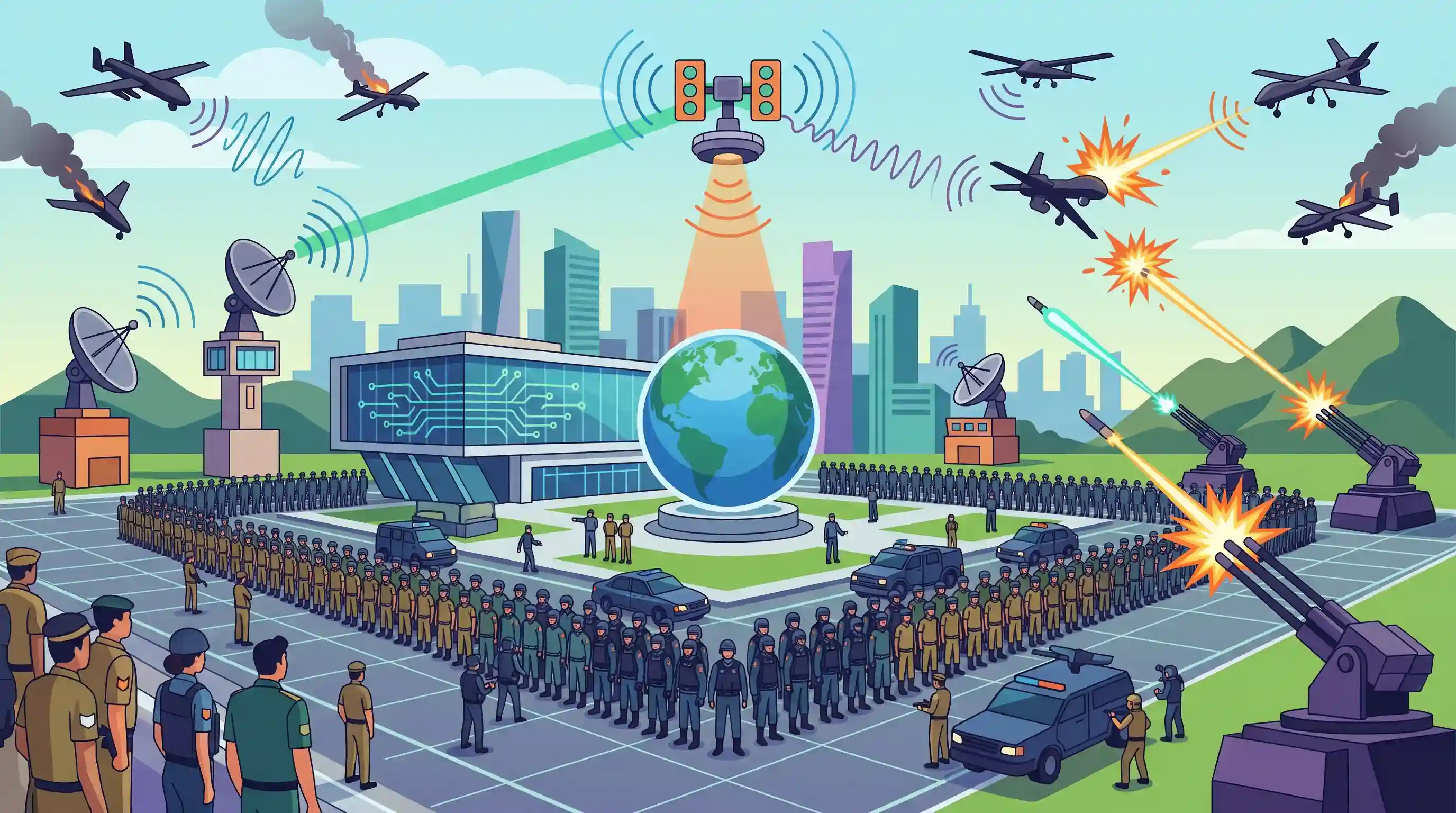
Security Grid and Anti Drone Measures for Delhi AI Summit
Source:Indian Express ↗
Why It Matters
The article illustrates the practical intersection of emerging technologies and internal security, demonstrating how state agencies counter modern asymmetric threats like drones during major international summits. This is directly relevant to the GS3 syllabus on the role of external state and non-state actors in creating challenges to internal security and awareness in the fields of IT and AI.
Summary
To secure a major Artificial Intelligence (AI) Summit in Delhi, a massive security grid comprising 15,000 personnel has been deployed. The security arrangements feature specialized aerial countermeasures, including six anti-drone systems and four air defence guns, reflecting the increasing threat of rogue Unmanned Aerial Vehicles (UAVs) in urban environments. This robust deployment underscores the evolving nature of internal security protocols required to protect high-profile international events from modern asymmetric threats.
Key Points
- A massive security deployment of 15,000 personnel has been mobilized to secure the AI Summit in Delhi.
- The security grid includes advanced technological countermeasures, notably six anti-drone systems and four air defence guns, to secure the airspace.
- The arrangements highlight the growing recognition of asymmetric security threats, particularly from rogue Unmanned Aerial Vehicles (UAVs), during high-profile events.
- The scale of deployment underscores India's evolving Standard Operating Procedures (SOPs) for hosting major international or technological summits safely.
Prelims Trap
Urban counter-drone protocols prioritize 'hard kill' kinetic neutralization to instantly eliminate rogue UAVs.
Urban SOPs prioritize 'soft kill' (RF/GPS jamming) to avoid civilian casualties from falling debris. 'Hard kill' is secondary or reserved for specific safe zones.
Static Concepts Connected
What are the primary mechanisms of Anti-Drone Technology?
- Soft Kill: Disrupts the drone's communication or navigation via RF jamming, GPS spoofing, or cyber takeovers.
- Hard Kill: Physically disables or destroys the drone using directed energy weapons (lasers), nets, or kinetic projectiles.
- Detection: Utilizes radar, electro-optical/infrared (EO/IR) sensors, and acoustic sensors to identify and track incoming UAVs.
How is drone airspace and rogue-drone regulation managed in India?
- Digital Sky Platform: Manages airspace mapping into Red, Yellow, and Green zones; Red zones strictly prohibit unauthorized flights without specialized clearance.
- MHA's ARDTC: The Anti Rogue Drone Technology Committee (ARDTC) under the Ministry of Home Affairs evaluates and certifies counter-drone technologies.
Cross-Topic Patterns
Border vs. Urban Drone Threats
While border areas face drone threats primarily for arms and drug smuggling, urban events face risks of targeted disruptions, requiring distinctly different, low-collateral counter-drone standard operating procedures (SOPs).
Tech Summits as Critical Infrastructure
The massive security grid highlights how technology summits and AI data hubs are increasingly protected as critical national assets against asymmetric threats, merging physical and cyber security domains.

GS3 2026 may feature a dual-focus question linking the asymmetric threat of rogue drones to the evolving challenges of urban event security.
Linked PYQs · 3
Linked PYQs · 3
- 2023MainsGS3
The use of unmanned aerial vehicles (UAVs) by our adversaries across the borders to ferry arms/ammunitions, drugs, etc., is a serious threat to the internal security. Comment on the measures being taken to tackle this threat.
- 2020PrelimsGS1
With the present state of development, Artificial Intelligence can effectively do which of the following? 1. Bring down electricity consumption in industrial units 2. Create meaningful short stories and songs 3. Disease diagnosis 4. Text-to-Speech Conversion 5. Wireless transmission of electrical energy Select the correct answer using the code given below:
- 2025PrelimsGS1
With reference to Unmanned Aerial Vehicles (UAVs), consider the following statements : I. All types of UAVs can do vertical landing. II. All types of UAVs can do automated hovering. III. All types of UAVs can use battery only as a source of power supply. How many of the statements given above are correct?
