AI Summit Security Grid and Urban Threat Mitigation Framework
Source:Indian Express ↗
Why It Matters
Provides a real-world example of mitigating emerging asymmetric threats (such as drones and UAVs) to internal security during high-profile international summits. It illustrates the role of various security agencies (like the NSG and local police) in managing complex urban security environments.
Summary
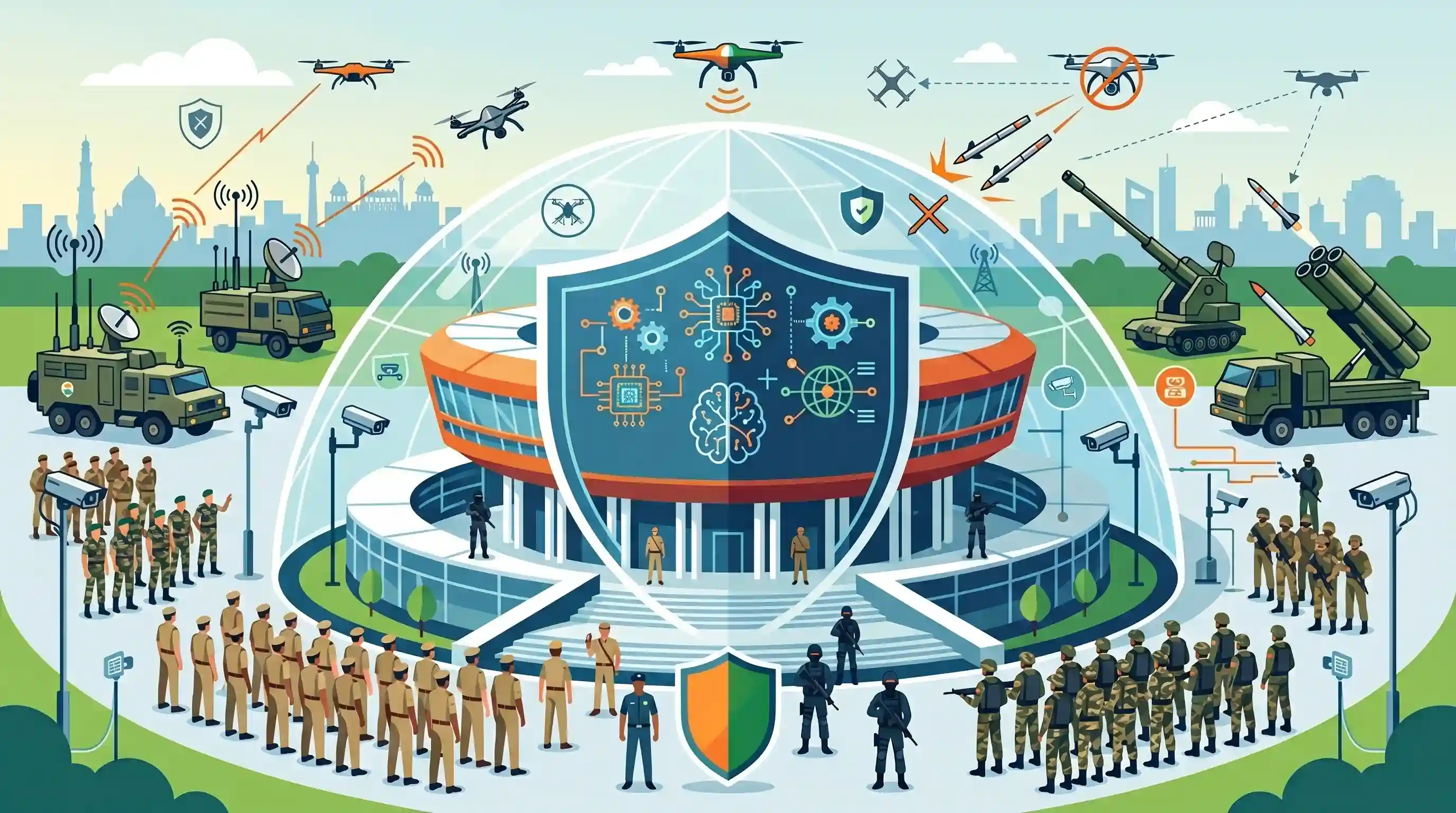
In preparation for the Global Partnership on Artificial Intelligence (GPAI) Summit at Bharat Mandapam, New Delhi, a massive security detail of around 15,000 personnel from the Delhi Police and paramilitary forces has been deployed. The security protocol—mirroring the arrangements of the recent G20 Summit—features six anti-drone systems, four air defence guns, specialized NSG commandos, and advanced surveillance mechanisms to counter emerging internal security and aerial threats.
Key Points
- The Global Partnership on Artificial Intelligence (GPAI) Summit is being hosted at Bharat Mandapam in New Delhi, demanding extensive security arrangements.
- Around 15,000 security personnel drawn from the Delhi Police and paramilitary forces have been deployed to secure the venue and delegates.
- To counter evolving asymmetric threats, the security grid includes six anti-drone systems, four air defence guns, and facial-recognition cameras.
- Specialized units including the National Security Guard (NSG) commandos and SWAT teams have been engaged, mirroring the high-level security protocol of the G20 Summit.
- The deployment highlights the increasing complexity of providing internal security and mitigating drone/UAV threats during high-profile international technology and diplomatic summits.
Important Terms
Global Partnership on Artificial Intelligence (GPAI)

An international multi-stakeholder initiative (est. 2020) that promotes responsible AI development. India is a founding member and served as the 2024 Lead Chair. Secretariat hosted by the OECD.
UPSC context
GS Paper 3 (S&T). Tests knowledge of international tech governance and India’s leadership in the Global South’s AI narrative.
National Security Guard (NSG)
India’s elite federal contingency force (est. 1986) under the Ministry of Home Affairs. Known as 'Black Cats,' they specialize in counter-terrorism, hostage rescue, and neutralizing high-risk threats.
UPSC context
GS Paper 3 (Internal Security). Tests understanding of specialized forces, their mandates, and responses to extraordinary security challenges.
Delhi Police
The law enforcement agency for India's National Capital Territory. Unlike state police, it reports directly to the Union Ministry of Home Affairs, handling VVIP security and metropolitan order.
UPSC context
GS Paper 2 (Polity) and GS Paper 3 (Security). Tests knowledge of UT administration and the Union's role in internal security.
Anti-Drone Systems
Technological countermeasures used to detect, track, and intercept unauthorized Unmanned Aerial Vehicles (UAVs). Common methods include frequency jamming, laser interception, and GPS spoofing.
UPSC context
GS Paper 3 (Internal Security). Tests awareness of emerging aerial threats and the modernization of security infrastructure against non-state actors.
Prelims Trap
"India recently joined the Global Partnership on Artificial Intelligence (GPAI) to host its summit."
India did not join recently; it is a founding member of GPAI (launched in 2020). Additionally, GPAI is an OECD-hosted initiative, not a UN body.
Static Concepts Connected
What is the Global Partnership on Artificial Intelligence (GPAI)?
- Origin & Secretariat: Launched in 2020 as a multi-stakeholder initiative, with its secretariat hosted by the OECD in Paris.
- India's Status: India is a founding member of the initiative and the lead chair for the 2024 cycle.
- Core Mandate: To bridge the gap between AI theory and practice, promoting human-centric and responsible AI development.
How do counter-drone technologies (C-UAS) neutralize rogue UAVs?
- Soft Kill: Disrupts the drone's communication or navigation links using radio frequency (RF) jamming or GPS spoofing.
- Hard Kill: Physically damages or destroys the drone using directed energy weapons (lasers), kinetic nets, or micro-missiles.
- DRDO Systems: India employs indigenous D4 (Drone Detect, Deter and Destroy) systems developed by the DRDO.
Cross-Topic Patterns
Facial Recognition vs Right to Privacy
Security deployment of AI cameras for summits directly intersects with Polity (Article 21). Lack of statutory backing for biometric data retention invites scrutiny under the Puttaswamy proportionality test.
Tech-Diplomacy and Global Governance
Securing and hosting the GPAI summit extends India's G20 legacy. It positions New Delhi as a critical rule-maker in global AI regulations, shifting from a technology consumer to a strategic standard-setter.

Expect a multi-statement Prelims question merging India's founding status in GPAI with the soft/hard kill mechanisms of anti-drone tech.
Linked PYQs · 3
Linked PYQs · 3
- 2023MainsGS3
The use of unmanned aerial vehicles (UAVs) by our adversaries across the borders to ferry arms/ammunitions, drugs, etc., is a serious threat to the internal security. Comment on the measures being taken to tackle this threat.
- 2023MainsGS3
Introduce the concept of Artificial Intelligence (AI). How does Al help clinical diagnosis? Do you perceive any threat to privacy of the individual in the use of Al in healthcare?
- 2023MainsGS3
What are the internal security challenges being faced by India? Give out the role of Central Intelligence and Investigative Agencies tasked to counter such threats.
