Bab el Mandeb Strait Vulnerability and Middle East Maritime Security
Source:Indian Express ↗
Why It Matters
The Middle East is crucial for India's energy security and diaspora. Disruptions in key maritime chokepoints like the Bab el-Mandeb Strait and the Strait of Hormuz directly impact global oil prices, inflation, and India's economic stability, making it a highly probable topic for both Prelims (Map-based) and Mains (IR and Security).
Summary
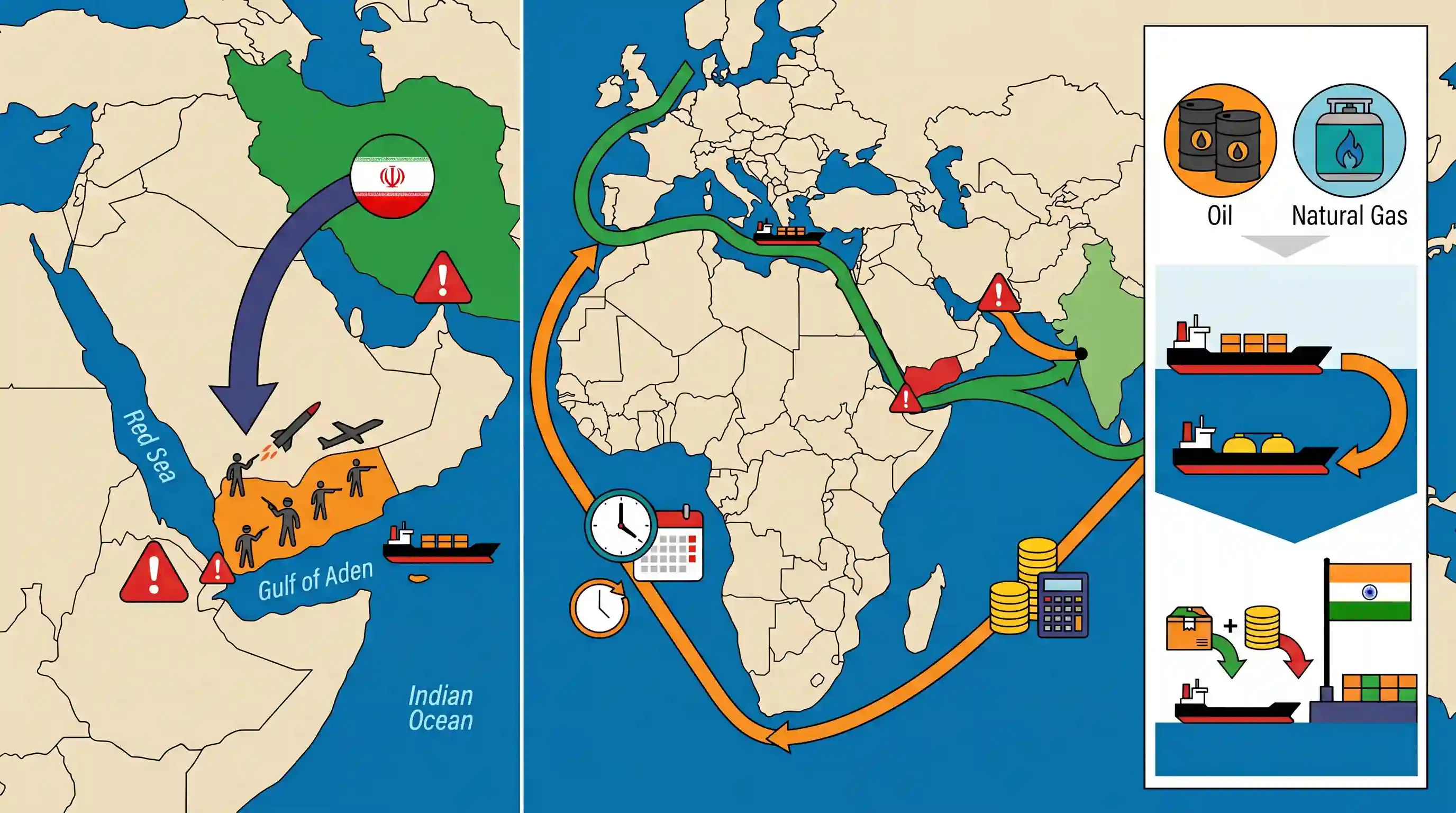
The article examines the escalating geopolitical tensions in the Middle East as Yemen's Iran-backed Houthi rebels threaten commercial shipping through the strategic Bab el-Mandeb Strait. This crucial maritime chokepoint connects the Red Sea to the Gulf of Aden and is vital for global trade and energy supplies traversing the Suez Canal. With the Strait of Hormuz also vulnerable due to Iran's regional posturing, the Houthi attacks are forcing commercial vessels to take the longer route around the Cape of Good Hope. This dual threat significantly impacts global supply chains, raises freight costs, and poses severe risks to the energy security and maritime trade interests of countries like India.
Key Points
- The Bab el-Mandeb Strait is a strategic maritime chokepoint connecting the Red Sea to the Gulf of Aden, essential for global trade passing through the Suez Canal.
- Iran-backed Houthi rebels in Yemen have targeted commercial shipping in the region, effectively bringing the Bab el-Mandeb into the broader Middle East proxy conflicts.
- Along with the Strait of Hormuz, disruptions here pose a dual threat to global energy security and force vessels to reroute around Africa, increasing freight costs and transit times.
- The escalating tensions highlight the vulnerabilities of global supply chains and underscore the critical need for robust maritime security to protect India's sea trade and energy imports.
Important Terms
Houthis

Officially known as 'Ansar Allah', they are a Zaydi Shia militant and political movement in Yemen, backed by Iran, and a key actor in the ongoing Yemeni Civil War and regional conflicts.
UPSC context
GS Paper II (International Relations); tests understanding of non-state actors, Middle East geopolitics, and their impact on global maritime security.
Bab el-Mandeb Strait
A strategic 32km-wide strait connecting the Red Sea to the Gulf of Aden. Located between Yemen and Djibouti/Eritrea, it serves as a critical gateway for vessels accessing the Suez Canal.
UPSC context
GS Paper I (World Geography) and II; tests mapping skills and knowledge of strategic maritime chokepoints affecting global trade.
Strait of Hormuz
A vital chokepoint between Iran and Oman/UAE, connecting the Persian Gulf to the Gulf of Oman. It is the world's most important oil transit point, handling one-fifth of global consumption.
UPSC context
GS Paper III (Energy Security); tests understanding of global energy supply chains and India's vulnerability to oil-route disruptions.
Maritime Chokepoints
Narrow, strategic sea passages (like straits or canals) through which high volumes of global trade pass. They are vulnerable to blockades, significantly impacting energy security and international shipping costs.
UPSC context
GS Paper III (Economy/Internal Security); tests analysis of global supply chain resilience and strategic maritime bottlenecks.
Cape of Good Hope
Located in South Africa, this historic route serves as the primary maritime alternative when the Suez Canal is blocked, though it adds significant time and fuel costs to global shipping.
UPSC context
GS Paper I (Geography) and III; tests knowledge of maritime logistics, historical trade routes, and economic impacts of rerouting.
Suez Canal
A major artificial sea-level waterway in Egypt connecting the Mediterranean and Red Seas. It provides the shortest maritime link between Europe and the Indian Ocean, facilitating roughly 12% of global trade.
UPSC context
GS Paper I (World Geography); tests understanding of man-made geographical features and their pivotal role in international commerce.
Prelims Trap
"The Bab el-Mandeb Strait is bordered by Yemen and Saudi Arabia, connecting the Persian Gulf to the Red Sea."
Bab el-Mandeb connects the Red Sea to the Gulf of Aden (not the Persian Gulf). Furthermore, it is bordered by Yemen, Djibouti, and Eritrea, not Saudi Arabia.
Static Concepts Connected
What are the defining geographical markers of the Bab el-Mandeb and Hormuz straits?
- Bab el-Mandeb: Connects the Red Sea to the Gulf of Aden/Arabian Sea. It is bordered by Yemen (Asia) to the east, and Djibouti and Eritrea (Africa) to the west.
- Strait of Hormuz: Connects the Persian Gulf to the Gulf of Oman and the Arabian Sea. It is bordered by Iran to the north and Oman (Musandam Peninsula) to the south.
- Suez Canal: An artificial sea-level waterway in Egypt, connecting the Mediterranean Sea to the Red Sea, which provides the shortest maritime route between Europe and the lands lying around the Indian and western Pacific oceans.
How does UNCLOS regulate maritime traffic through international straits?
- Transit Passage: Under UNCLOS, ships and aircraft enjoy the right of 'transit passage' through straits used for international navigation, such as the Bab el-Mandeb.
- Coastal State Limits: Bordering states cannot arbitrarily suspend transit passage, even for foreign warships. However, transiting vessels must proceed without delay and refrain from the threat or use of force.
Cross-Topic Patterns
Chokepoints & Imported Inflation
Disruptions force ships around the Cape of Good Hope, spiking freight and insurance rates. This directly translates to imported inflation for India's energy and fertilizer sectors.
IMEC as a Strategic Bypass
The Red Sea crisis accelerates the geopolitical rationale for the India-Middle East-Europe Economic Corridor (IMEC) as a multi-modal alternative to reduce dependency on vulnerable maritime chokepoints.
Non-state Actors & Asymmetric Warfare
The use of advanced drones and anti-ship missiles by Houthi rebels highlights the growing threat of non-state actors crippling global, state-led maritime trade routes.

Expect a match-the-pair prelims question mapping Middle Eastern straits (Bab el-Mandeb, Hormuz) to their bordering nations and seas.
Linked PYQs · 3
Linked PYQs · 3
- 2025MainsGS2
"Energy security constitutes the dominant kingpin of India's foreign policy, and is linked with India's overarching influence in Middle Eastern countries.” How would you integrate energy security with India's foreign policy trajectories in the coming years?
- 2025MainsGS3
Why is maritime security vital to protect India's sea trade? Discuss maritime and coastal security challenges and the way forward.
- 2022PrelimsGS1
The term "Levant" often heard in the news roughly corresponds to which of the following regions?
