Urban Housing Market Trends and Property Price Rise
Source:The Hindu ↗
Why It Matters
The data highlights key trends in India's real estate sector and urban economy. The sharp 21% rise in housing prices and the shift toward luxury homes raise critical concerns regarding affordable housing, urban poverty, and the marginalization of lower-income groups in metropolises. Aspirants can use these statistics in answers related to urbanization (GS1) and infrastructure or economic development (GS3).
Summary
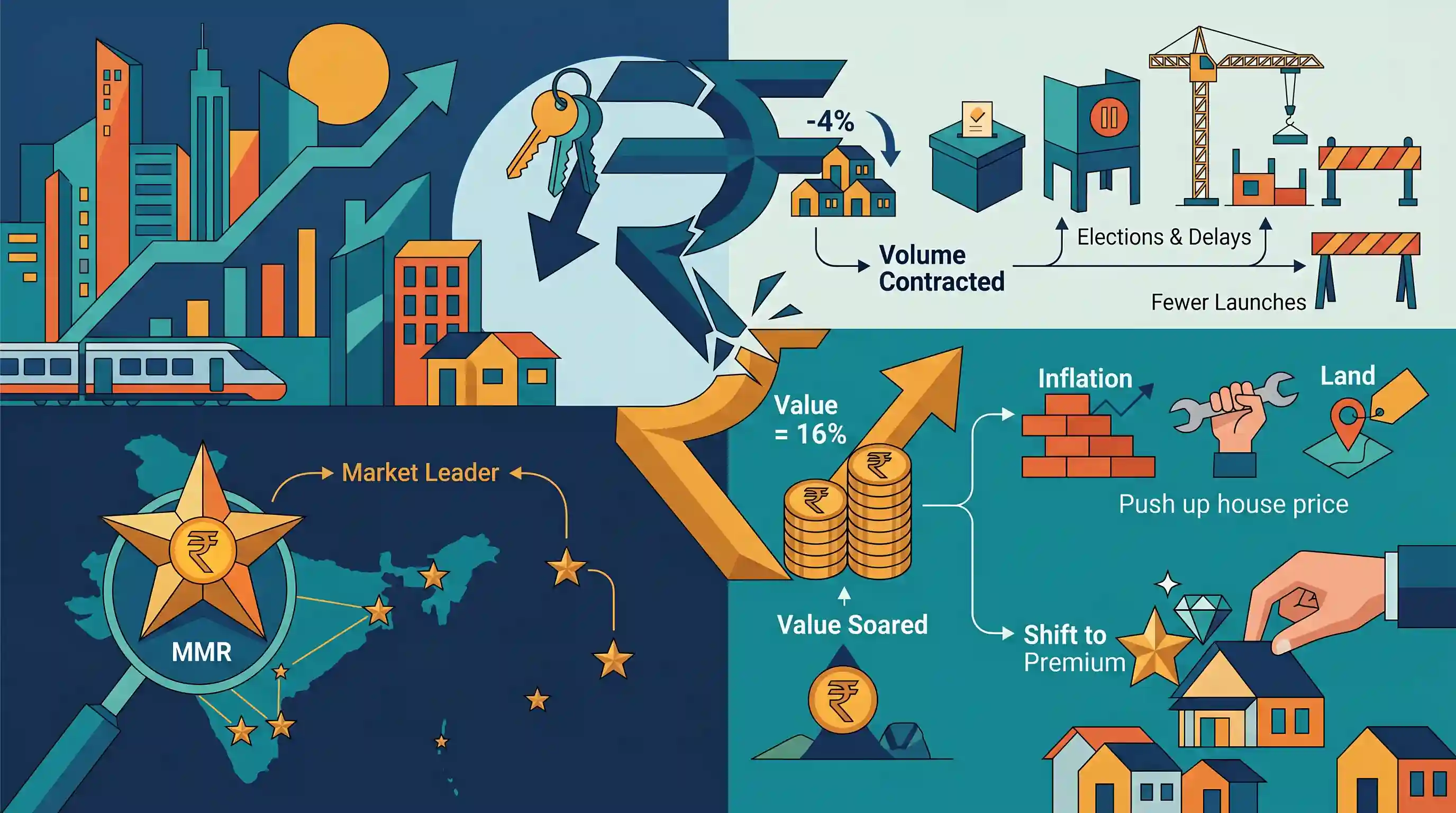
According to a report by brokerage firm Anarock, housing sales volume in India's top 7 cities fell by 4% to 4.56 lakh units in 2024. However, the total sales value soared by 16% to reach a new record of ₹5.68 lakh crore. The volume contraction is attributed to fewer project launches and delays in regulatory approvals amid the general elections. Meanwhile, real estate developers saw increased revenue due to a significant 21% rise in average housing prices, driven by the escalating costs of land, labor, and raw materials, as well as a strong market preference for premium and luxury homes. MMR led the market with the highest sales value.
Key Points
- Housing sales volume in India's top seven cities declined by 4% to 4.56 lakh units in 2024.
- Despite the volume drop, the total value of residential properties sold surged 16% to a record high of ₹5.68 lakh crore.
- The decline in sales volume was driven by fewer new project launches and delayed regulatory approvals during the 2024 general elections.
- Average housing prices jumped 21% across these cities, fueled by rising costs of land, labor, and construction materials.
- Mumbai Metropolitan Region (MMR) recorded the highest sales value at ₹2.77 lakh crore, contributing nearly half of the total.
- The data indicates a robust shift in consumer demand toward premium and luxury housing segments, contributing to the higher overall sales value.
Important Terms
Real Estate Sector

The industry encompassing the development, sale, and management of residential, commercial, retail, and hospitality properties; India's second-largest employer.
UPSC context
GS III (Economy); essential for understanding GDP contribution, employment generation, and backward-forward linkages with industries like steel and cement.
Urbanization
The physical and demographic growth of urban areas caused by migration and population shifts from rural regions to cities.
UPSC context
GS I (Social Issues) and GS III; vital for studying urban planning challenges, infrastructure strain, and the housing deficit.
Mumbai Metropolitan Region (MMR)
A major metropolitan area in Maharashtra comprising Mumbai and satellite towns like Thane and Navi Mumbai, overseen by the MMRDA.
UPSC context
GS I/III; a key case study for urban agglomerations, regional planning, and concentrated real estate market dynamics in India.
Anarock Group
A leading Indian real estate consultancy providing market research, advisory, and transaction services across the property value chain.
UPSC context
GS III (Economy); a primary source of data for analyzing urban housing trends, demand-supply gaps, and investment patterns.
Luxury Housing Segment
The high-end residential market catering to affluent buyers (HNIs), characterized by premium amenities, prime locations, and higher price points.
UPSC context
GS III (Economy); reflects shifts in consumer behavior, wealth distribution, and market resilience during economic volatility.
Cost-Push Inflation
Inflation driven by increases in the cost of production inputs, such as land, labor, and raw materials like cement and steel.
UPSC context
GS III (Economy); explains why housing prices may rise significantly even when sales volumes remain flat or decline.
Prelims Trap
The Indian real estate sector witnessed a decline in both sales volume and total revenue in 2024.
While sales volume (units sold) contracted by 4%, the total sales value actually surged by 16% due to a steep rise in property prices and luxury demand.
Static Concepts Connected
What distinguishes cost-push from demand-pull inflation?
- Cost-push inflation: Driven by an increase in the cost of production factors (e.g., land, labor, raw materials like steel/cement).
- Demand-pull inflation: Occurs when aggregate demand in an economy outpaces aggregate supply (often termed "too much money chasing too few goods").
What are the key regulatory protections under RERA, 2016?
- Escrow requirement: Developers must deposit 70% of project funds collected from buyers into a separate escrow account for construction costs.
- Standardized definitions: Properties must be sold based on the standard 'carpet area' rather than the ambiguous 'super built-up area'.
- Grievance redressal: Establishes state-level Real Estate Regulatory Authorities for speedy dispute resolution and protects buyers from project delays.
Cross-Topic Patterns
K-Shaped recovery in urban real estate
The surge in premium housing value amid falling overall sales volumes mirrors a broader K-shaped consumption pattern, sharply contrasting with the mandate for affordable housing under schemes like PMAY-Urban.
Spatial concentration and Urban Primacy
With MMR contributing nearly 50% of top-7 city sales value, this reflects severe spatial concentration of capital, tying into geography concepts of uneven regional development and urban primacy.

Mains GS-3: Expect questions linking cost-push construction inflation and premium housing demand to the urban affordable housing deficit.
Linked PYQs · 3
Linked PYQs · 3
- 2023MainsGS1
Does urbanization lead to more segregation and/or marginalization of the poor in Indian metropolises?
- 2025MainsGS1
How does smart city in India, address the issues of urban poverty and distributive justice?
- 2021MainsGS3
“Investment in infrastructure is essential for more rapid and inclusive economic growth.” Discuss in the light of India's experience.
