Rising Medical Inflation Exposes Households to Severe Financial Risks
Source:The Hindu ↗
Why It Matters
Understanding health inflation and the financialization of healthcare is crucial for assessing India's progress toward Universal Health Coverage (UHC). The article highlights systemic gaps in health insurance, the 'missing middle', and the urgent need for state regulation of private healthcare—themes central to GS Paper 2 (Health & Social Justice).
Summary
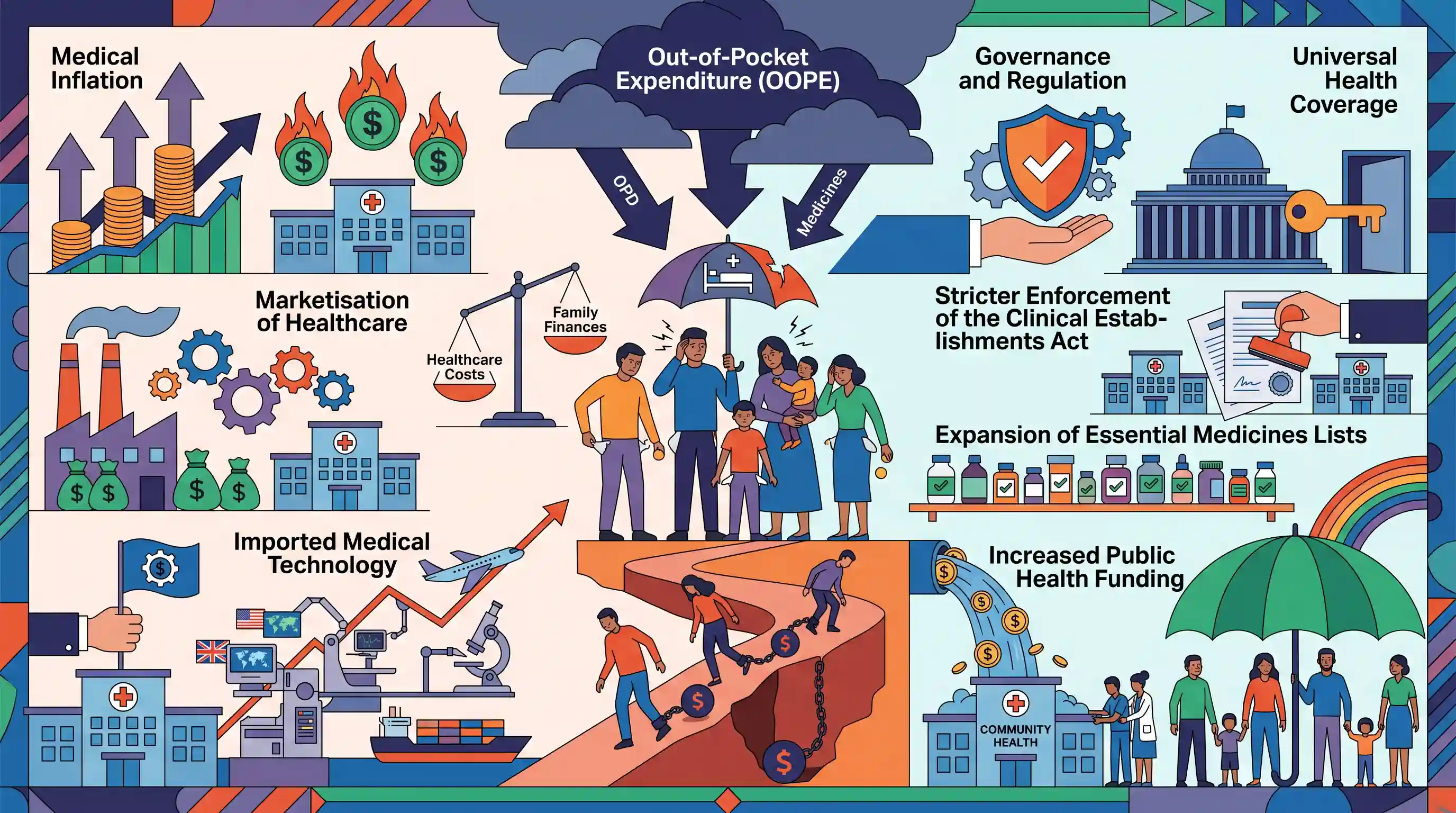
The article analyzes the financial risks faced by Indian households due to soaring medical inflation, which market reports estimate at 12-13%, significantly higher than official figures. This inflation is driven by rising hospital input costs, reliance on imported medical technology, and the marketisation of healthcare, including increased private equity investments in the sector. With limited insurance penetration and a focus on inpatient care, patients bear high out-of-pocket expenditures (OOPE) for OPD and medicines, pushing many into debt. The article advocates for robust state intervention, including stricter enforcement of the Clinical Establishments Act, expansion of essential medicines lists, and increased public health funding to ensure equitable access and mitigate the adverse impacts of a profit-driven healthcare model.
Key Points
- There is a significant gap between official health inflation figures (approx. 3%) and market estimates (12-13%), leading to high out-of-pocket expenditure (OOPE) and financial distress for households.
- The marketisation of healthcare, highlighted by a high reliance on private hospitals (over 61% of hospitalisations) and growing private equity investments, has driven up costs and widened healthcare inequities.
- Health insurance in India primarily covers inpatient care, leaving OPD and medicinal costs uninsured and exposing the 'missing middle' demographic to catastrophic expenditures.
- Medical inflation is fueled by structural factors such as costly technological advancements, reliance on imported medical devices and drugs, higher hospital input costs, and global supply chain disruptions.
- Proposed regulatory solutions include enforcing the Clinical Establishments Act to cap private sector pricing, expanding the National List of Essential Medicines (NLEM), and significantly increasing public health expenditure to reduce OOPE.
Important Terms
Out-of-Pocket Expenditure (OOPE)

Direct payments made by individuals for healthcare services at the point of care, without reimbursement from insurance or the state. It often drives households into poverty.
UPSC context
GS Paper II: Health/Social Justice; indicates weak public financing and lack of universal coverage.
Ayushman Bharat (AB-PMJAY)
The world's largest government-funded health assurance scheme, providing ₹5 lakh per family annually for secondary and tertiary hospitalization to over 12 crore poor and vulnerable families.
UPSC context
GS Paper II: Government Schemes; tests effectiveness in reducing catastrophic health expenditure and achieving UHC.
Clinical Establishments (Registration and Regulation) Act 2010
A central legislation that mandates the registration and regulation of all clinical establishments (public and private) to ensure minimum quality standards and transparency in pricing.
UPSC context
GS Paper II: Governance/Health; critical for regulating private healthcare costs and standardizing services.
National List of Essential Medicines (NLEM)
A dynamic list issued by the Health Ministry featuring drugs considered essential for priority healthcare; these are subject to price ceilings fixed by the NPPA.
UPSC context
GS Paper II: Health Policy; vital for ensuring affordable access to life-saving drugs.
National Pharmaceutical Pricing Authority (NPPA)
An independent regulator under the Ministry of Chemicals and Fertilizers that fixes/revises prices of controlled bulk drugs and formulations under the Drugs (Prices Control) Order.
UPSC context
GS Paper II: Statutory Bodies/Health; regulates pharma pricing to curb medical inflation.
Private Equity (PE) funds (in Healthcare)
Investment firms that pool capital to acquire stakes in healthcare providers, often driving consolidation and a focus on high-margin, profitable services.
UPSC context
GS Paper III: Indian Economy/Investment Models; tests understanding of healthcare financialization and profit-driven models.
Marketisation of Healthcare
The process of transforming healthcare from a social service into a market-driven commodity, often leading to increased costs and prioritized profitability.
UPSC context
GS Paper II: Social Sector/Health; explores the tension between private profit and public health equity.
Prelims Trap
"The Clinical Establishments Act, 2010 is binding and centrally enforced across all States in India."
Health is a State subject. Parliament passed the Act under Article 252, meaning it only applies to States that voluntarily adopt it via a legislative resolution.
Static Concepts Connected
How is drug pricing regulated in India?
- NLEM Formulation: The Ministry of Health and Family Welfare prepares this list based on public health relevance, efficacy, and safety.
- Legal Backing: Prices of NLEM drugs are capped via the Drug Price Control Order (DPCO), issued under the Essential Commodities Act, 1955.
- Enforcement by NPPA: The National Pharmaceutical Pricing Authority (under the Ministry of Chemicals and Fertilizers) calculates and enforces these ceiling prices.
Who constitutes the "Missing Middle" in India's healthcare financing?
- Definition: Approximately 30% of India's population (around 40 crore individuals) who lack any form of financial protection for health (NITI Aayog).
- The Exclusion: They are not poor enough to qualify for state-subsidized schemes like PM-JAY, yet not affluent enough to afford comprehensive private voluntary insurance.
- Vulnerability: They are highly vulnerable to catastrophic Out-Of-Pocket Expenditure (OOPE), often pushed into debt due to uninsured OPD and medicinal costs.
Cross-Topic Patterns
Health Equity + Investment Models
The surge of Private Equity (PE) in hospitals links GS-III (Investment Models) with GS-II (Health). PE's profit-maximization mandate often inflates healthcare costs, directly increasing Out-Of-Pocket Expenditure.
Medical Inflation + Make in India
Rising healthcare costs are exacerbated by India's 70-80% import dependence for high-end medical devices, linking the domestic OOPE crisis directly to the necessity of PLI schemes in manufacturing.

Expect a GS-II Mains question linking the 'missing middle', Out-of-Pocket Expenditure, and the Clinical Establishments Act in 2026.
Linked PYQs · 2
Linked PYQs · 2
- 2024MainsGS2
In a crucial domain like the public healthcare system the Indian State should play a vital role to contain the adverse impact of marketisation of the system. Suggest some measures through which the State can enhance the reach of public healthcare at the grassroots level.
- 2015MainsGS2
Public health system has limitations in providing universal health coverage. Do you think that the private sector could help in bridging the gap? What other viable alternatives would you suggest?
