Household Inflation and RBI Monetary Policy Challenges
Source:Indian Express ↗
Why It Matters
Crucial for understanding RBI's inflation targeting framework, monetary policy transmission, and the challenges of managing inflation above the tolerance threshold.
Summary
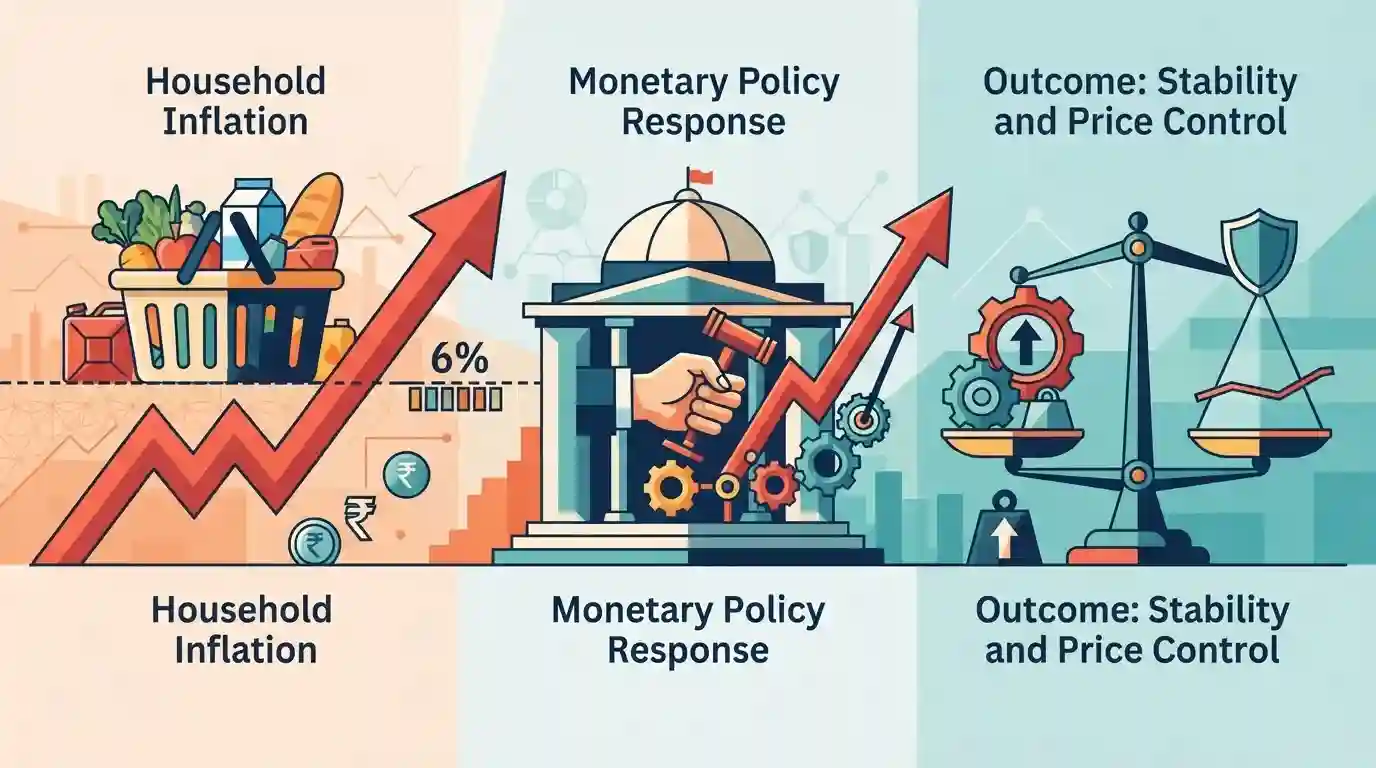
The article discusses household inflation crossing the 6 percent mark, prompting discussions around the Reserve Bank of India (RBI) rate hikes and monetary policy responses to maintain macroeconomic stability and price control.
Key Points
- Household inflation expectations or actual inflation metrics crossed the 6 percent threshold, challenging price stability targets.
- The Reserve Bank of India faces critical policy choices regarding rate hikes and liquidity management to anchor inflation within the mandated tolerance band (4% +/- 2%).
- Persistently high inflation impacts consumer purchasing power, savings behavior, and broader macroeconomic stability.
Important Terms
Reserve Bank of India

India's central banking institution, established under the RBI Act of 1934, responsible for regulating the nation's monetary policy, issuing currency, and maintaining financial stability.
UPSC context
Crucial for GS Paper III (Indian Economy - Monetary Policy, Banking, and Inflation Control). Tests knowledge of central bank mandates and macroeconomic management.
Flexible Inflation Targeting
India's statutory monetary policy framework that requires the RBI to keep Consumer Price Index (CPI) inflation at 4 percent, with an upper tolerance limit of 6 percent and lower limit of 2 percent.
UPSC context
Essential for GS Paper III (Economy - Inflation and Monetary Policy Framework). Tests understanding of India's inflation management regime and statutory targets.
Static Concepts Connected
What is the statutory inflation-targeting framework of the RBI under the RBI Act, 1934?
- Target Band: Mandate requires maintaining headline CPI inflation at 4% with a tolerance band of +/- 2% (2% to 6%).
- MPC Composition: Statutory six-member body (three RBI officials, three external government appointees) set up under Section 45ZB.
- Failure Report: If inflation stays outside the 2%–6% band for three consecutive quarters, RBI must report to the Centre explaining reasons and remedies.
Cross-Topic Patterns
Inflation vs Household Financial Savings Behavior
High headline inflation erodes real household savings, shifting investment patterns away from bank deposits toward gold, real estate, and equity markets.
Food Inflation vs Core Inflation Dilemma
Persistent supply-side food price spikes often force monetary tightening even when core inflation is benign, testing the limits of single-rate interest policy.

RBI Act inflation targeting mandate (4+/-2%), MPC voting structure, and the 3-quarter failure report rule are prime prelim targets.
Linked PYQs · 2
Linked PYQs · 2
- 2022PrelimsGS1
In India, which one of the following is responsible for maintaining price stability by controlling inflation?
- 2024MainsGS3
What are the causes of persistent high food inflation in India? Comment on the effectiveness of the monetary policy of the RBI to control this type of inflation.
