Household Inflation Trends and RBI Monetary Policy Response
Source:Indian Express ↗
Why It Matters
Crucial for understanding how household inflation expectations influence RBI's monetary policy stance, rate actions, and broader macroeconomic stability.
Summary
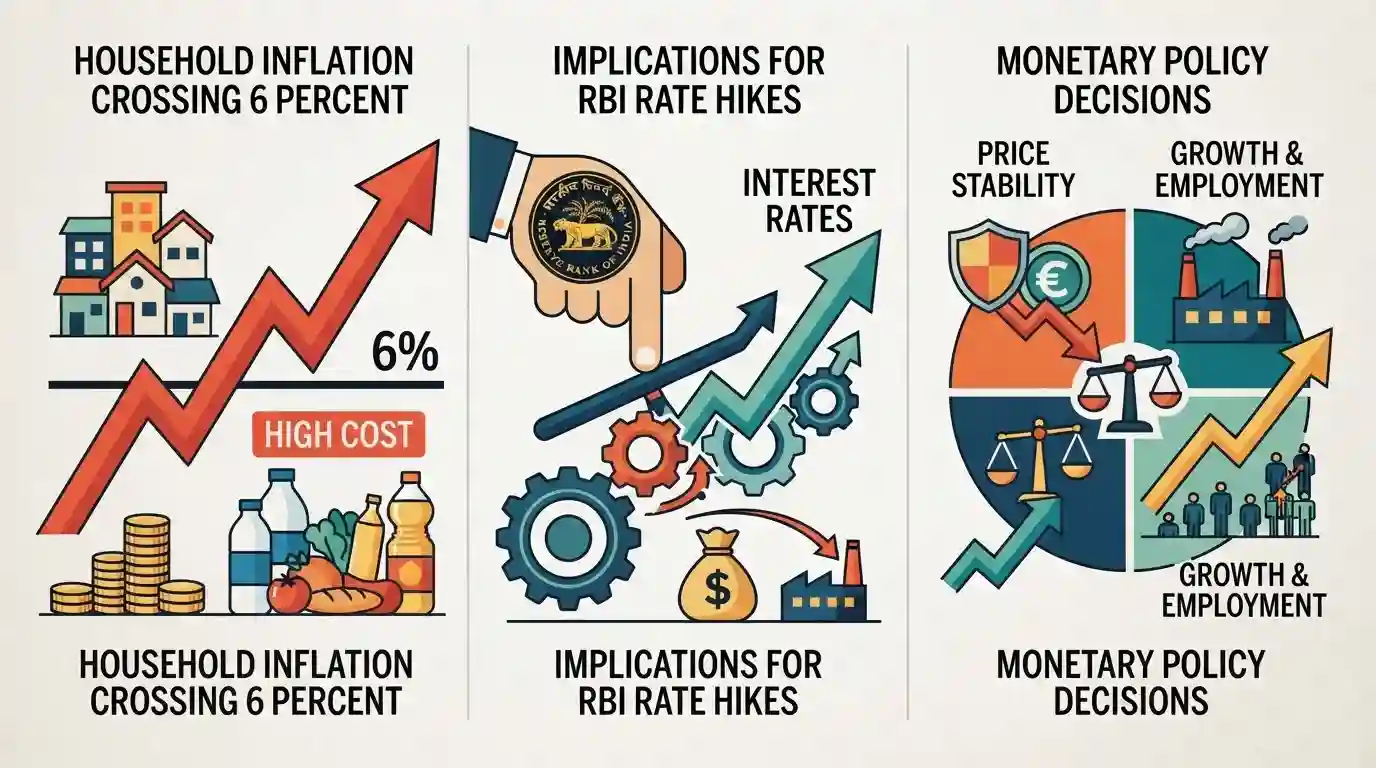
The article discusses household inflation crossing 6 percent and its implications for RBI rate hikes and monetary policy decisions.
Key Points
- Household inflation expectations and consumer price trends have crossed the 6 percent mark.
- Elevated inflation levels put pressure on the Reserve Bank of India to consider or maintain rate hikes and tightening measures.
- Monetary policy transmission relies on managing retail inflation and household price expectations within the mandated tolerance band.
Important Terms
Reserve Bank of India

India's central banking institution, established under the RBI Act of 1934, responsible for regulating the monetary policy, issuing currency, and maintaining price stability alongside economic growth.
UPSC context
Important for GS Paper III (Indian Economy - Monetary Policy, Banking, and Inflation Targeting).
Prelims Trap
Household inflation expectations and consumer price trends have crossed the 6 percent mark.
Aspirants often confuse WPI and CPI weightages; food has a much higher weight in CPI, which directly impacts household inflation expectations.
Static Concepts Connected
What is the statutory inflation targeting framework for the Reserve Bank of India?
- Mandated Target: Flexible target set at 4% Consumer Price Index (CPI) inflation.
- Tolerance Band: Allowed tolerance band of +/- 2%, meaning an acceptable range of 2% to 6%.
- Accountability Mechanism: Failure occurs if inflation remains outside 2%-6% for three consecutive quarters, necessitating a formal report to the central government.
- Statutory Basis: Statutory backing provided by an amendment to the Reserve Bank of India (RBI) Act, 1934 in 2016.
Cross-Topic Patterns
Food Inflation vs Monetary Policy Transmission
Food items carry higher weight in CPI than WPI. Supply shocks in agriculture directly feed into household inflation expectations, complicating RBI's monetary tightening mandate.
Inflation Targeting and Fiscal-Monetary Accountability
Persistent inflation breaches trigger mandatory accountability reports to the Central Government under the RBI Act, testing central bank autonomy.

Expect a multi-statement question on RBI's statutory inflation tolerance band, MPC composition, and accountability mechanisms under failure.
Linked PYQs · 3
Linked PYQs · 3
- 2023PrelimsGS1
Consider the following statements: Statement-I: In the post-pandemic recent past, many Central Banks worldwide had carried out interest rate hikes. Statement-II: Central Banks generally assume that they have the ability to counteract the rising consumer prices via monetary policy means. Which one of the following is correct in respect of the above statements?
- 2022PrelimsGS1
In India, which one of the following is responsible for maintaining price stability by controlling inflation?
- 2024MainsGS3
What are the causes of persistent high food inflation in India? Comment on the effectiveness of the monetary policy of the RBI to control this type of inflation.
