Household Inflation and RBI Monetary Policy Challenges
Source:Indian Express ↗
Why It Matters
Crucial for understanding how consumer inflation trends directly dictate central bank interest rate actions and monetary policy framework efficacy in India.
Summary
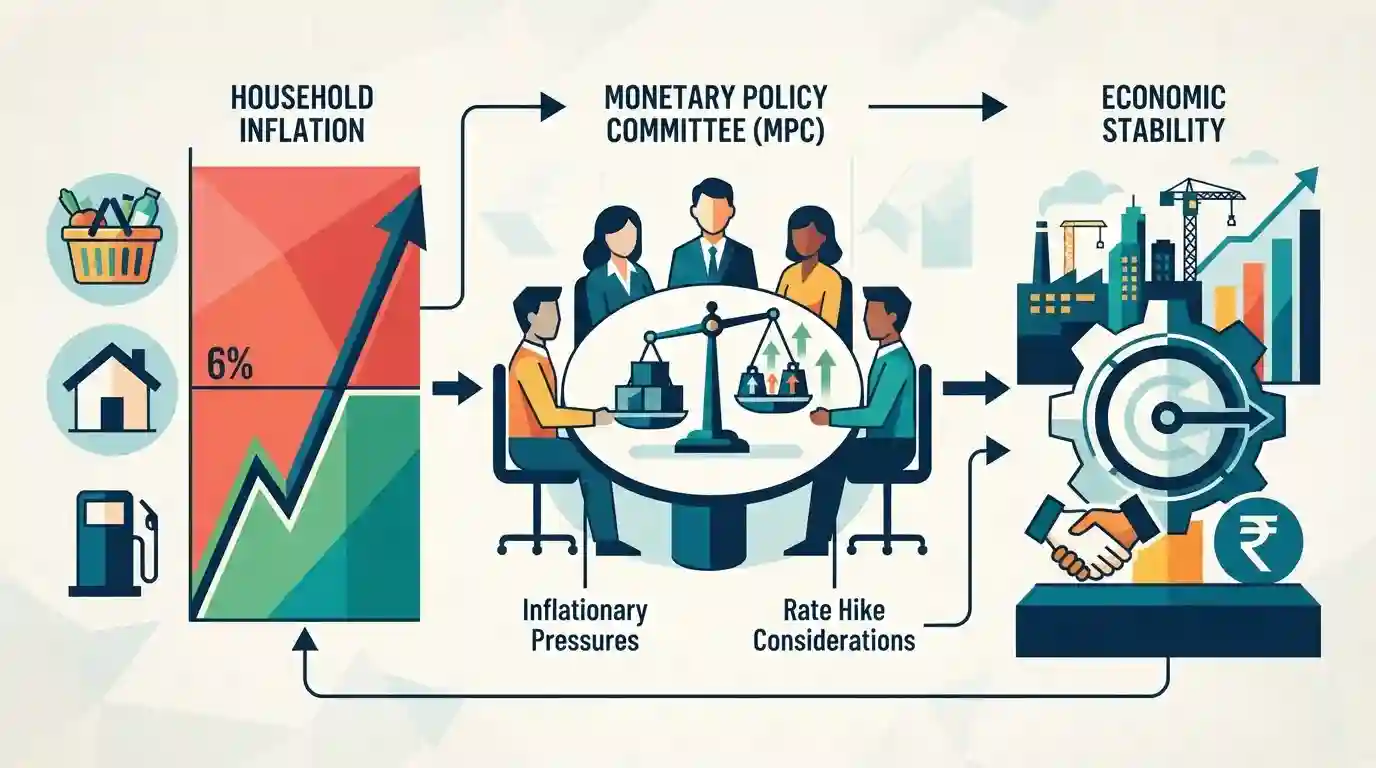
The article examines how household inflation crossing the 6 percent mark impacts the Reserve Bank of India's monetary policy stance, rate hike considerations, and overall economic stability.
Key Points
- Household inflation expectations and retail inflation metrics have risen past the 6 percent threshold, testing comfort zones.
- The Reserve Bank of India faces critical challenges in balancing growth and price stability under its inflation-targeting framework.
- Persistent inflationary pressures complicate decisions regarding interest rate changes and liquidity management by the Monetary Policy Committee.
Important Terms
Reserve Bank of India

India’s central banking institution, established under the RBI Act 1934, responsible for regulating the monetary system, issuing currency, and maintaining price stability alongside economic growth.
UPSC context
UPSC GS Paper III (Indian Economy & Mobilization of Resources). Frequently asked regarding monetary policy, inflation management, and central banking functions.
Monetary Policy Committee
A statutory six-member body constituted under the RBI Act, 1934, responsible for fixing the benchmark interest rate to achieve the inflation target while keeping growth in mind.
UPSC context
UPSC GS Paper III (Economy). Tests understanding of monetary policy formulation, inflation targeting framework, and institutional governance.
Prelims Trap
Any monthly retail inflation print exceeding the 6 percent threshold legally triggers the RBI's failure report to the central government.
Aspirants often confuse a single month's breach of the 6% upper tolerance limit with a statutory failure of the inflation target, which actually requires three consecutive quarters of breach.
Static Concepts Connected
What is the statutory framework and accountability mechanism of India's Flexible Inflation Targeting (FIT)?
- Target Band: Statutory Mandate: Established under an amended RBI Act, 1934, requiring the central bank to maintain CPI inflation at 4% with a band of +/- 2%.
- Statutory Failure: Failure Definition: Defined as headline inflation remaining outside the 2%-6% band for three consecutive quarters.
- Government Report: Accountability Report: A failing RBI must submit a formal report to the Central Government explaining reasons, remedial actions, and estimated timeframes.
Cross-Topic Patterns
Inflation Targeting vs. Fiscal Food Management
Persistent food inflation spikes test the RBI's inflation-targeting mandate while simultaneously straining rural livelihoods and public food management systems like the PDS and buffer stocks.

RBI's 2-6% CPI mandate and the 3-consecutive-quarter failure rule will feature as a statement-based prelims question.
Linked PYQs · 4
Linked PYQs · 4
- 2024MainsGS3
What are the causes of persistent high food inflation in India? Comment on the effectiveness of the monetary policy of the RBI to control this type of inflation.
- 2022PrelimsGS1
In India, which one of the following is responsible for maintaining price stability by controlling inflation?
- 2020PrelimsGS1
Consider the following statements: 1. The weightage of food in Consumer Price Index (CPI) is higher than that in Wholesale Price Index (WPI). 2. The WPI does not capture changes in the prices of services, which CPI does. 3. Reserve Bank of India has now adopted WPI as its key measure of inflation and to decide on changing the key policy rates. Which of the statements given above is/are correct?
- 2023PrelimsGS1
Consider the following statements: Statement-I: In the post-pandemic recent past, many Central Banks worldwide had carried out interest rate hikes. Statement-II: Central Banks generally assume that they have the ability to counteract the rising consumer prices via monetary policy means. Which one of the following is correct in respect of the above statements?
