Household Debt Trends and Macroprudential Regulatory Challenges
Source:The Hindu ↗
हे का महत्त्वाचे आहे
Understanding household debt trends and savings patterns is essential for analyzing India's macroeconomic stability, private consumption-led growth, and banking sector asset quality, making it a high-yield theme for GS Paper III.
सारांश
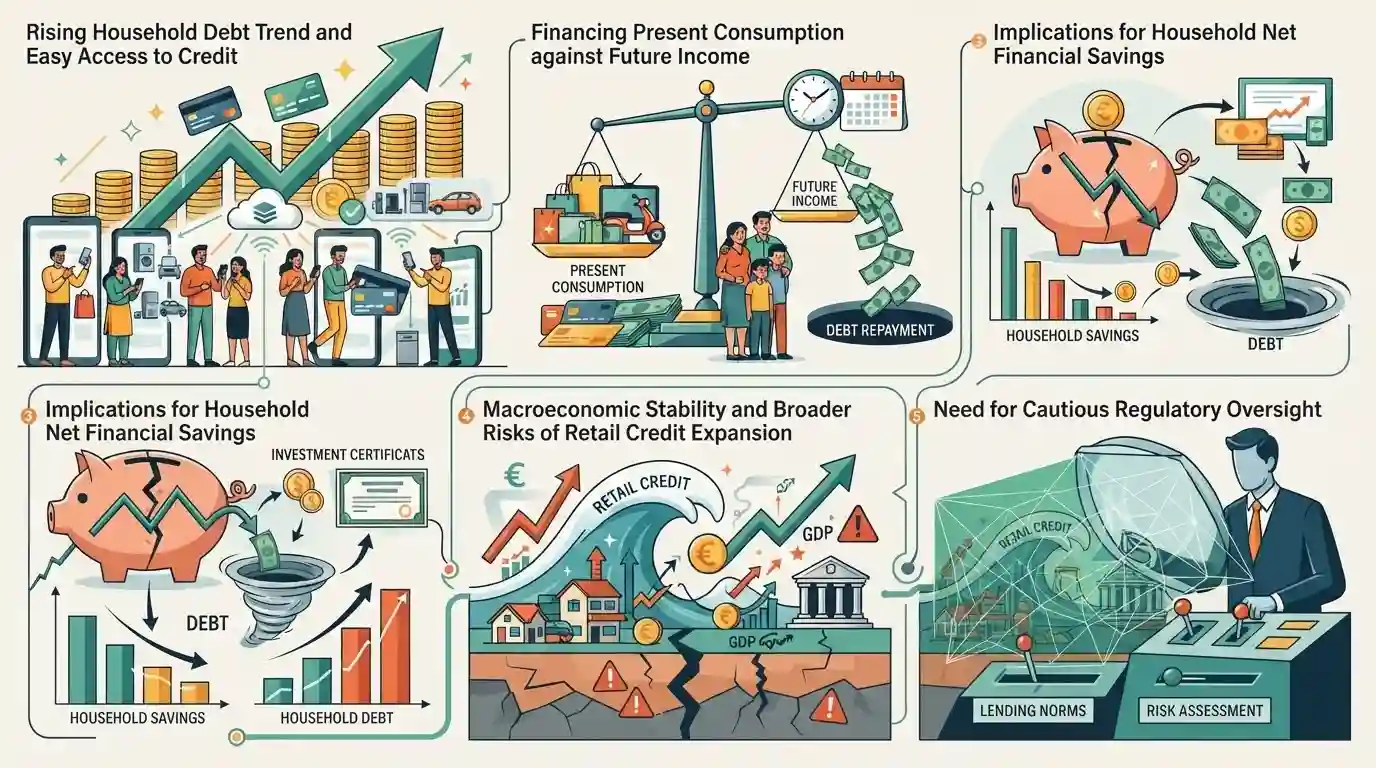
The article examines the rising trend of household debt in India, analyzing how easy access to credit has transformed consumer behavior toward financing present consumption against future income. It highlights the implications for household net financial savings, macroeconomic stability, and the broader risks of retail credit expansion, emphasizing the need for cautious regulatory oversight.
मुख्य मुद्दे
- Household debt dynamics in India reflect a shift towards financing current consumption against future earnings, altering savings and liability patterns.
- Decline in net household financial savings raises concerns about macroeconomic stability, capital formation, and long-term economic growth.
- Easy availability of digital credit and consumer loans has heightened vulnerabilities among lower and middle-income households.
- Balancing financial inclusion with robust macroprudential regulation is crucial to prevent systemic risks arising from rising household indebtedness.
महत्त्वाच्या संज्ञा
Household Debt

The total financial liabilities owed by individuals and families, including housing loans, vehicle loans, and unsecured consumer borrowings such as personal loans and credit card dues.
UPSC context
UPSC GS Paper III (Indian Economy): Tests understanding of growth, development, credit trends, and financial vulnerabilities of consumer sectors.
Net Financial Savings
The financial assets of households minus their new financial liabilities; it indicates the net surplus or savings available for productive capital formation in the economy.
UPSC context
UPSC GS Paper III (Resource Mobilization & Savings): Important for evaluating household capital generation and investment trends.
Retail Credit Expansion
The rapid surge in consumer-facing lending—such as personal loans, credit cards, and digital credit—often directed toward immediate consumption rather than long-term asset creation.
UPSC context
UPSC GS Paper III (Banking Sector & Monetary Policy): Evaluates credit growth risks, financial stability, and systemic vulnerability.
Regulatory Oversight (Risk Weights)
Capital adequacy adjustments introduced by central banks, such as raising risk weights on unsecured retail loans, to make riskier credit costlier and protect lenders from defaults.
UPSC context
UPSC GS Paper III (Banking Regulations): Essential for questions on central bank tools, macro-prudential regulations, and asset quality management.
पूर्वपरीक्षा सापळा
household sector debt climbed to 45.5% of GDP
Aspirants often assume that a rise in gross household borrowing automatically means an equal rise in household wealth, ignoring that much of this debt is funding unsecured short-term consumption rather than wealth-creating physical or financial assets.
संबंधित स्थिर संकल्पना
What are macroprudential regulations and which instruments does the RBI use to curb systemic risk?
- Systemic Focus: Macroprudential tools aim to mitigate systemic risk across the financial system, unlike microprudential tools that focus on individual institution health.
- Risk Weights: The RBI raises risk weights on specific lending segments (e.g., unsecured retail) to increase capital requirements and disincentivize excessive credit growth.
- Capital Buffers: Countercyclical capital buffers and loan-to-value (LTV) limits are classic macroprudential instruments used during credit booms.
आंतर-विषय नमुने
Household Savings + Banking Liquidity Stress
A decline in net household financial savings forces banks to rely on volatile wholesale and foreign deposits to fund corporate credit, testing monetary transmission.
Digital Credit + Financial Inclusion Trade-offs
Rapid digitalization of retail credit creates a trade-off between achieving financial inclusion targets and preventing systemic debt traps among vulnerable demographics.

RBI risk-weight hikes on unsecured retail loans + declining household financial savings = prime target for a multi-statement prelims question.
संबंधित PYQ · 3
संबंधित PYQ · 3
- 2017MainsGS3
Among several factors for India's potential growth, savings rate is the most effective one. Do you agree? What are the other factors available for growth potential?
- 2022PrelimsGS1
With reference to the Indian economy, consider the following statements: 1. A share of the household financial savings goes towards government borrowings. 2. Dated securities issued at market-related rates in auctions form a large component of internal debt. Which of the above statements is/are correct?
- 2020PrelimsGS1
In the context of the Indian economy, non-financial debt includes which of the following? 1. Housing loans owed by households 2. Amounts outstanding on credit cards 3. Treasury bills Select the correct answer using the code given below:
