US House Rebukes Executive Tariffs on Canada and Mexico
Source:Indian Express ↗
Why It Matters
Provides a contemporary, real-world case study for comparative constitution topics (checks and balances, separation of powers between executive and legislature). Additionally, it highlights the intersection of international trade agreements, protectionism, and internal security, showing how nations increasingly use economic tools like tariffs to address non-trade issues like border security and drug trafficking.
Summary
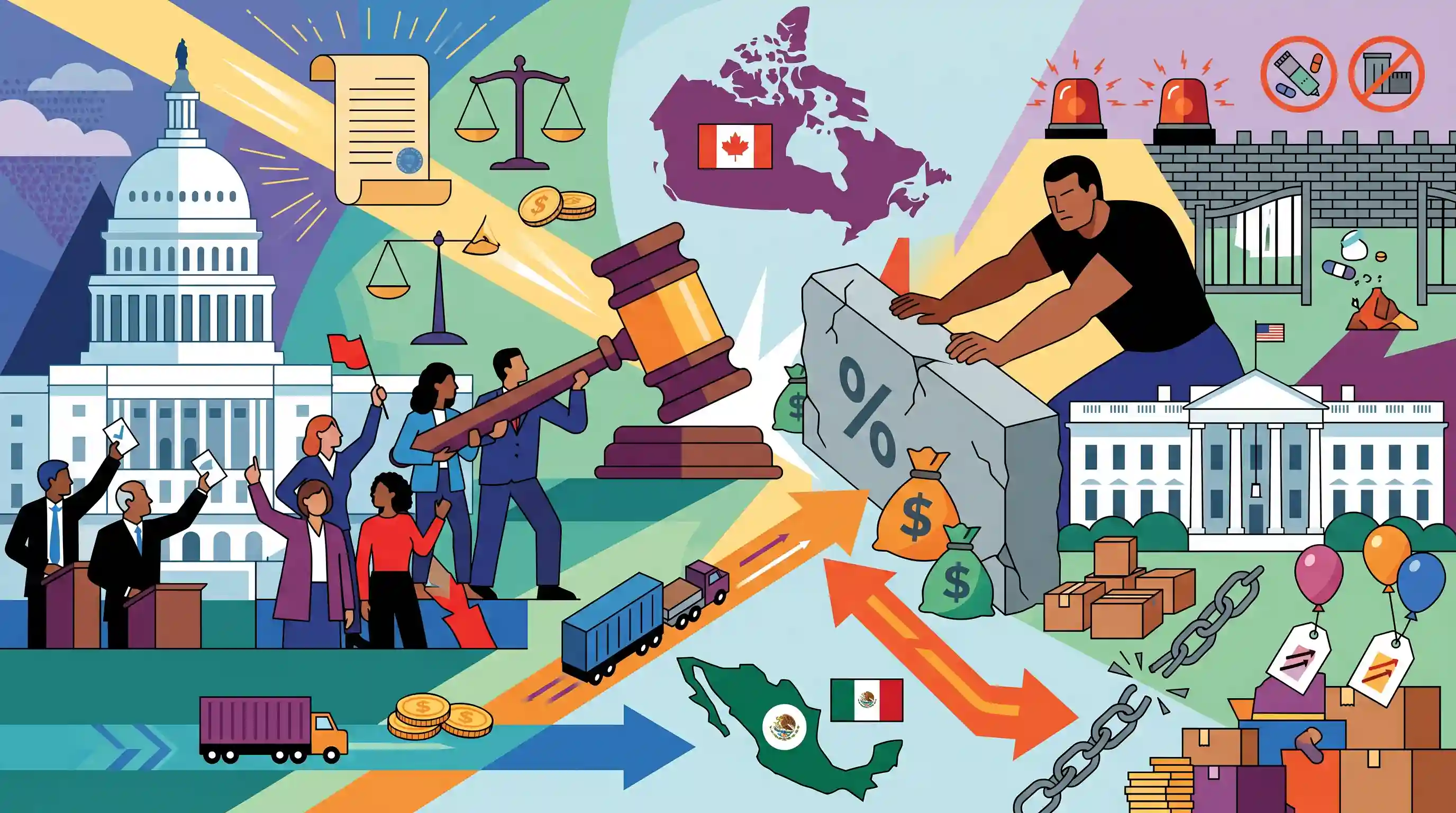
The US House of Representatives passed a rare bipartisan resolution to block President Donald Trump’s proposed 25% tariffs on Canada and Mexico, asserting Congress's constitutional authority over trade and taxation. The legislative rebuke challenges the executive branch’s attempt to bypass the US-Mexico-Canada Agreement (USMCA) by framing illicit drug flows (fentanyl) and border issues as a national emergency justifying unilateral protectionist measures. The move underscores the growing tension between executive protectionism and domestic economic concerns over inflation and disrupted supply chains, while providing a clear example of the separation of powers in the US government.
Key Points
- The US House of Representatives passed a rare bipartisan measure to block President Trump's proposed 25% tariffs on goods from Canada and Mexico.
- The vote asserts Congress's constitutional authority (Article 1) over trade and taxation, checking the executive branch's attempt to act unilaterally.
- Trump attempted to use emergency powers to impose the tariffs, citing the fentanyl drug crisis and border security as justifications outside the purview of the USMCA trade pact.
- Bipartisan opposition was driven by concerns over inflation, describing the tariffs as a tax on domestic consumers that would severely disrupt highly integrated cross-border supply chains.
- The clash illustrates the growing global trend of weaponizing trade and economic policies to achieve internal security and border control objectives.
Important Terms
US-Mexico-Canada Agreement (USMCA)

A free trade pact between the US, Mexico, and Canada that replaced NAFTA in 2020. It modernizes trade rules regarding digital commerce, labor standards, and intellectual property.
UPSC context
GS-II (International Relations). Analyzes trade blocs and the effect of developed-country policies on global economic interests.
Separation of Powers
A constitutional doctrine dividing government functions into three branches—legislative, executive, and judicial—to prevent the concentration of power and provide a system of checks and balances.
UPSC context
GS-II (Comparative Constitution). Compares the rigid US presidential system with India’s parliamentary model where executive and legislature are linked.
Protectionism
An economic policy of shielding a country's domestic industries from foreign competition by taxing imports or imposing restrictive quotas on foreign goods.
UPSC context
GS-III (Indian Economy). Relevant for evaluating trade wars, self-reliance (Atmanirbhar Bharat), and global trade dynamics.
US House of Representatives
The lower chamber of the US Congress, primarily responsible for initiating revenue-related legislation and exercising legislative oversight over executive branch spending and trade policies.
UPSC context
GS-II (Comparative Constitution). Compares legislative powers, such as the 'power of the purse,' between the Indian Lok Sabha and US House.
Tariff
A tax or duty imposed by a government on imported or exported goods, used to generate revenue or protect domestic producers from foreign competition.
UPSC context
GS-III (Economy/International Trade). Essential for understanding WTO regulations, bilateral trade disputes, and their impact on Indian exports.
International Emergency Economic Powers Act (IEEPA)
A 1977 US law granting the President broad authority to regulate international commerce and freeze assets after declaring a national emergency to address extraordinary foreign threats.
UPSC context
GS-II (Comparative Constitution). Examines the scope of executive emergency powers and legislative checks in various democratic systems.
Prelims Trap
The US President holds absolute constitutional authority to levy tariffs during national emergencies.
In the US, Article 1 of the Constitution explicitly grants trade and taxation powers to Congress, not the President. The executive relies on delegated emergency statutes, which Congress can check.
Static Concepts Connected
How does US separation of powers contrast with India?
- Strict vs Fusion: The US features a rigid separation where the executive is outside the legislature. India follows a parliamentary fusion model where the executive is drawn from Parliament.
- Commerce Clause: Article 1 of the US Constitution explicitly vests trade and taxation powers in Congress, strictly limiting unilateral presidential tariff actions without statutory backing.
What are synthetic opioids and their security implications?
- Synthetic nature: Fentanyl is an entirely lab-synthesized opioid, unlike natural plant-based opiates (heroin). It is 50-100 times stronger than morphine, making smuggling easier.
- Border weaponization: Developed nations increasingly leverage economic tools like tariffs and trade agreements to coerce neighbors into curbing transnational illicit drug flows.
Cross-Topic Patterns
Comparative constitutional checks
The US Congress using Article 1 to block executive tariffs serves as a classic GS2 comparative polity case study on rigid separation of powers versus India's parliamentary executive model.
Trade policy as border security
Linking tariffs to fentanyl flows shows how developed nations weaponize macroeconomic tools for internal security, a trend affecting global free-trade frameworks and WTO norms.

Expect GS2 Mains to test comparative 'Separation of Powers' using US executive-legislative clashes over trade and security.
Linked PYQs · 5
Linked PYQs · 5
- 2025MainsGS3
What are the challenges before the Indian economy when the world is moving away from free trade and multilateralism to protectionism and bilateralism? How can these challenges be met?
- 2018MainsGS3
How would the recent phenomena of protectionism and currency manipulations in world trade affect macroeconomic stability of India?
- 2018MainsGS3
India's proximity to two of the world's biggest illicit opium-growing states has enhanced her internal security concerns. Explain the linkages between drug trafficking and other illicit activities such as gunrunning, money laundering and human trafficking. What counter-measures should be taken to prevent the same?
- 2024MainsGS3
Explain how narco-terrorism has emerged as a serious threat across the country. Suggest suitable measures to counter narco-terrorism.
- 2020MainsGS2
Judicial Legislation is antithetical to the doctrine of separation of powers as envisaged in the Indian Constitution. In this context justify the filing of large number of public interest petitions praying for issuing guidelines to executive authorities.
