Bihar Assembly passes supplementary budget for current fiscal year
Source:timesofindia ↗
Why It Matters
Supplementary budgets illustrate mid-year adjustments to state economic planning and priorities. The success of the Jeevika scheme and its SHGs highlights the effectiveness of decentralized microcredit, poverty alleviation, and women's economic empowerment as core strategies for Bihar's growth.
Summary
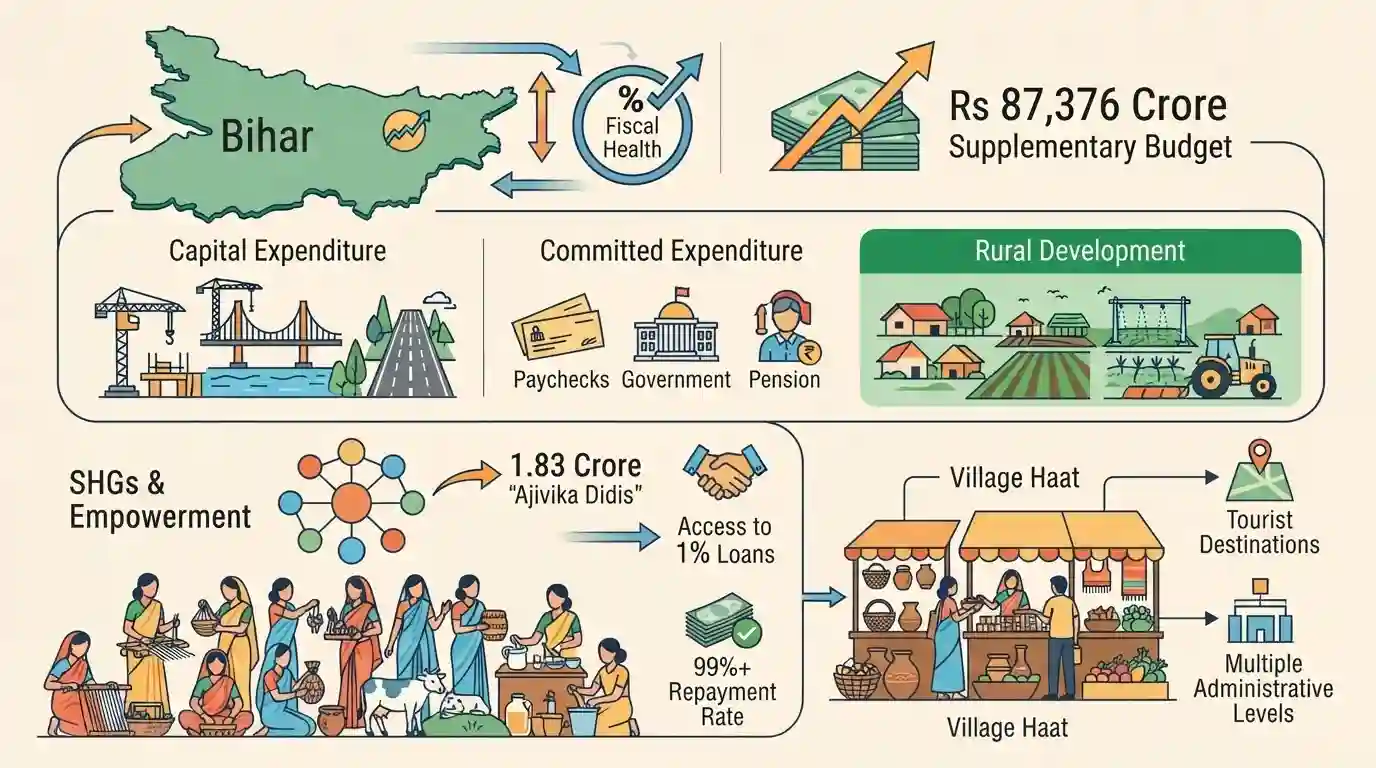
The Bihar assembly has passed a substantial supplementary budget of Rs 87,376 crore for the financial year 2026-27. Defending the state's economic health, Deputy CM and Finance Minister Bijendra Prasad Yadav dismissed allegations of a fiscal crisis. The budget earmarks Rs 25,404 crore for capital expenditure under the state plan and Rs 30,265 crore for committed expenditures like salaries and pensions. Highlighting a strong rural focus, Rs 13,682.63 crore was allocated to the Rural Development Department. The government lauded the economic contribution of 11.83 lakh Self-Help Groups (SHGs) and 1.83 crore 'Ajivika Didis' (under the Jeevika initiative), noting their access to 1% interest loans and a repayment rate exceeding 99%. Additionally, the state plans to develop 'village haats' at multiple administrative levels and tourist destinations to help market SHG products.
Key Points
- The Bihar assembly approved a Rs 87,376 crore supplementary budget for 2026-27, with the state government refuting claims of a fiscal crisis.
- Key allocations include Rs 25,404 crore for capital expenditure under the state plan head, Rs 30,265 crore for committed expenditure, and Rs 57,077 crore for project implementation.
- The Rural Development Department received Rs 13,682.63 crore, indicating a strong focus on grassroots welfare and rural infrastructure.
- Bihar's 11.83 lakh SHGs and 1.83 crore 'Ajivika Didis' are recognized as pivotal drivers of the state's Gross State Domestic Product (GSDP).
- The government supports these SHGs with bank loans at a 1% interest rate, achieving an exemplary loan repayment rate of over 99%.
- To boost rural commerce, village haats will be established across various administrative tiers and at major tourist centers like Bodh Gaya and Vaishali to market SHG products.
Important Terms
Supplementary Budget / Grants

Additional financial grants sought by the government from the legislature during a financial year when the original budget allocation proves insufficient for mandated expenditures, governed by Article 115 of the Constitution.
UPSC context
Relates to GS Paper 2 (Polity); tests understanding of legislative control over public finance, budget processes, and Article 115.
Self-Help Groups (SHGs)
Informal, voluntary associations of people—primarily women from similar socio-economic backgrounds—who pool savings to provide collateral-free microloans to members, fostering financial inclusion, employment, and social empowerment.
UPSC context
Key topic in GS Paper 2 (Social Justice/Governance), focusing on poverty alleviation, microfinance, and women's socio-economic empowerment.
JEEViKA (Bihar Rural Livelihoods Project)
A World Bank-assisted poverty alleviation initiative by the Bihar government. It focuses on the socio-economic empowerment of the rural poor by organizing women into sustainable Self-Help Groups to enhance livelihoods.
UPSC context
Excellent case study for GS Paper 2 (Governance) regarding state-level rural development, poverty eradication, and women's empowerment models.
Capital Expenditure (Capex)
Government spending allocated for acquiring, upgrading, or creating permanent physical and economic assets like infrastructure, roads, and hospitals. It generates future income and has a high multiplier effect on the economy.
UPSC context
Crucial for GS Paper 3 (Indian Economy); tests knowledge of government budgeting, fiscal policy, and drivers of long-term economic growth.
Prelims Trap
Supplementary grants indicate a declared state fiscal crisis.
Supplementary grants (Article 205 for states) are routine constitutional tools used when authorized funds fall short, not proof of a financial emergency or fiscal crisis.
Static Concepts Connected
What are the constitutional provisions for extra state expenditure?
- Supplementary Grant: Passed when the amount authorized by the Appropriation Act is insufficient for a particular service in the current year.
- Additional Grant: Granted for a new service not contemplated in the original budget for that financial year.
- Excess Grant: Requires Public Accounts Committee (PAC) approval before being voted on by the legislature, covering overspending.
How does the SHG-Bank Linkage Programme operate in India?
- NABARD's SHG-BLP: Launched by NABARD in 1992, it integrates informal women's collectives with the formal banking sector.
- DAY-NRLM Scheme: Promotes SHG federations and provides revolving funds/community investment support to alleviate rural poverty.
- Interest Subvention: Central and state schemes offer subsidized credit (like Bihar's 1% loans) conditional on prompt repayment.
Cross-Topic Patterns
SHG Micro-enterprises + Tourism Multiplier
Linking SHG 'village haats' to Buddhist circuit sites (Bodh Gaya, Vaishali) bridges rural micro-enterprises with the tourism multiplier effect, a strong model for Mains answers on women's empowerment.
State Fiscal Health + Committed Expenditure
RBI frequently flags high 'committed expenditure' (pensions, salaries) in state budgets, as seen here, which crowds out state capital expenditure and poses long-term debt sustainability risks.

Mains GS2/3 will likely ask to evaluate the 'Jeevika' SHG model as a template for rural women's economic empowerment and credit discipline.
Linked PYQs · 3
Linked PYQs · 3
- 2022BPSC_PRELIMSGS1
The fiscal deficit in Bihar during 2021-22 is estimated as
- 2016BPSC_PRELIMSGS1
'JEEVIKA' is an initiative of Bihar Govt for:
- 2025BPSC_PRELIMSGS1
According to PLFS 2023-24, which of the following statements best describe the nature of employment among women in Bihar?
