Ladakh activist Sonam Wangchuk detained during Delhi Chalo march
Source:Indian Express ↗
Why It Matters
The Ladakh protests represent a critical intersection of constitutional governance, democratic rights, and environmental sustainability. It provides a real-world case study on the demands for the Sixth Schedule outside the Northeast, the balance between Article 19 freedoms and public order, and the ecological vulnerability of the Himalayan region, making it highly relevant for GS-2 and GS-3.
Summary
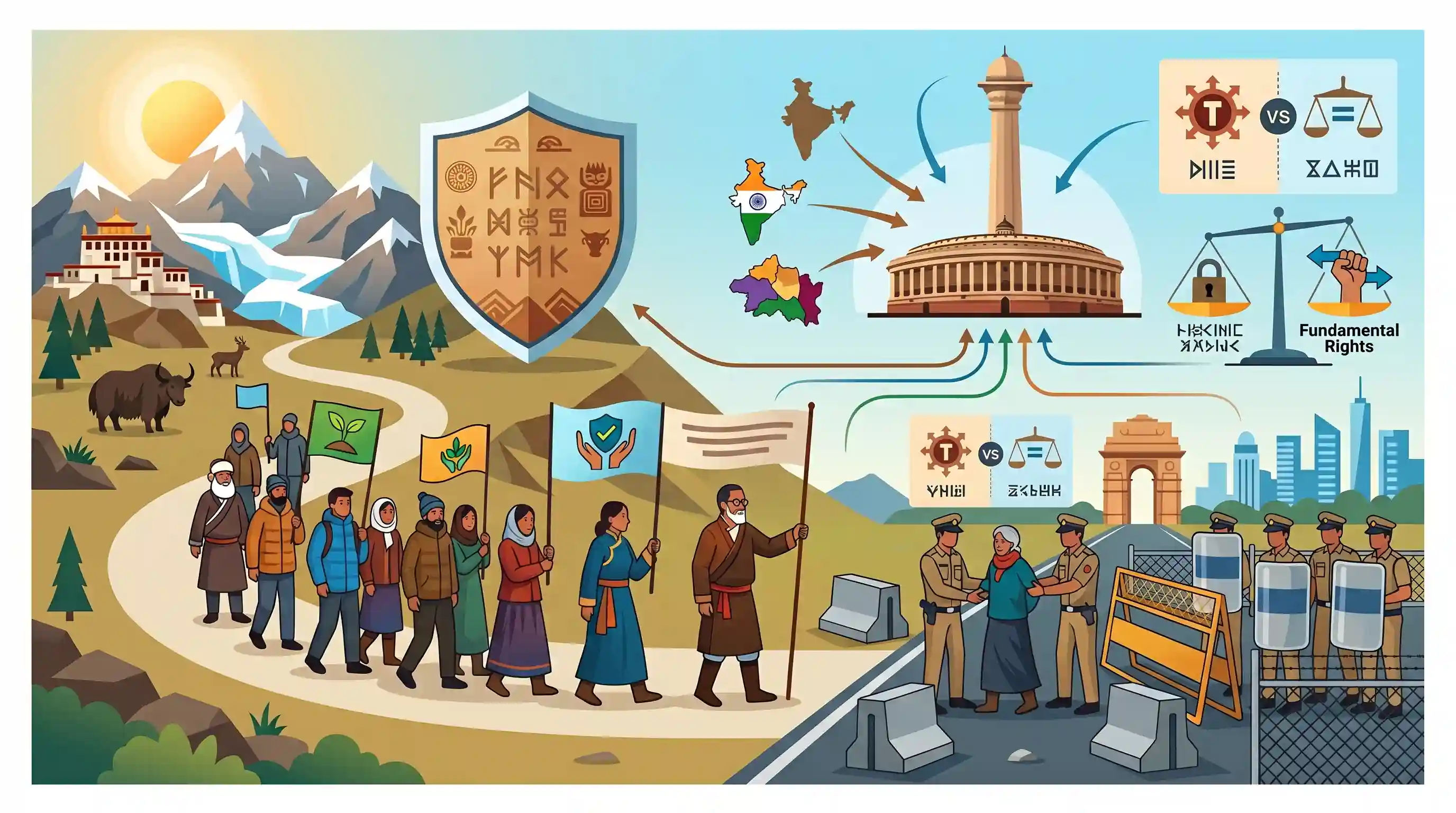
Following the detention of climate activist Sonam Wangchuk and his supporters at the Delhi border during their 'Delhi Chalo' foot march, his wife released a statement asserting their loyalty to India and the truth, while accusing the national machinery of attempting to tarnish his image. Wangchuk has been leading a peaceful march from Leh to New Delhi to demand statehood for Ladakh, its inclusion in the Sixth Schedule of the Constitution to protect its fragile ecology, and better political representation. The arrest highlights the ongoing tensions between citizens' fundamental rights to peaceful assembly and movement, and the state's use of preventive measures citing law and order, alongside the broader environmental and constitutional concerns of the Ladakh region.
Key Points
- Climate activist Sonam Wangchuk and his supporters were detained while attempting to enter Delhi after a month-long foot march from Leh.
- The march aimed to press for a four-point agenda for Ladakh: Statehood, inclusion in the Sixth Schedule of the Constitution, a dedicated Public Service Commission, and separate Lok Sabha seats for Leh and Kargil.
- Following the arrest, Wangchuk's wife defended the movement, stating they stand with 'India and truth' and alleged that the national machinery was being unleashed to malign his image.
- The detention brings into focus the tension between the fundamental rights to peaceful assembly and movement across India (Article 19) and state restrictions imposed under the guise of public order.
- The underlying cause highlights the ecological fragility of the Ladakh region and the local demand for autonomous governance (Sixth Schedule) to protect tribal land, culture, and the environment from unregulated exploitation.
Important Terms
Sixth Schedule of the Indian Constitution

Constitutional provision under Articles 244(2) and 275(1) providing autonomous governance for tribal areas in Assam, Meghalaya, Tripura, and Mizoram through Autonomous District Councils (ADCs).
UPSC context
GS Paper 2: Polity. Tests knowledge of special administrative provisions for tribal areas and federalism.
Article 19 of the Indian Constitution
A fundamental right guaranteeing six freedoms, including speech, assembly without arms, and movement throughout India, subject to 'reasonable restrictions' like public order and national security.
UPSC context
GS Paper 2: Fundamental Rights. Essential for understanding the balance between civil liberties and state authority.
Statehood
The status of a constituent political entity with its own elected legislative assembly and government, as demanded by Ladakh to end its 'Union Territory without legislature' status.
UPSC context
GS Paper 2: Federalism. Concerns the reorganization of states and democratic representation in Union Territories.
Ladakh Autonomous Hill Development Council (LAHDC)
Autonomous bodies (Leh and Kargil) established to administer Ladakh at the local level; protesters argue their powers are currently insufficient compared to Sixth Schedule ADCs.
UPSC context
GS Paper 2: Local Governance. Tests decentralized administration models in sensitive border regions.
Section 144 (CrPC/BNSS)
A legal provision (now under BNSS) allowing magistrates to issue orders to prevent urgent cases of nuisance or apprehended danger, often used to prohibit public assemblies.
UPSC context
GS Paper 2: Governance/Polity. Relevant for discussions on law and order versus fundamental rights.
Article 244
The core constitutional pillar for the administration of Scheduled Areas and Tribal Areas, where Clause (2) specifically empowers the Sixth Schedule provisions.
UPSC context
GS Paper 2: Polity. Fundamental for understanding tribal autonomy and constitutional safeguards.
Prelims Trap
"The Sixth Schedule provides constitutional safeguards to tribal areas across all Himalayan and North-Eastern states."
The Sixth Schedule specifically applies ONLY to Assam, Meghalaya, Tripura, and Mizoram (AMTM) under Article 244(2). Ladakh is currently not included, nor are other Himalayan states.
Static Concepts Connected
What are the powers of Autonomous District Councils (ADCs) under the Sixth Schedule?
- Legislative powers: Empowered to make laws regarding land, forests, shifting cultivation, village administration, and inheritance of property.
- Judicial powers: Can constitute village councils or courts to try suits and cases between parties belonging to Scheduled Tribes.
- Financial powers: Authorized to assess and collect land revenue, and impose specified taxes (e.g., on professions, trades, animals, and vehicles).
How does Article 19 balance free movement with tribal protection?
- Core Rights: Articles 19(1)(d) and (e) guarantee citizens the right to move freely throughout the territory of India and reside/settle in any part.
- Reasonable Restrictions: Under Article 19(5), the State can impose reasonable restrictions on these rights to protect the interests of any Scheduled Tribe (preventing land alienation and cultural erosion).
Cross-Topic Patterns
Eco-conservation via Sixth Schedule
Ladakh's demand uniquely merges constitutional tribal safeguards with environmental protection, seeking to use ADCs to block unregulated mining and infrastructure projects in fragile cold-desert ecosystems.
UT status and democratic deficit
Connects to the broader structural debate on UTs without legislatures (Ladakh, Lakshadweep, A&N Islands) facing democratic friction and governance protests compared to full states or UTs with legislatures.

Expect a Prelims question differentiating ADC powers in the 6th Schedule vs. TACs in the 5th Schedule, contextualized by Ladakh's demands.
Linked PYQs · 4
Linked PYQs · 4
- 2015PrelimsGS1
The provisions in Fifth Schedule and Sixth Schedule in the Constitution of India are made in order to
- 2022MainsGS2
“Right of movement and residence throughout the territory of India are freely available to the Indian citizens, but these rights are not absolute.” Comment.
- 2017MainsGS3
'Climate change' is a global problem. How India will be affected by climate change? How Himalayan and coastal states of India will be affected by climate change?
- 2019MainsGS3
Define the concept of carrying capacity of an ecosystem as relevant to an environment. Explain how understanding this concept is vital while planning for sustainable development of a region.
