National Highway Right Of Way Anti Encroachment Drive
Source:thelivenagpur ↗
Why It Matters
Highlights the interplay between judicial directives (Supreme Court) and executive enforcement (District Collectors, NHAI) in improving highway infrastructure and public safety, critical for GS Polity and Governance sections.
Summary
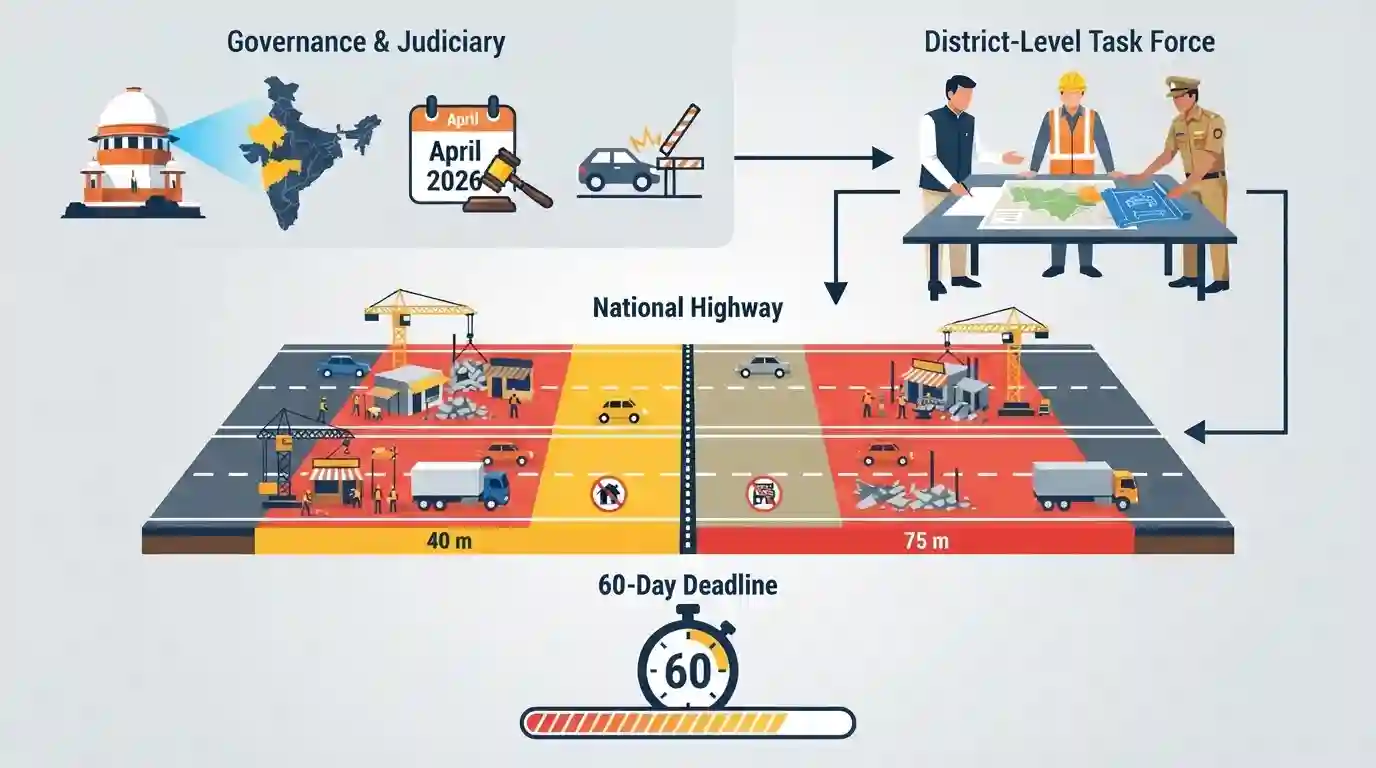
In a decisive step to enhance road safety, the Maharashtra Government announced a 60-day deadline to clear unauthorized hotels and dhabas built within the Right of Way (ROW) on National Highways. This action aligns with a Supreme Court order from April 2026, which followed a tragic accident in Rajasthan. District-level task forces led by Collectors, alongside NHAI and police, will enforce strict no-construction zones extending 40 meters for residential and 75 meters for commercial entities from the highway midpoints.
Key Points
- The Maharashtra government ordered the demolition of unauthorized structures like hotels and dhabas within the Right of Way (ROW) along National Highways.
- The move complies with an April 2026 Supreme Court directive originating from a suo motu petition over a major accident on the Bharatmala Highway in Phalodi, Rajasthan.
- Strict land-use regulations prohibit residential structures within 40 meters and commercial structures within 75 meters from the midpoint of National Highways.
- District Collectors will lead newly formed Highway Safety Task Forces—including Police, NHAI, PWD, and local bodies—to enforce this mandate within a 60-day deadline.
Important Terms
Right of Way (RoW) norms

The total width of land legally acquired and owned by highway authorities for road construction, operation, and future expansion, where unauthorized commercial or residential structures are strictly prohibited.
UPSC context
GS Paper III (Infrastructure/Roads). Tests understanding of regulatory compliance, road safety guidelines, and infrastructure land-management policies.
National Highways Authority of India (NHAI)
An autonomous agency under the Ministry of Road Transport and Highways, established by the NHAI Act, 1988, responsible for developing, maintaining, and managing India's National Highways network.
UPSC context
GS Paper II (Statutory Bodies) & GS Paper III (Infrastructure). Tests knowledge of governance bodies executing critical national infrastructure.
Public Works Department (PWD)
State-level government departments responsible for planning, constructing, and maintaining public infrastructure, including state highways, administrative buildings, and local road networks, while ensuring structural safety.
UPSC context
GS Paper II (State Government Organs). Tests understanding of decentralized administrative structures managing public goods and inter-agency coordination.
Supreme Court of India
The apex judicial body in India under Article 124 of the Constitution, functioning as the ultimate interpreter of laws and protector of fundamental rights.
UPSC context
GS Paper II (Judiciary). Tests knowledge of judicial activism, landmark directives, and fundamental rights under Article 21.
Bharatmala Pariyojana
A centrally-sponsored, massive highway development program launched in 2017 to optimize freight and passenger movement across India by developing economic corridors, border roads, and expressways.
UPSC context
GS Paper III (Infrastructure). Tests understanding of flagship connectivity schemes, economic corridors, and logistical efficiency in Indian infrastructure.
Prelims Trap
The National Highways Authority of India possesses independent executive powers to unilaterally demolish encroachments without state-level administrative or police assistance.
While NHAI owns and manages national highways, land revenue and law-and-order are state subjects, requiring NHAI to execute evictions through District Collectors and State Police.
Static Concepts Connected
What is the administrative and statutory division of power over National Highways?
- Constitutional Jurisdiction: National Highways are under Union List Entry 23, giving Parliament exclusive legislative authority over their declaration and maintenance.
- Statutory Control: The Control of National Highways (Land and Traffic) Act, 2002 empowers central Highway Administrators to prevent and remove unauthorized highway encroachments.
- Executive Execution: Physical removal of encroachments relies on state law-and-order machinery, as police and land revenue fall under the State List.
Cross-Topic Patterns
Federalism in Asset Enforcement
Shows how central entities (NHAI) depend on state-level executive machinery (District Collectors and Police) to execute central statutes on land encroachment and public safety.
Judicial Activism and Road Safety
Demonstrates the Supreme Court leveraging Article 21 (Right to Life) through suo motu petitions to drive fast-tracked executive policies on infrastructure regulation.

NHAI's statutory powers vs state executive roles in highway clearance likely to feature as a federalism-infrastructure question.
Linked PYQs · 3
Linked PYQs · 3
- 2021MPSC_PRELIMSGS1
Which of the following group of cities are connected by Golden Quadrilateral National Highway System ?
- 2022MPSC_PRELIMSGS1
Which of the following statement/s is/are applicable to the web based utility — BhoomiRashi ? (a) It was launched on 1st April, 2018. (b) It has been launched by the Ministry of Road Transport and Highways. (c) It has been introduced to fully digitize and automate the entire process of land acquisition. Answer Options :
- 2018MPSC_PRELIMSGS1
Recommendations of the Sixth Report of Second Administrative Reforms Commission on Local Government are a. Set up unified metropolitan transport authority in all cities of one million plus population. b. Constitute a local body ombudsman. c. Direct election of the Mayors. d. Set up District Councils and the Collector would work as the Chief Secretary. Answer Options :
