Uttarakhand CM Dhami discusses Delhi hotel fire arrest with Delhi CM
Source:newsarenaindia ↗
Why It Matters
This incident underscores the dynamics of inter-state administrative relations and federal cooperation when the rights of migrant populations are affected. For the UKPSC exam, understanding the welfare of Uttarakhand's large out-migrant diaspora, the legal distinction between police/judicial custody, and public safety/occupational health compliance is highly crucial.
Summary
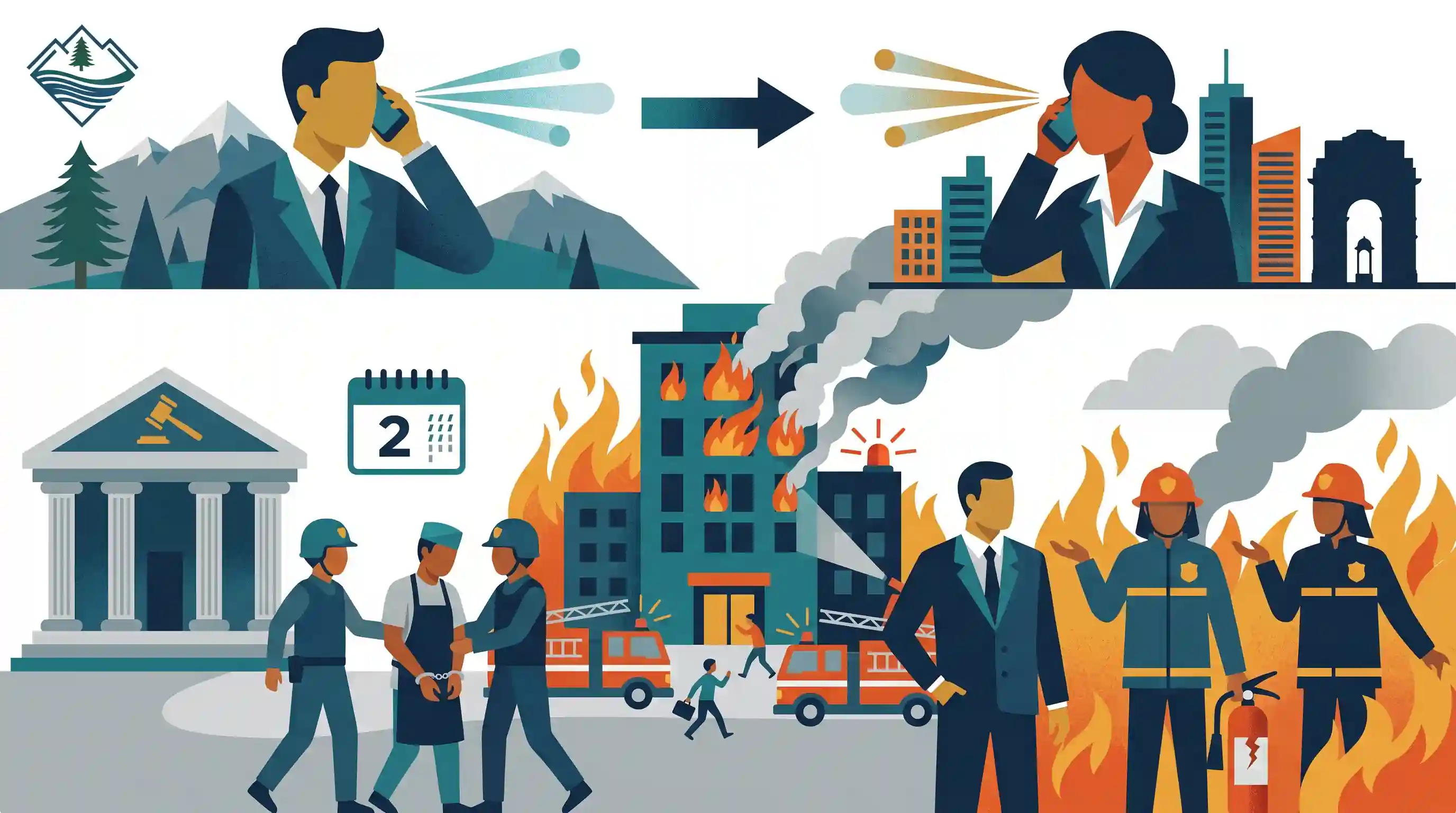
Uttarakhand Chief Minister Pushkar Singh Dhami has intervened in the arrest of Keshav Negi, a resident of Uttarakhand employed as a cook at a Malviya Nagar hotel in South Delhi where a tragic fire killed 21 people. To ensure a fair and unbiased probe, Dhami communicated with Delhi Chief Minister Rekha Gupta, who assured him that no innocent person would face injustice. Meanwhile, the Uttarakhand Congress strongly condemned Negi's arrest, claiming it was an attempt to scapegoat a low-wage worker and divert attention from the actual culprits, such as the hotel owner (Lavkesh Bajaj, who was booked under culpable homicide) and municipal fire inspectors. Negi has been remanded to two days of police custody by a Delhi court.
Key Points
- Uttarakhand CM Pushkar Singh Dhami intervened in the arrest of Keshav Negi, an Uttarakhand native employed as a cook, following a devastating hotel fire in Malviya Nagar, Delhi, that claimed 21 lives.
- Dhami communicated with Delhi CM Rekha Gupta, receiving assurances that a fair, evidence-based investigation would be conducted without injustice to innocent individuals.
- The Uttarakhand Congress, led by state president Ganesh Godiyal, condemned the arrest, arguing that a cook has no structural responsibility for fire safety and alleging that the arrest serves to shield the hotel's owner and municipal inspectors.
- The hotel owner, Lavkesh Bajaj, was booked under charges of culpable homicide not amounting to murder, while Negi was remanded to two days of police custody by a Delhi court.
- The controversy highlights the socio-political vulnerability and legal protection of the estimated 10 lakh migrants from Uttarakhand residing in Delhi.
Important Terms
Bharatiya Nyaya Sanhita

India's consolidated substantive penal code, effective from July 1, 2024. It defines criminal offences and punishments, replacing the colonial-era Indian Penal Code of 1860.
UPSC context
GS Paper II: Criminal Justice System, Polity, Governance; tests judicial reforms and statutory updates.
Bharatiya Nagarik Suraksha Sanhita
The chief procedural statute administering criminal justice in India. Effective July 1, 2024, it replaced the old Code of Criminal Procedure, modernizing police investigations and trials.
UPSC context
GS Paper II: Criminal Justice reforms; tests procedural laws and citizen rights protection.
Indian Penal Code
The colonial-era official criminal code of India enacted in 1860. It established the substantive criminal law framework until it was replaced by the Bharatiya Nyaya Sanhita.
UPSC context
GS Paper II: Legal evolution; tests colonial legal legacy and criminal law transition.
Code of Criminal Procedure
The primary procedural legislation that governed the administration of substantive criminal law in India from 1973 until its repeal and replacement by the BNSS.
UPSC context
GS Paper II: Criminal justice administration; tests historic procedural systems and modern structural shifts.
Delhi Police
The principal law enforcement agency for the National Capital Territory of Delhi, functioning uniquely under the direct administrative control of India's Ministry of Home Affairs.
UPSC context
GS Paper II: Federalism and UT administration; tests policing structures under asymmetric arrangements.
Prelims Trap
The National Building Code of India (NBC) is a mandatory central statutory law governing structural fire safety across all states.
The NBC is not a statutory central Act passed by Parliament. It is a recommendatory model code formulated by the Bureau of Indian Standards (BIS) that states must adopt via local building bye-laws.
Static Concepts Connected
Under which constitutional provisions are Fire Services regulated in India?
- Seventh Schedule: Fire Services is listed as a State Subject under the Seventh Schedule, making state governments primarily responsible for its legislative and regulatory frameworks.
- Twelfth Schedule: Entry 7 of the Twelfth Schedule (Article 243W, added by the 74th CAA, 1992) lists fire services as a function of urban local bodies.
- Recommendatory Code: The National Building Code (NBC) is published by the Bureau of Indian Standards (BIS) as a voluntary model code, requiring state adoption to become binding.
What are the core legal distinctions between Police Custody and Judicial Custody?
- Physical Lodging: The accused is physically held in a police station lock-up, whereas in judicial custody, the person is lodged in jail under the court's supervision.
- Interrogation Rights: Investigating officers can interrogate the suspect directly, whereas in judicial custody, interrogation requires specific permission from the concerned Magistrate.
- Duration Limits: Police custody is generally limited to the first 15 days of arrest under procedural law, while judicial custody can extend up to 60 or 90 days.
Cross-Topic Patterns
Federal coordination + Migrant protection
Inter-state migration creates federal coordination challenges, requiring collaborative state-level legal aid mechanisms to protect vulnerable migrants under the OSH Code, 2020.
Municipal governance + Fire safety
Frequent urban tragedies expose accountability deficits in Urban Local Bodies, showing how weak enforcement of building bye-laws undermines the 74th Constitutional Amendment's goals.

The 74th Amendment's municipal mandates vs. actual administrative capacities in public safety likely to feature as a GS-2 mains question.
Linked PYQs · 2
Linked PYQs · 2
- 2021UKPSC_PRELIMSGS1
Who among the following chairs the Zonal Council?
- 2025UKPSC_PRELIMSGS1
As on April 2025, India is not a party to which of the following international conventions / commissions ?
