US Climate Policy Rollbacks and Implications for Global Emission Norms
Source:The Hindu ↗
Why It Matters
Highlights the impact of shifting political regimes on long-term climate action and environmental regulations. It underscores the importance of the electric vehicle transition and cautions developing nations like India against weakening domestic environmental and emission standards in response to global policy rollbacks.
Summary
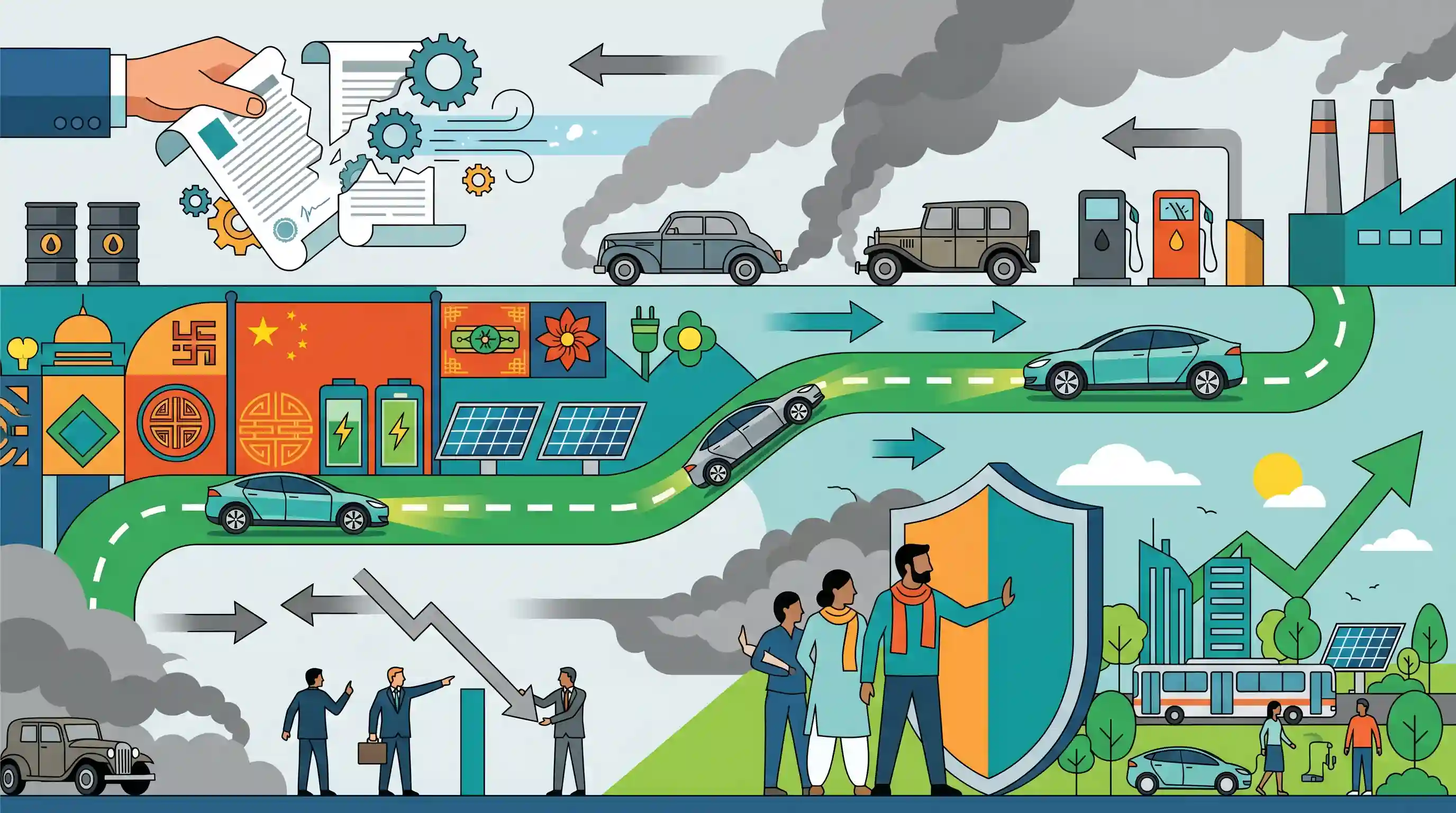
The editorial criticizes the Trump administration's decision to revoke the Environmental Protection Agency's (EPA) 'endangerment finding', a foundational regulation that enabled the control of greenhouse gas emissions from vehicles. By rolling back Obama-era fuel efficiency standards, the US aims to protect traditional auto manufacturing jobs and revive fossil-fuel consumption. However, the author argues this move is regressive and out of touch with global automotive trends, which are irreversibly pivoting towards electric vehicles (EVs)—a value chain presently dominated by China. For India, the main concern is that domestic automakers may use this US policy reversal as a pretext to lobby against stringent domestic fuel efficiency and emission norms. The piece emphasizes that India must hold firm to its own environmental and public health goals regardless of global political shifts.
Key Points
- The Trump administration has repealed the EPA's 'endangerment finding', effectively rolling back Obama-era fuel economy and greenhouse gas (GHG) emission standards for the US transportation sector.
- The original 'endangerment finding', enacted in 2009 after a 2007 US Supreme Court ruling, classified six GHGs (including CO2 and methane) as pollutants, significantly accelerating the global transition toward hybrid and battery-electric vehicles.
- The rollback is driven by an intention to revive traditional auto manufacturing jobs and boost fossil fuel demand, but ignores the reality that global auto production has already shifted towards electrification, a supply chain currently dominated by China.
- The editorial cautions that the US regulatory reversal could encourage Indian automakers to lobby against stringent domestic fuel efficiency and emission norms, urging India to strictly maintain its environmental standards.
Important Terms
Endangerment Finding

A 2009 formal determination by the US EPA that greenhouse gases threaten public health, providing the legal mandate to regulate emissions under the Clean Air Act.
UPSC context
GS III (Environment). Illustrates how administrative findings form the legal basis for climate action; relevant for comparative study of environmental law.
Environmental Protection Agency (EPA)
An independent US federal agency responsible for environmental protection and human health by writing and enforcing regulations based on laws passed by Congress.
UPSC context
GS II/III. Key for understanding global environmental governance and how major powers' domestic policies influence international climate commitments.
Massachusetts v. EPA
A landmark 2007 US Supreme Court ruling that established greenhouse gases as pollutants, compelling the EPA to regulate them if they were found to endanger health.
UPSC context
GS II (Judiciary). A significant precedent for judicial review in environmental matters; comparable to Indian judicial activism regarding the 'Right to Clean Environment'.
Electric Vehicles (EVs)
Vehicles powered by electric motors using energy stored in rechargeable batteries, seen as a cleaner alternative to internal combustion engine (ICE) vehicles.
UPSC context
GS III (Economy/S&T). Central to India's green transition, FAME schemes, and the target of achieving Net Zero emissions by 2070.
Corporate Average Fuel Efficiency (CAFE) Norms
Regulations requiring automakers to improve the average fuel economy of their vehicle fleets to reduce overall carbon dioxide emissions and fuel consumption.
UPSC context
GS III (Environment). Relevant to India's transition to stricter emission standards (BS-VI) and the balance between industrial growth and environmental protection.
Prelims Trap
"BS-VI norms in India are primarily designed to regulate fleet-wide carbon dioxide (CO2) emissions."
BS-VI norms limit toxic exhaust emissions (NOx, PM, SOx) per vehicle. CAFE norms (Energy Conservation Act) regulate fleet-wide fuel efficiency and CO2 footprint.
Static Concepts Connected
What are India's Corporate Average Fuel Economy (CAFE) norms?
- Objective: Aim to reduce the carbon footprint of the auto industry by lowering overall fuel consumption and CO2 emissions.
- Metric: Measured as a sales-weighted fleet average for an automaker, rather than applied strictly to individual vehicles.
- Nodal agency: Implemented by the Bureau of Energy Efficiency (BEE) under the Energy Conservation Act, 2001.
How are Greenhouse Gases legally classified in India versus the US?
- US approach: The EPA traditionally classified GHGs like CO2 and methane as air pollutants under the Clean Air Act via the 'endangerment finding'.
- Indian approach: CO2 is not strictly defined as an air pollutant under the Air Act 1981; emissions are managed via efficiency standards under the Energy Conservation Act.
Cross-Topic Patterns
EV Supply Chain Geopolitics
Rolling back ICE regulations contrasts with global EV transitions, highlighting Western vulnerability to China's near-monopoly on critical minerals and battery value chains.
Regulatory Spillover Risks
Environmental rollbacks in developed nations often embolden domestic industry lobbies in developing countries to push back against stringent climate commitments and decarbonization timelines.

Expect a 2026 Prelims question testing the technical difference between BS-VI (toxic emissions) and CAFE norms (CO2/fuel efficiency).
Linked PYQs · 3
Linked PYQs · 3
- 2023MainsGS3
The adoption of electric vehicles is rapidly growing worldwide. How do electric vehicles contribute to reducing carbon emissions and what are the key benefits they offer compared to traditional combustion engine vehicles?
- 2022MainsGS3
Discuss global warming and mention its effects on the global climate. Explain the control measures to bring down the level of greenhouse gases which cause global warming, in the light of the Kyoto Protocol, 1997.
- 2022MainsGS2
‘Clean energy is the order of the day.’ Describe briefly India's changing policy towards climate change in various international fora in the context of geopolitics.
