US Climate Policy Rollback Threatens Global Electric Vehicle Shift
Source:The Hindu ↗
Why It Matters
Highlights the interconnectedness of domestic environmental regulations and global manufacturing trends. For UPSC aspirants, it is essential for understanding how advanced nations\' climate policy reversals impact global EV adoption, carbon emission targets, and the geopolitical dominance of critical supply chains by countries like China.
Summary
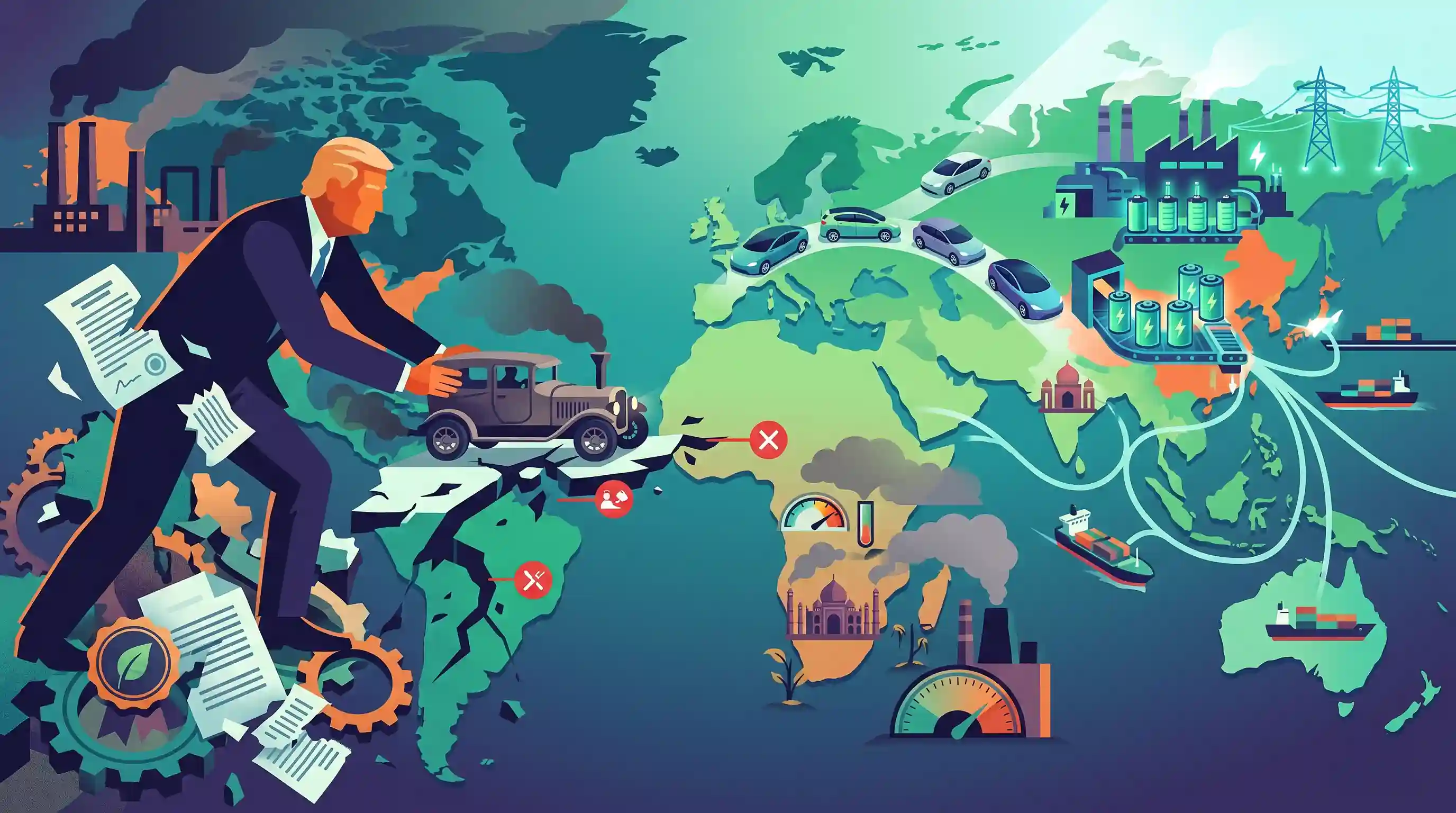
The editorial critically examines U.S. President Donald Trump\'s move to dismantle the Environmental Protection Agency\'s (EPA) \'endangerment finding,\' which regulates automobile greenhouse gas emissions. While Trump seeks to revitalize traditional car manufacturing and abandon the transition to electric vehicles (EVs), the article argues this is a geopolitical and economic misstep. The global auto industry has already committed to EVs and hybrids, an arena where China heavily dominates the supply chain. Ultimately, the reversal of U.S. climate policies will not only fail to restore American automotive dominance but also threatens to dilute critical fuel efficiency and environmental standards globally, including in countries like India.
Key Points
- U.S. President Donald Trump is working to repeal the EPA\'s \'endangerment finding,\' a core regulation stemming from a 2007 Supreme Court ruling that mandates limits on greenhouse gas emissions from transportation.
- The original EPA standards catalyzed a global automotive shift toward fuel-efficiency, hybrid engines, and electric vehicles (EVs).
- The Trump administration\'s policy aims to revive traditional internal combustion engine vehicles and domestic manufacturing, ignoring the global industry\'s irreversible shift toward EVs.
- China currently dominates the global EV supply chain and holds a significant manufacturing advantage, rendering the U.S. return to gas-guzzling vehicles economically and technologically counterproductive.
- The editorial warns that relaxed U.S. regulations could embolden automakers in developing countries like India to lobby against local fuel efficiency and environmental norms.
Important Terms
Endangerment Finding

A legal determination by the U.S. EPA that greenhouse gases threaten public health and welfare, mandating their regulation under the Clean Air Act to mitigate climate change.
UPSC context
GS Paper III (Environment); tests knowledge of international environmental law and domestic regulatory frameworks affecting global climate policy.
Massachusetts vs. EPA (2007)
A landmark U.S. Supreme Court ruling that greenhouse gases are "air pollutants" under the Clean Air Act, requiring the EPA to regulate them if they endanger public health.
UPSC context
GS Paper II (Judiciary); illustrates judicial intervention in environmental protection and its global ripple effects on carbon regulation.
Environmental Protection Agency (EPA)
The U.S. federal agency responsible for safeguarding human health and the environment by drafting and enforcing regulations based on laws like the Clean Air Act.
UPSC context
GS Paper III (Environment); relevant for comparative studies with India's CPCB and international environmental governance.
Clean Energy Transition
The global shift from fossil-fuel-based energy systems to renewable sources like solar and wind to achieve net-zero emissions and ensure sustainable energy security.
UPSC context
GS Paper III (Energy/Environment); critical for India's Panchamrit targets and global climate commitments under the Paris Agreement.
EV Supply Chain
The network of raw materials, critical minerals, and battery manufacturing processes essential for electric vehicles, currently characterized by heavy geopolitical concentration in China.
UPSC context
GS Paper III (Economy/Security); highlights geopolitical risks in energy security and the importance of critical mineral diplomacy for India.
Prelims Trap
"The EPA's endangerment finding is a U.S. commitment under the Paris Agreement."
It is a purely domestic U.S. regulatory mechanism under the Clean Air Act, triggered by a 2007 Supreme Court ruling, not an international treaty obligation.
Static Concepts Connected
How does India regulate vehicle emissions and fuel efficiency?
- BS-VI Emission Norms: Limit direct tailpipe air pollutants (NOx, PM, CO). India skipped BS-V to implement these stringent norms directly in 2020.
- CAFE Norms: Corporate Average Fuel Economy norms mandate a fleet-wide reduction in fuel consumption for automakers, thereby indirectly curbing greenhouse gas (CO2) emissions.
Why is the global EV supply chain highly concentrated?
- Mineral Processing Dominance: China controls over 70% of the global processing capacity for essential battery minerals like lithium, cobalt, and graphite.
- Vertical Integration: Chinese firms dominate the entire value chain, from upstream mining investments in Africa/South America to downstream cell and battery pack manufacturing.
Cross-Topic Patterns
Regulatory Spillover vs. Domestic Norms
Relaxed emission mandates in the US embolden automakers in India to lobby against local fuel efficiency targets, complicating India's Net Zero by 2070 goals.
Trade Protectionism and Clean Tech
Western attempts to protect legacy ICE industries often clash with the geopolitical reality of China's absolute dominance in clean-tech manufacturing and supply chains.

Expect a GS-3 Mains question linking Western protectionism in legacy auto sectors to India's EV strategy and critical mineral security.
Linked PYQs · 3
Linked PYQs · 3
- 2023MainsGS3
The adoption of electric vehicles is rapidly growing worldwide. How do electric vehicles contribute to reducing carbon emissions and what are the key benefits they offer compared to traditional combustion engine vehicles?
- 2022MainsGS3
Discuss global warming and mention its effects on the global climate. Explain the control measures to bring down the level of greenhouse gases which cause global warming, in the light of the Kyoto Protocol, 1997.
- 2024PrelimsGS1
According to the Environmental Protection Agency (EPA), which one of the following is the largest source of sulphur dioxide emissions?
