Horticulture Minister Reviews Implementation of HPSHIVA Project
Source:thestatesman ↗
Why It Matters
HPSHIVA is a flagship externally aided project in Himachal Pradesh directly impacting farmer income, crop diversification, and irrigation infrastructure. Projects funded by international bodies like ADB and state-specific agricultural schemes are high-yield topics in the HPAS Prelims exam.
Summary
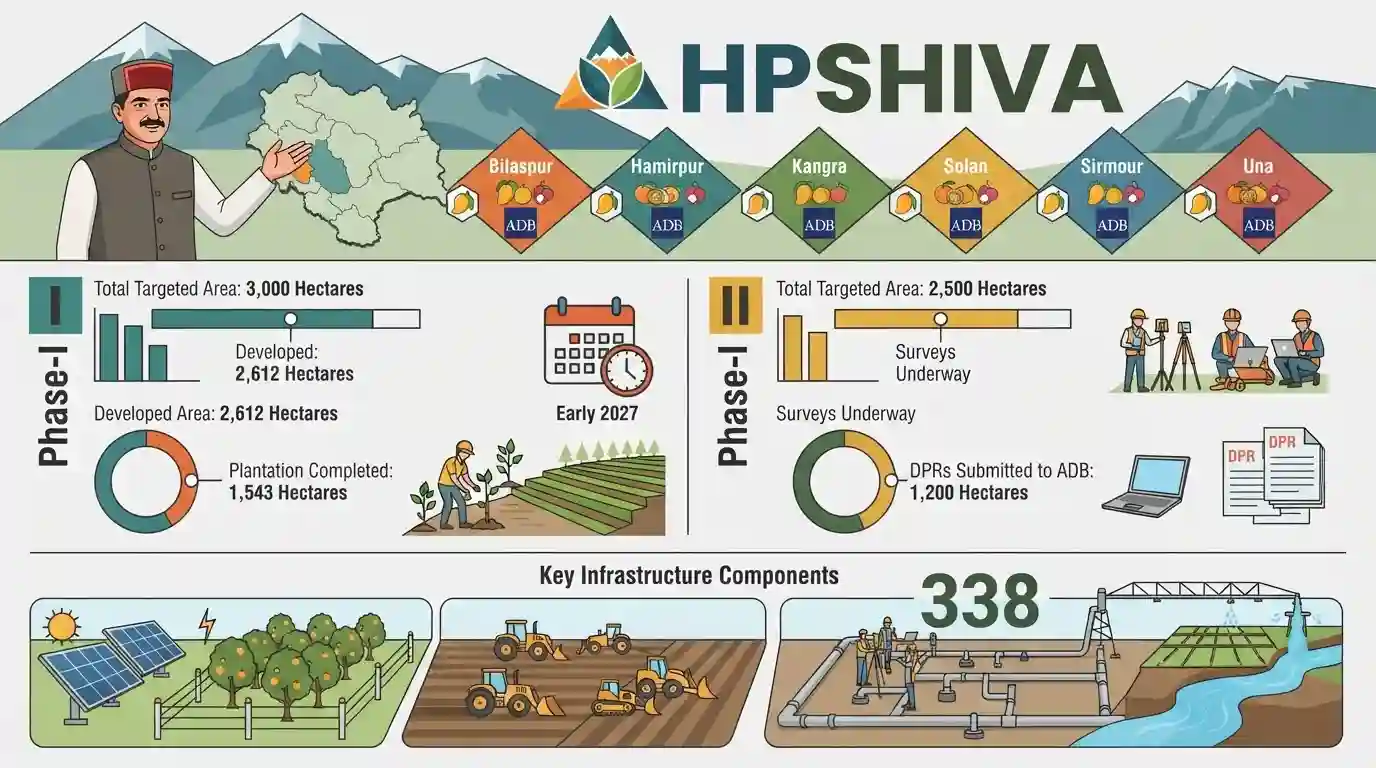
Himachal Pradesh Horticulture Minister Jagat Singh Negi reviewed the progress of the Asian Development Bank (ADB)-funded HPSHIVA project, which is being implemented across seven districts (Bilaspur, Hamirpur, Mandi, Kangra, Solan, Sirmour, and Una) to develop subtropical horticulture. In Phase-I, targeted for 3,000 hectares, 2,612 hectares have been developed and plantations have been completed on 1,543 hectares. The remaining plantation will conclude by early 2027. Under Phase-II, which targets 2,500 hectares, surveys are underway and detailed project reports (DPRs) for 1,200 hectares have been submitted to ADB. Key infrastructure projects like solar fencing, field preparation, and 338 drip and lift irrigation schemes are also part of this extensive agricultural initiative.
Key Points
- The HPSHIVA project is an Asian Development Bank (ADB)-funded initiative aimed at expanding subtropical horticulture across seven districts in Himachal Pradesh.
- Phase-I of the project targets developing 3,000 hectares of land, with 2,612 hectares already developed and plantations completed on 1,543 hectares.
- Phase-I plantation activities are scheduled to be completed by January-February 2027.
- Phase-II targets an additional 2,500 hectares, for which survey work is ongoing and Detailed Project Reports (DPRs) for 1,200 hectares have been submitted to ADB.
- The project includes extensive civil works such as solar fencing, land preparation, and the implementation of 338 drip and lift irrigation schemes.
Important Terms
HPSHIVA project

A flagship horticulture development initiative in Himachal Pradesh, jointly funded by the state government and the Asian Development Bank (ADB), to promote climate-resilient subtropical fruit cultivation, modern irrigation, and value-chain development.
UPSC context
GS Paper III: Agriculture, cropping patterns, irrigation systems, and state-level government initiatives for promoting sustainable rural livelihood.
Himachal Pradesh Subtropical Horticulture, Irrigation, and Value Addition project
The official name of the HPSHIVA project, designed to shift farmers in subtropical zones of the state from traditional crops to high-yielding, climate-resilient fruit crops supported by micro-irrigation and post-harvest infrastructure.
UPSC context
GS Paper III: Agricultural diversification, technology missions, and public-private-cooperative initiatives for enhancing farmers' income.
Asian Development Bank (ADB)
A regional development bank established in 1966, headquartered in Manila, Philippines, that provides financial and technical assistance to reduce poverty and foster sustainable economic development across Asia and the Pacific region.
UPSC context
GS Paper II: Important international financial institutions, their mandates, and impact of multilateral development funding on Indian infrastructure projects.
Project Monitoring Unit
A dedicated administrative division created within a government or externally-aided project to oversee execution, track physical/financial progress, coordinate among stakeholder departments, and handle grievance redressal.
UPSC context
GS Paper II: Governance, institutional frameworks, and mechanisms for effective implementation, monitoring, and grievance redressal of developmental projects.
Prelims Trap
"The HPSHIVA project is a Central Sector Scheme aimed at boosting temperate apple production in Himachal Pradesh."
HPSHIVA explicitly diversifies away from temperate crops (apples) to promote subtropical horticulture (citrus, guava) in low-lying districts, and is funded by the ADB, not the Centre.
Static Concepts Connected
How is voting power distributed in the Asian Development Bank (ADB)?
- Capital-based Voting: Voting rights are distributed in proportion to members' capital subscriptions, avoiding a strict one-country-one-vote system.
- Top Shareholders: Japan and the United States hold the largest shares (approx. 15% each), followed by China and India.
- Non-regional Membership: While focused on the Asia-Pacific, the ADB allows non-regional developed nations to become members and contribute capital.
What are the core components of Participatory Irrigation Management (PIM)?
- Water User Associations: Statutory or cooperative bodies formed by farmers to manage water distribution at the tertiary canal or micro-irrigation level.
- Cost Recovery: WUAs are responsible for collecting irrigation water charges to fund local operation and maintenance (O&M) of the infrastructure.
- Decentralization: Shifts the burden of micro-level water management from centralized state irrigation departments directly to local farming communities.
Cross-Topic Patterns
Horticulture & Climate Adaptation
Diversifying from temperate crops like apples to subtropical varieties acts as an adaptation strategy against declining winter chill-hours and changing microclimates in the Himalayas.
FPOs and EAP Conditionality
Multilateral lenders like ADB increasingly mandate local capacity-building structures, such as Farmer Producer Organizations (FPOs) and Water User Associations, to ensure project sustainability.

State-specific agricultural initiatives paired with multilateral funding agencies (like HPSHIVA + ADB) are prime targets for Prelims matching pairs.
Linked PYQs · 2
Linked PYQs · 2
- 2022HPAS_PRELIMSGS1
Which of the following statements about tea production in H.P. is correct ? (i) There are 5900 tea growers in the state. (ii) Total area under tea cultivation in H.P. is 2500 hectares (iii) In 2020-21 tea production in H.P. was 11.45 lakh kilograms. (iv) Small and marginal farmers are provided agriculture inputs on 50% subsidy basis.
- 2025HPAS_PRELIMSGS1
Consider the following statements : (1) Accelerated Irrigation Benefits Programme was launched in 1996-97. (2) Command Area Development Programme was taken up in 2014-15 (3) Hydrology Project was launched by Government of India with the World Bank assistance in 1974-75 (4) Pradhan Mantri Krishi Sinchayee Yojana was launched during 2015-16. Choose the correct answer from the options given below :
