Congress Demands Parliamentary Debate on China During Monsoon Session
Source:The Hindu ↗
Why It Matters
The issue perfectly illustrates the intersection of border security, economic vulnerability (trade deficit), and regional geopolitics (China-Pak nexus, US-Pak relations). For UPSC aspirants, it highlights how domestic political discourse shapes foreign policy accountability and underscores the dual-front security challenge India faces on its northern and western borders.
Summary
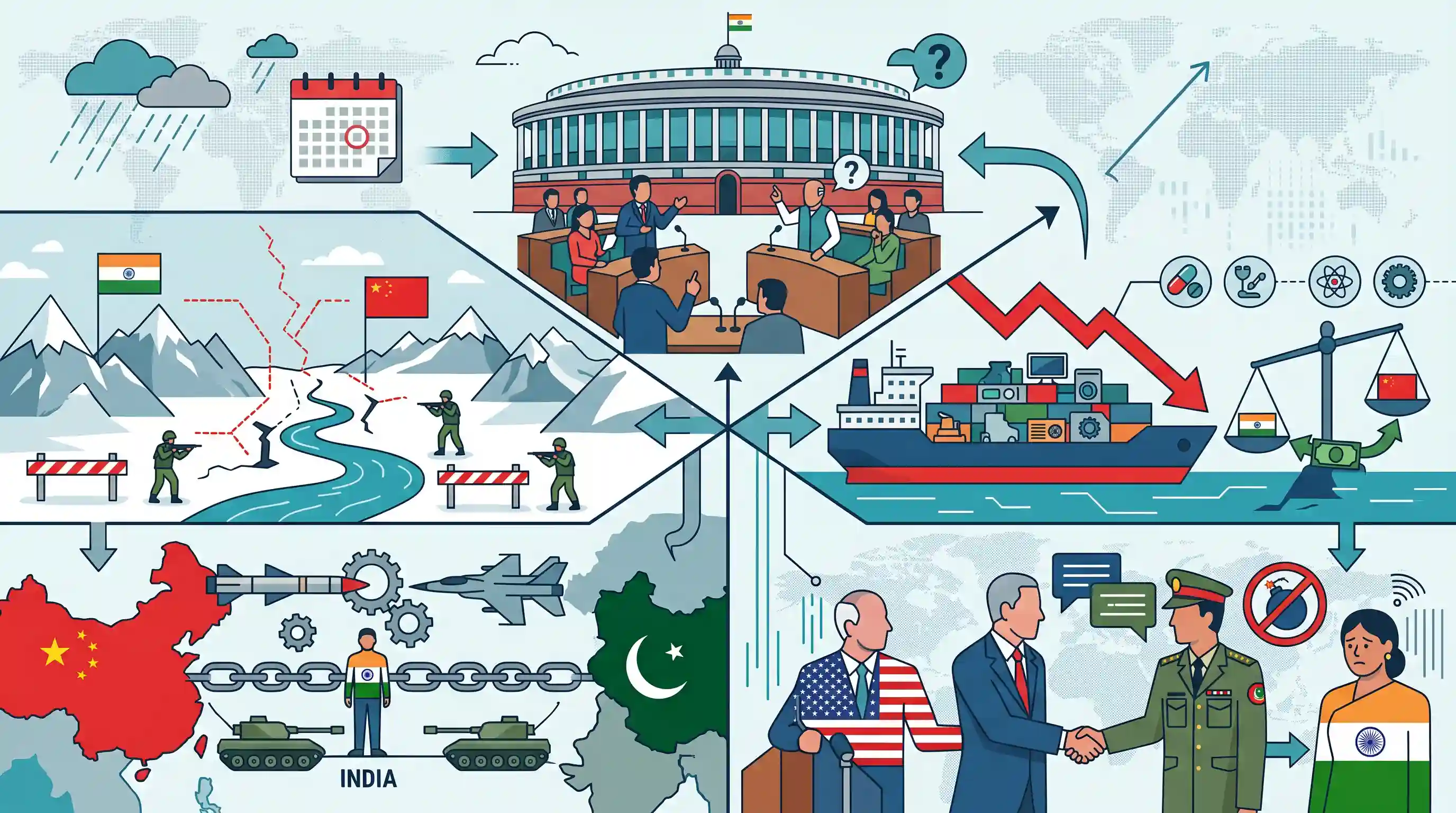
The Congress party has demanded a comprehensive parliamentary debate during the upcoming Monsoon Session concerning India's escalating challenges with China. The opposition's concerns focus on three main pillars: unresolved territorial disputes in Ladakh (including Depsang, Demchok, and Galwan), an alarming $99.2 billion trade deficit driven by heavy dependence on Chinese imports in critical sectors, and China's deepening military nexus with Pakistan. Furthermore, the Congress criticized the US administration for holding high-level diplomatic engagements with Pakistan's Army Chief, arguing that such moves undermine India's security concerns regarding cross-border terrorism.
Key Points
- The Congress party demanded a parliamentary debate in the upcoming Monsoon Session over China's territorial incursions in Ladakh and the establishment of buffer zones on Indian territory.
- The opposition highlighted India's growing economic vulnerability, citing a $99.2 billion trade deficit with China in 2024-25 and heavy import reliance in critical sectors like telecom, pharma, and electronics.
- Concerns were raised about China's deepening military ties with Pakistan, including the supply of advanced equipment like J-10C fighters and PL-15E missiles, which threaten India's security.
- The Congress also criticized US President Donald Trump for engaging diplomatically with Pakistan's Army Chief, Asim Munir, disregarding protocol while India faces ongoing terrorism from Pakistan.
Important Terms
Line of Actual Control (LAC)

The notional demarcation line (approx. 3,488 km) separating Indian-controlled territory from Chinese-controlled territory. Unlike the LoC, it is not mutually agreed, leading to differing perceptions and territorial disputes.
UPSC context
GS Paper II (IR); central to India-China border management and security dynamics.
Trade Deficit
An economic condition where the value of a country's imports exceeds its exports. India’s deficit with China reached $99.2 billion (2024-25), indicating critical dependency.
UPSC context
GS Paper III (Economy); tests knowledge of trade balance and strategic autonomy.
Parliamentary Accountability
The constitutional obligation of the Executive to be answerable to the Legislature (Article 75). Scrutiny is exercised through Question Hour, debates, and motions.
UPSC context
GS Paper II (Polity); core principle of India's parliamentary democracy.
Monsoon Session
The second of three annual parliamentary sessions, typically held between July and September. It is a critical period for legislative business and national debates.
UPSC context
GS Paper II (Polity); relates to the structure and functioning of Parliament.
Cross-border Terrorism
A security threat where territory in one country is used to launch terrorist attacks in another. It is a key pillar of India's security challenges with Pakistan.
UPSC context
GS Paper III (Internal Security); vital for understanding regional stability.
China-Pakistan Nexus
The deepening military and economic collaboration between China and Pakistan (e.g., CPEC) aimed at containing India's influence and creating a two-front security threat.
UPSC context
GS Paper II (IR); strategic challenge affecting India's neighborhood policy.
Prelims Trap
"Adjournment motions to discuss urgent security issues like border disputes can be raised in either House of Parliament."
An adjournment motion contains an element of censure against the executive. Therefore, it can only be introduced in the Lok Sabha, not the Rajya Sabha.
Static Concepts Connected
What is the North-to-South alignment of key India-China friction points in Eastern Ladakh?
- Depsang Plains: Northernmost friction point, situated near the strategic Daulat Beg Oldie (DBO) airstrip and the Karakoram Pass.
- Galwan & Gogra: The Galwan Valley lies south of Depsang, followed further south by the Hot Springs and Gogra Post areas.
- Pangong & Demchok: Pangong Tso lies south of Gogra, while Demchok is situated in the southernmost sector of the eastern Ladakh friction areas.
Which parliamentary devices allow the Opposition to force a debate on national security?
- Adjournment Motion: Requires 50 members' support to disrupt normal business. It entails an element of government censure and is restricted to the Lok Sabha.
- Short Duration Discussion: Governed by Rule 193 (LS) and Rule 176 (RS). Allows for debate on urgent public matters without involving a formal vote or censure.
- Calling Attention Motion: Introduced by a member to call a Minister's attention to an urgent matter, requesting an authoritative and official statement.
Cross-Topic Patterns
API reliance + PLI schemes
The $99.2B trade deficit with China links directly to GS3 Economy and Health. Heavy reliance on Chinese Active Pharmaceutical Ingredients (APIs) prompted India's PLI schemes to secure domestic supply chains.
Two-front war + Defense indigenization
China supplying advanced J-10C jets to Pakistan elevates the 'two-front war' threat, accelerating India's push for integrated theater commands and indigenous defense platforms like the LCA Tejas.

North-South mapping of Eastern Ladakh friction points combined with India's API/electronic import dependencies is highly probable for 2026.
Linked PYQs · 4
Linked PYQs · 4
- 2012MainsGS2
Do you think that China's emergence as one of the largest trading partners of India has adversely affected the settlement of the outstanding border problem?
- 2024MainsGS2
‘The West is fostering India as an alternative to reduce dependence on China's supply chain and as a strategic ally to counter China's political and economic dominance.’ Explain this statement with examples.
- 2024MainsGS3
India has a long and troubled border with China and Pakistan fraught with contentious issues. Examine the conflicting issues and security challenges along the border. Also give out the development being undertaken in these areas under the Border Area Development Programme (BADP) and Border Infrastructure and Management (BIM) Scheme.
- 2015MainsGS2
Terrorist activities and mutual distrust have clouded India-Pakistan relations. To what extent the use of soft power like sports and cultural exchanges could help generate goodwill between the two countries? Discuss with suitable examples.
