External Affairs Minister Discusses India EU Trade Pact in Germany
Source:The Hindu ↗
Why It Matters
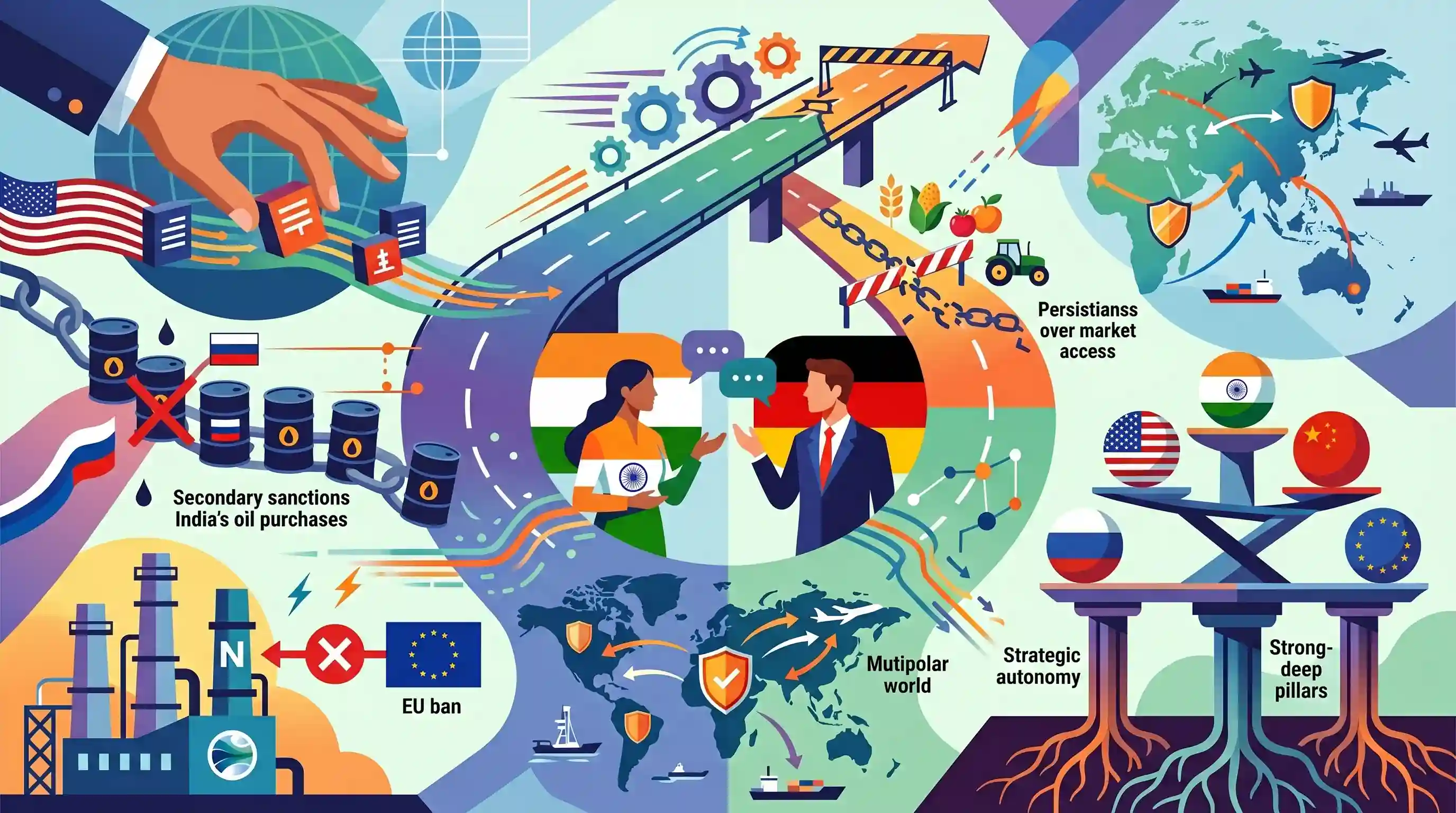
The article touches upon the intersection of economic diplomacy and strategic autonomy. It highlights the complexities of negotiating the India-EU FTA amidst protectionist trends, and illustrates the practical impact of secondary sanctions on India's energy security (e.g., Nayara Energy). This serves as a vital case study for GS2 IR questions on India-Europe ties, navigating global sanctions, and managing a multipolar foreign policy.
Summary
External Affairs Minister S. Jaishankar and his German counterpart Johann Wadephul held bilateral talks focusing on expediting the India-EU Free Trade Agreement (FTA), though disagreements over agricultural market access persist. The discussions covered complex geopolitical challenges, including impending US tariffs, Western secondary sanctions affecting India's purchase of Russian oil, and the EU's recent ban on Nayara Energy. The leaders also underscored the importance of ensuring Indo-Pacific security and fostering a multipolar world order based on strategic autonomy.
Key Points
- External Affairs Minister S. Jaishankar and Germany's new Foreign Minister Johann Wadephul discussed fast-tracking the India-EU Free Trade Agreement (FTA), which remains delayed over agricultural market access issues.
- Both ministers acknowledged navigating the "twin challenges" of economic volatility and political uncertainty, particularly amid fears of impending US tariffs.
- Addressing concerns over US secondary sanctions on Russian oil, Jaishankar defended India's stance based on energy security needs, noting that Western nations originally drove the sanctions regime.
- The EU's recent trade ban on Nayara Energy—a firm co-owned by Russia's Rosneft that operates a major refinery in Gujarat—adds friction to bilateral trade relations.
- The dialogue reaffirmed mutual commitment to Indo-Pacific security, countering regional aggression, and promoting a multipolar global order rooted in strategic autonomy.
Important Terms
India-EU Free Trade Agreement (FTA)

A comprehensive economic pact between India and the 27-member EU bloc, concluded in January 2026, aimed at eliminating tariffs on over 99% of Indian exports.
UPSC context
GS Paper II (International Relations) and III (Economy); tests bilateral trade, supply chain resilience, and economic diplomacy.
Broad-based Trade and Investment Agreement (BTIA)
The original framework for trade negotiations between India and the EU started in 2007; it stalled in 2013 over disagreements before re-launching in 2022.
UPSC context
GS Paper II; understanding the historical friction in India-EU trade relations, including data localization and professional visa issues.
Nayara Energy
An Indian oil refiner (Vadinar) majority-owned by Rosneft and Kesani Enterprises; became the first Indian firm hit by EU sanctions in July 2025.
UPSC context
GS Paper III (Energy Security); illustrates the impact of global sanctions on Indian corporate and energy interests.
Rosneft
Russia's state-integrated energy giant; its 49.13% stake in Nayara Energy triggered EU restrictive measures to curb Russian global oil revenues.
UPSC context
GS Paper II; critical for topics on Russia-India energy ties and the geopolitical use of energy as a strategic tool.
Secondary Sanctions
Economic penalties imposed by a country on third parties (like Indian banks/refiners) for doing business with a primary sanctioned target (like Russia).
UPSC context
GS Paper II; tests understanding of extra-territorial laws and their effect on India's sovereign foreign policy and energy imports.
Strategic Autonomy
India's foreign policy principle of making independent decisions without being constrained by foreign powers or formal military alliances.
UPSC context
GS Paper II; a core pillar of Indian diplomacy, frequently tested in the context of balancing ties between the West and Russia.
Prelims Trap
"US and EU secondary sanctions on Russian entities are legally binding on Indian refiners under international law."
India legally recognizes only UN Security Council sanctions, not unilateral or secondary sanctions imposed by individual nations or blocs. Extraterritorial application of domestic laws violates international law principles.
Static Concepts Connected
What are the key bottlenecks in the India-EU Broad-based Trade and Investment Agreement (BTIA)?
- Market Access: Disagreements persist over India's high tariffs on European automobiles, wines, and dairy, while India demands easier movement of professionals (Mode 4 services access).
- Non-Tariff Barriers: The EU heavily pushes for stringent labor standards, environmental sustainability clauses, and intellectual property rights (TRIPS-plus), which India resists as non-trade issues.
How do secondary sanctions differ from primary sanctions in international relations?
- Primary Sanctions: Direct embargoes where the sanctioning state (e.g., the US) strictly forbids its own citizens and domestic companies from doing business with the targeted country.
- Secondary Sanctions: Extraterritorial measures punishing third-party nations or entities for trading with the target, often by denying them access to the sanctioning state's financial system (like SWIFT/US Dollar).
Cross-Topic Patterns
EU FTA vs CBAM and Non-Tariff Barriers
The India-EU FTA negotiations face major headwinds from the EU's Carbon Border Adjustment Mechanism (CBAM) and deforestation laws, which India classifies as disguised protectionism and non-tariff barriers at the WTO.
Strategic Autonomy vs Geoeconomic Coercion
India’s refusal to halt Russian oil imports, despite Western secondary sanctions targeting firms like Nayara Energy, perfectly illustrates 'Strategic Autonomy' balancing domestic energy security against deep Western strategic partnerships.

Extraterritorial secondary sanctions and the India-EU BTIA's structural bottlenecks are prime targets for a multi-statement Prelims Q in 2026.
Linked PYQs · 3
Linked PYQs · 3
- 2017PrelimsGS1
'Broad-based Trade and Investment Agreement (BTIA)' is sometimes seen in the news in the context of negotiations held between India and
- 2023MainsGS2
‘The expansion and strengthening of NATO and a stronger US-Europe strategic partnership works well for India.’ What is your opinion about this statement ? Give reasons and examples to support your answer.
- 2025MainsGS2
"Energy security constitutes the dominant kingpin of India's foreign policy, and is linked with India's overarching influence in Middle Eastern countries.” How would you integrate energy security with India's foreign policy trajectories in the coming years?
