Geopolitical shifts undermine multilateral global climate governance
Source:The Hindu ↗
Why It Matters
Understanding the geopolitical dimensions of climate change is crucial for UPSC aspirants, as questions frequently explore the intersection of international relations, domestic politics of developed countries, and their cascading impact on India's environmental goals and global multilateralism.
Summary
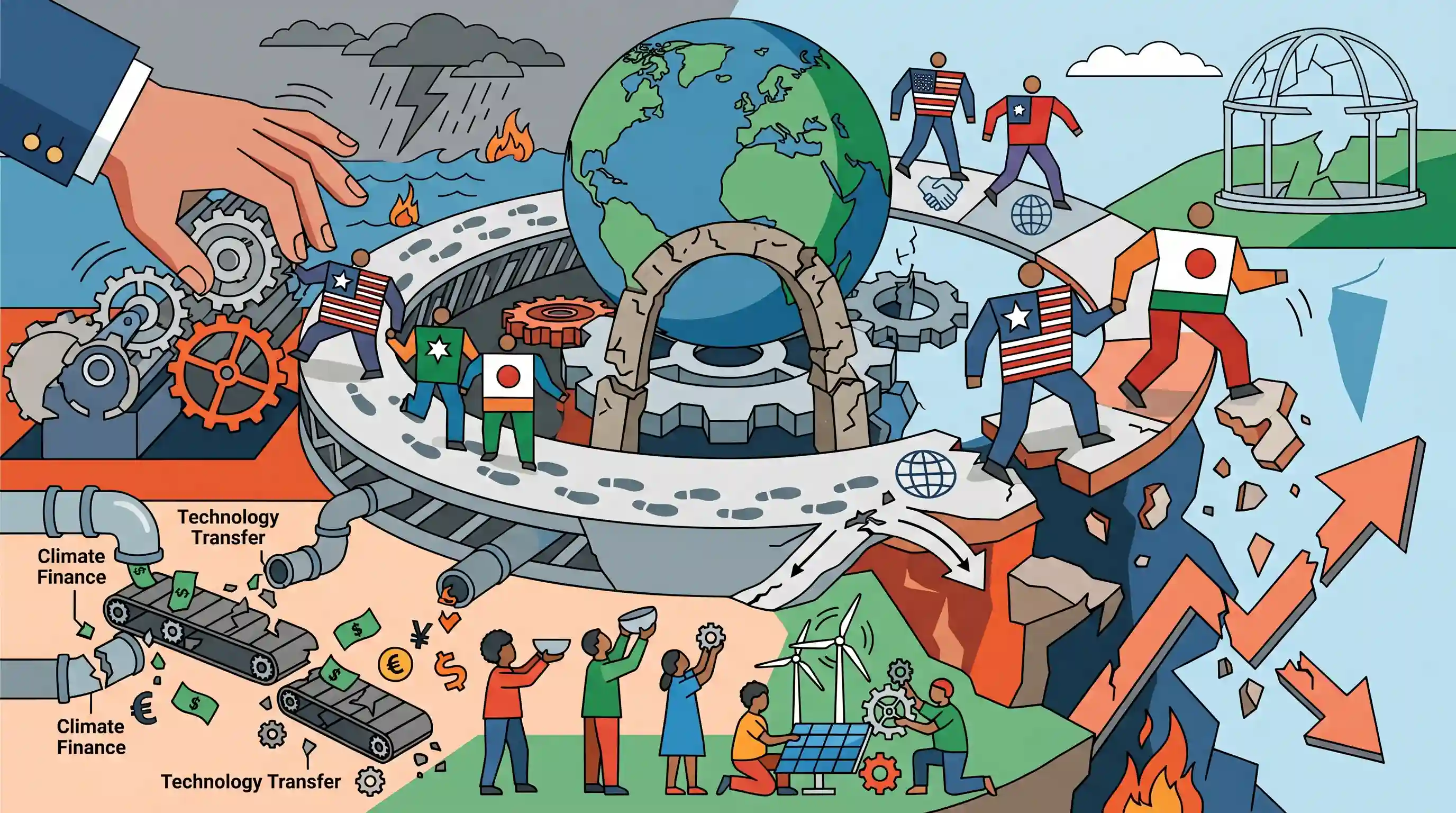
The article critiques the transient and inconsistent nature of global climate governance, describing it as a 'hop-on, hop-off' system where major nations periodically withdraw from or weaken their commitments to multilateral climate treaties (such as the Paris Agreement) due to shifting domestic political landscapes. This volatility destabilizes international climate action, undermines the UNFCCC framework, and poses severe challenges for developing nations that rely on consistent climate finance and technological support to meet their climate goals. The author highlights the need for resilient global frameworks that can withstand the erratic participation of individual nation-states.
Key Points
- Global climate governance suffers from severe policy whiplash, heavily influenced by the domestic electoral cycles and political shifts in major economies.
- The 'hop-on, hop-off' approach—where key powers withdraw from or dilute commitments to multilateral environmental treaties—undermines the credibility and efficacy of frameworks like the Paris Agreement.
- Inconsistent geopolitical commitments directly threaten the predictability of climate finance, technology transfer, and capacity-building mechanisms essential for developing nations.
- There is an escalating tension between short-term sovereign interests and long-term global environmental responsibilities, demanding more resilient and decentralized climate action frameworks.
Important Terms
UNFCCC

A 1992 international treaty aimed at stabilizing greenhouse gas concentrations to prevent dangerous human interference with the climate system. It serves as the parent framework for the Kyoto Protocol and Paris Agreement.
UPSC context
GS III (Environment); GS II (International Relations). Tests knowledge of global governance structures and multilateral environmental negotiations.
Paris Agreement
A legally binding 2015 international treaty with a goal to limit global warming to well below 2°C, preferably 1.5°C, compared to pre-industrial levels.
UPSC context
GS III (Environment). Essential for questions on climate change mitigation, adaptation, and the shift from top-down to bottom-up global climate action.
Nationally Determined Contributions (NDCs)
The core of the Paris Agreement, these are individual climate action plans submitted by countries to outline their targets for reducing emissions and adapting to climate impacts.
UPSC context
GS III (Environment/Conservation). Tests understanding of national commitments and the 'ratchet mechanism' for increasing climate ambition over time.
Kyoto Protocol
A 1997 treaty that operationalized the UNFCCC by committing industrialized countries and economies in transition to limit and reduce greenhouse gas emissions according to agreed individual targets.
UPSC context
GS III (Environment). Often tested in comparison with the Paris Agreement regarding legal bindingness and the responsibilities of developed versus developing nations.
Climate Finance
Financial resources—drawn from public, private, and alternative sources—intended to support climate mitigation and adaptation actions in developing countries, often recognizing historical emission responsibilities.
UPSC context
GS III (Environment/Economics). A critical topic for issues of global equity, North-South cooperation, and the feasibility of achieving net-zero targets.
Common But Differentiated Responsibilities (CBDR)
A principle within the UNFCCC acknowledging that while all states are responsible for addressing climate change, they have different capabilities and historical responsibilities for emissions.
UPSC context
GS II (International Relations); GS III (Environment). Central to discussions on climate justice and the geopolitical tensions in multilateral climate negotiations.
Prelims Trap
The Paris Agreement imposes binding economic penalties on nations that fail to meet their NDCs.
While the Paris Agreement is a legally binding treaty, the specific NDC targets are not legally binding, and there are no punitive economic sanctions for missing targets or withdrawing.
Static Concepts Connected
What are the mechanisms under Article 6 of the Paris Agreement?
- Carbon markets: It enables countries to voluntarily cooperate to achieve emission reduction targets set out in their NDCs.
- Bilateral trading (6.2): Allows bilateral trading of Internationally Transferred Mitigation Outcomes (ITMOs) between two nations to meet their respective targets.
- Centralized mechanism (6.4): Establishes a centralized global carbon credit market overseen by a UN supervisory body.
How does the CBDR-RC principle shape global climate agreements?
- Origin & Shared Duty: Formalized at the 1992 Earth Summit, it acknowledges that all states share an obligation to address environmental destruction.
- Historical Equity: Places a proportionally greater mitigation and financing burden on developed nations due to their historical emissions and superior technical capacities.
Cross-Topic Patterns
Climate Finance vs Sovereign Debt
Predictable climate finance failures push Global South nations into sovereign debt traps, linking UNFCCC governance directly to Bretton Woods reform debates like the Bridgetown Initiative.
Domestic Politics vs Treaty Law
The 'hop-on, hop-off' dynamic highlights the tension in international law between executive agreements (which can be reversed easily by a new administration) and formally ratified treaties.

Expect a multi-statement question interlinking Article 6 carbon markets, the legal status of NDCs, and the CBDR-RC principle in 2026.
Linked PYQs · 5
Linked PYQs · 5
- 2025MainsGS3
Write a review on India's climate commitments under the Paris Agreement (2015) and mention how these have been further strengthened in COP26 (2021). In this direction, how has the first Nationally Determined Contribution intended by India been updated in 2022?
- 2022MainsGS2
‘Clean energy is the order of the day.’ Describe briefly India's changing policy towards climate change in various international fora in the context of geopolitics.
- 2022MainsGS3
Discuss global warming and mention its effects on the global climate. Explain the control measures to bring down the level of greenhouse gases which cause global warming, in the light of the Kyoto Protocol, 1997.
- 2025PrelimsGS1
Consider the following statements : Statement I: Article 6 of the Paris Agreement on climate change is frequently discussed in global discussions on sustainable development and climate change. Statement II: Article 6 of the Paris Agreement on climate change sets out the principles of carbon markets. Statement III : Article 6 of the Paris Agreement on climate change intends to promote inter-country non-market strategies to reach their climate targets. Which one of the following is correct in respect of the above statements?
- 2019MainsGS2
‘Too little cash, too much politics, leaves UNESCO fighting for life.’ Discuss the statement in the light of US' withdrawal and its accusation of the cultural body as being 'anti-Israel bias'.
