Hooghly Dairy Unit Penalized by Pollution Control Board for Violations
Source:theplurals ↗
Why It Matters
Provides a practical example of the enforcement mechanisms of the Water Act (1974) and EPA (1986), highlighting concepts like BOD and TSS in environmental compliance and industrial pollution control.
Summary
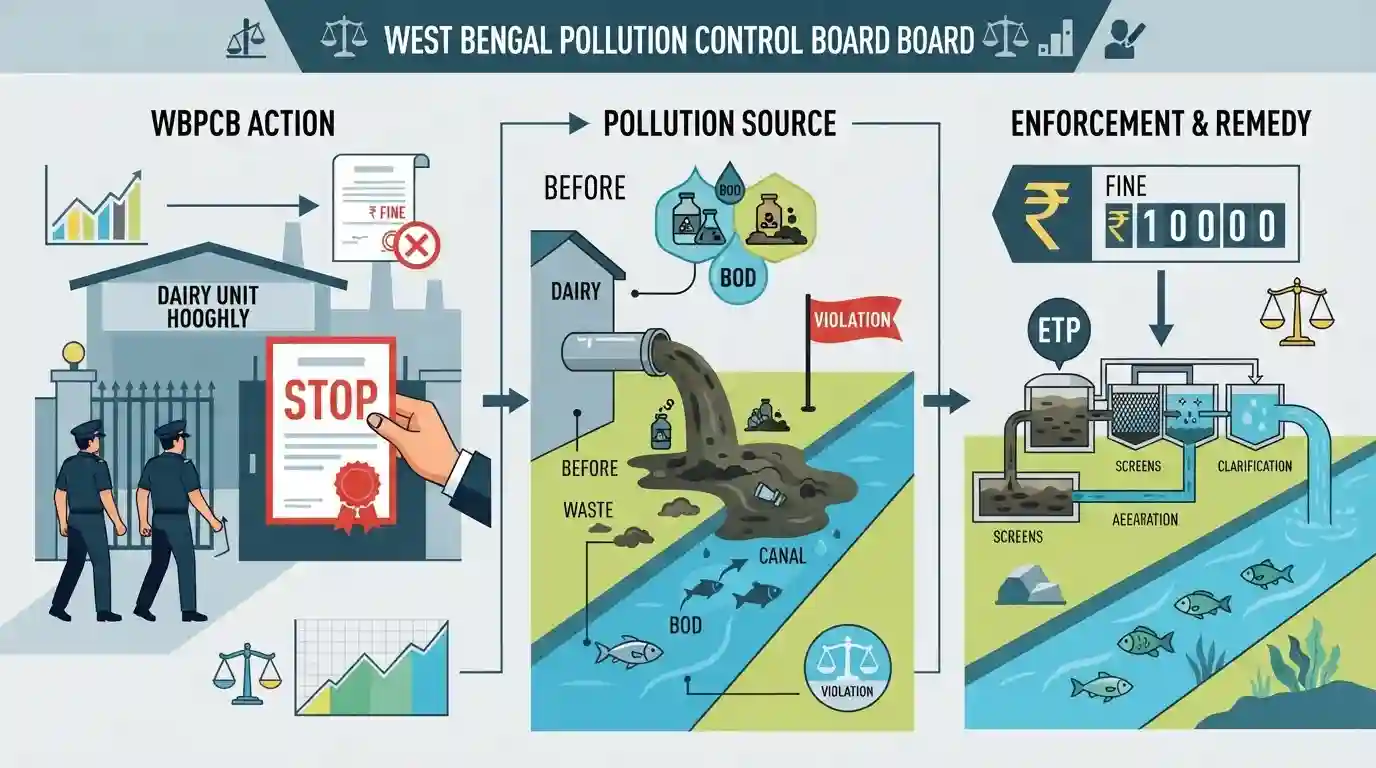
The WBPCB penalized a dairy unit in Hooghly with a Rs 3.5 lakh fine and a conditional closure notice for discharging heavily polluted, untreated wastewater into a local canal, violating the Water Act and Environment Protection Act.
Key Points
- Starmilk Products (P) Ltd in Hooghly bypassed its Effluent Treatment Plant (ETP), discharging highly polluted wastewater into the Akambari Canal.
- The West Bengal Pollution Control Board (WBPCB) issued a closure order and imposed an environmental compensation penalty of Rs 3.5 lakh.
- The untreated effluent exhibited Biochemical Oxygen Demand (BOD) and Total Suspended Solids (TSS) levels drastically exceeding permissible limits.
- The closure has been conditionally suspended to allow the unit to run a new ETP and establish a zero liquid discharge system, following a complaint under the Water Act (1974) and Environment Protection Act (1986).
Important Terms
Water (Prevention and Control of Pollution) Act, 1974

An Indian law enacted to prevent and control water pollution by regulating pollutant discharge, establishing water quality standards, and creating the Central and State Pollution Control Boards.
UPSC context
Crucial for WBCS Mains Paper IV (Environment), testing statutory frameworks for pollution control and the regulatory powers of SPCBs.
Environment (Protection) Act, 1986
A comprehensive umbrella legislation enacted to protect and improve environmental quality. It empowers the Central Government to establish emission standards, regulate hazardous substances, and enforce pollution control measures.
UPSC context
Highly important for WBCS Paper IV (Environment) as India's core environmental law, frequently tested on its statutory provisions.
West Bengal Pollution Control Board (WBPCB)
A statutory authority in West Bengal responsible for implementing environmental laws. It regulates industrial operations, monitors pollution levels, issues closure notices, and levies fines to ensure compliance.
UPSC context
Vital for WBCS Mains (Environment and State Governance), focusing on state-level enforcement of environmental regulations and administrative actions.
Paribesh Academy
A Chandannagar-based environmental non-profit organization that actively monitors local ecological issues, raises public complaints, and engages with authorities like the WBPCB to hold polluting industries accountable.
UPSC context
Relevant for WBCS current affairs and Paper IV as a practical example of civil society's role in environmental governance.
Prelims Trap
The WBPCB is a statutory body established under the Environment (Protection) Act, 1986.
Pollution Control Boards (Central and State) were established under the Water Act, 1974, not the later Environment (Protection) Act, 1986, though they enforce both.
Static Concepts Connected
What is the statutory framework of the State Pollution Control Boards (SPCBs)?
- Origin: Constituted under the Water (Prevention and Control of Pollution) Act, 1974 to regulate water pollution.
- Expanded Powers: Later entrusted with enforcement functions under the Air (Prevention and Control of Pollution) Act, 1981.
- EPA 1986 Role: Acts as the nodal agency at the state level to enforce rules under the umbrella Environment (Protection) Act, 1986.
What is Biochemical Oxygen Demand (BOD) and its environmental significance?
- Definition: The amount of dissolved oxygen needed by aerobic microorganisms to break down organic material in a given water sample.
- Pollution Indicator: A high BOD indicates high levels of organic pollution (like dairy effluent or sewage), leading to oxygen depletion for aquatic life.
- Treatment Target: Standard effluent treatment plants (ETPs) are primarily designed to reduce BOD and Total Suspended Solids (TSS) before discharge.
Cross-Topic Patterns
ZLD mandates in Agro-industries
The push for Zero Liquid Discharge connects the industrial economy with aquatic ecology. WBCS often tests the environmental footprint of agro-processing units (sugar, dairy, paper) alongside local river pollution.
Canal systems of lower Bengal
Local canals like Akambari feed into the larger Hooghly basin. Geography questions on Bengal's drainage systems frequently test tributaries and distributaries affected by industrial hubs.

Expect a multi-statement question contrasting the origin of SPCBs under the Water Act (1974) with their powers under the EPA (1986).
Linked PYQs · 2
Linked PYQs · 2
- 2020WBCS_PRELIMSGS1
Excess fluoride in drinking water causes
- 2019WBCS_PRELIMSGS1
Noise pollution is created if noise is in excess to
