High Court Discharges Hooda in Land Case
Source:Indian Express ↗
Why It Matters
Provides a concrete case study on the role of investigative agencies (CBI, ED) and the legal distinction between 'discharge' and 'acquittal'. It also touches upon the ethics of discretionary powers, conflict of interest, and the application of the Prevention of Corruption Act.
Summary
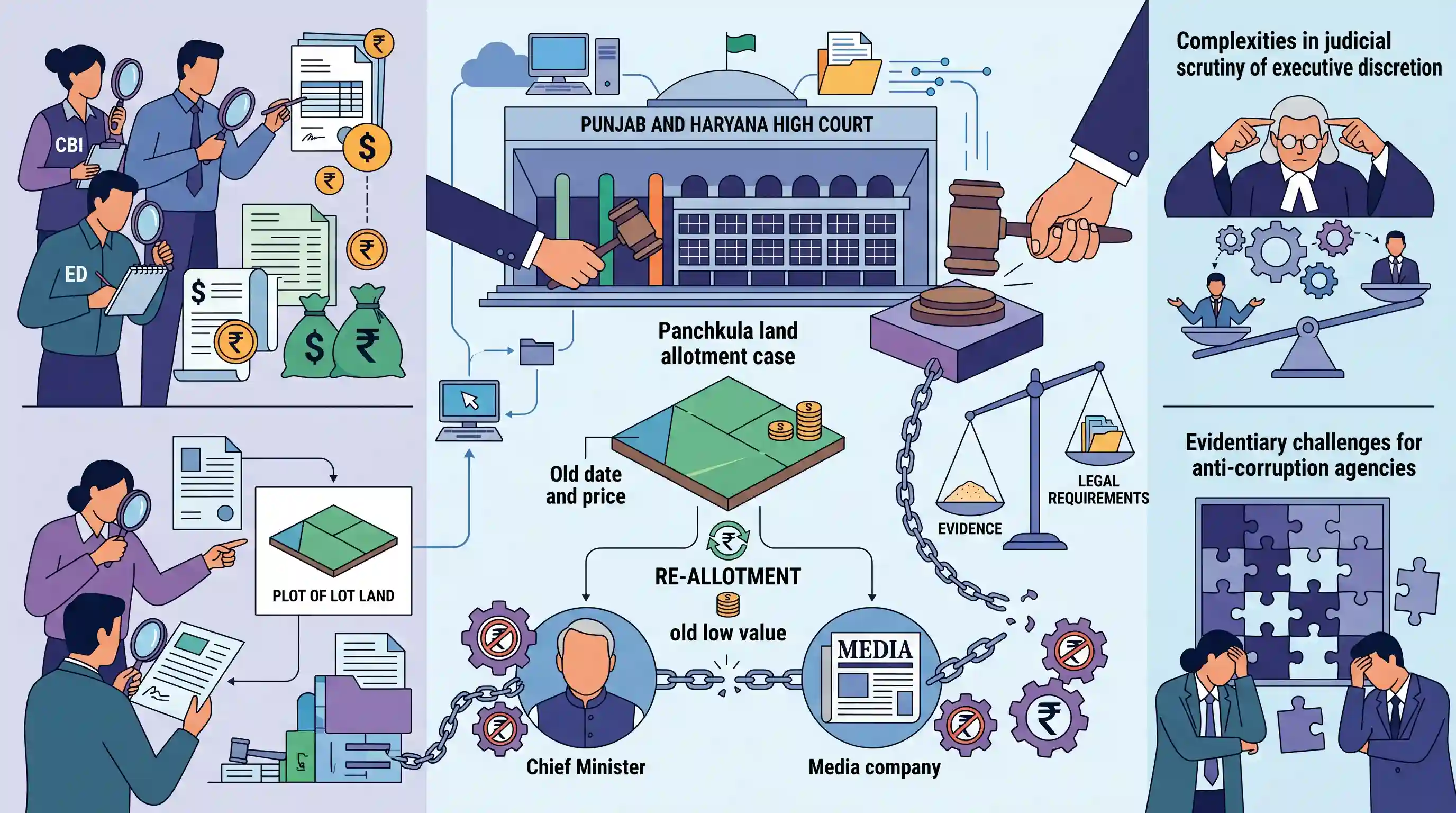
The Punjab and Haryana High Court has discharged former Haryana Chief Minister Bhupinder Singh Hooda and Associated Journals Ltd (AJL) in the Panchkula land allotment case. Investigated by the CBI and ED, the case involved the 2005 re-allotment of a plot to AJL at 1982 rates, allegedly causing a loss to the state exchequer. The agencies had accused Hooda of criminal conspiracy and corruption under the Prevention of Corruption Act for allegedly misusing his discretionary powers. The High Court's discharge order signifies that the prosecution failed to present sufficient evidence to warrant a trial, underscoring the complexities in judicial scrutiny of executive discretion and the evidentiary challenges faced by anti-corruption agencies.
Key Points
- The case centered on the 2005 re-allotment of a prime Panchkula plot to AJL (publisher of National Herald) at the original 1982 rates, despite HUDA having resumed the land in 1992 for non-construction.
- The CBI and ED charged former CM Hooda with criminal conspiracy and violations of the Prevention of Corruption Act, alleging he misused his discretionary powers as HUDA Chairman to favor AJL.
- The Punjab and Haryana High Court 'discharged' the accused, meaning the court found the prosecution's prima facie evidence insufficient to even frame charges and proceed with a trial.
- The ruling highlights the judicial threshold required to distinguish between legitimate administrative discretion and malafide abuse of official position.
Important Terms
Prevention of Corruption Act

India's primary 1988 legislation targeting bribery and misconduct by public servants. A 2018 amendment criminalized bribe-giving and introduced a "shield" requiring prior government sanction before investigating officials.
UPSC context
GS Paper II (Governance) and GS IV (Probity). Tests understanding of anti-corruption frameworks and legal safeguards for executive discretion.
Central Bureau of Investigation (CBI)
India's premier federal agency for investigating corruption, economic offenses, and serious crimes. Established in 1963, it derives its legal investigative powers from the Delhi Special Police Establishment Act, 1946.
UPSC context
GS Paper II (Executive/Statutory Bodies). Tests knowledge of federal investigative structures and the requirement of state consent for operations.
Enforcement Directorate (ED)
A specialized financial probe agency under the Ministry of Finance. It enforces the Prevention of Money Laundering Act (PMLA) and handles cases involving proceeds of crime and foreign exchange violations.
UPSC context
GS Paper II (Statutory Bodies) and GS III (Internal Security). Tests understanding of financial intelligence and money laundering combat strategies.
Punjab and Haryana High Court
The common judicial seat for Punjab, Haryana, and Chandigarh. It exercises writ jurisdiction under Article 226 of the Constitution to protect fundamental rights and oversee subordinate courts.
UPSC context
GS Paper II (Judiciary). Tests knowledge of High Court jurisdiction, judicial review of executive actions, and the common court system.
Associated Journals Ltd (AJL)
A commercial entity founded in 1937 by Jawaharlal Nehru to publish the National Herald. It is at the center of high-profile litigation regarding public land re-allotment and asset transfers.
UPSC context
GS Paper II (Governance). Relevant to case studies on administrative transparency, executive discretion, and the legal scrutiny of land allotments.
Haryana Urban Development Authority (HUDA)
A statutory body (now Haryana Shehri Vikas Pradhikaran) established in 1977. It manages planned urban expansion, infrastructure development, and the allotment of residential, commercial, and industrial plots in Haryana.
UPSC context
GS Paper II (Governance/Statutory Bodies). Tests understanding of state-level developmental authorities and the administrative processes of public land distribution.
Prelims Trap
"A court 'discharging' an accused is legally identical to an acquittal and prevents future trials."
A discharge happens before charges are framed due to lack of prima facie evidence. An acquittal is a final 'not guilty' verdict delivered after a full trial.
Static Concepts Connected
What is the legal difference between Discharge and Acquittal?
- Discharge: Granted by the judge before charges are formally framed if the prosecution's prima facie evidence is insufficient to proceed to trial.
- Acquittal: A formal verdict of 'not guilty' delivered by the court only after evaluating all evidence during a full trial.
- Double Jeopardy: A discharged person can potentially be charged again if fresh evidence emerges, whereas an acquitted person is protected against Double Jeopardy.
How do CBI and ED divide jurisdictions in economic offenses?
- Predicate Offense: CBI probes the primary crime (corruption, criminal conspiracy) and derives its powers from the Delhi Special Police Establishment (DSPE) Act, 1946.
- Proceeds of Crime: ED exclusively investigates the laundering of illegal wealth generated from the predicate offense, drawing its mandate from the Prevention of Money Laundering Act (PMLA), 2002.
Cross-Topic Patterns
Administrative Discretion vs. Probity
The boundary between legitimate administrative error and malafide 'criminal misconduct' is a core GS4 theme, especially after the Prevention of Corruption Act was amended in 2018 to protect honest decision-making.
Twin probes by CBI and ED
Mains GS2 frequently tests the functional overlap and parallel jurisdictions of the CBI (investigating the predicate corruption offense) and the ED (tracing proceeds of crime under PMLA).

Expect a GS2/GS4 question in 2026 on distinguishing honest administrative errors from malafide intent under the amended PCA 2018.
Linked PYQs · 3
Linked PYQs · 3
- 2021MainsGS2
The jurisdiction of the Central Bureau of Investigation (CBI) regarding lodging an FIR and conducting probe within a particular State is being questioned by various States. However, the power of the States to withhold consent to the CBI is not absolute. Explain with special reference to the federal character of India.
- 2018MainsGS4
As a senior officer in the Ministry, you have access to important policy decisions and upcoming big announcements such as road construction projects before they are notified in the public domain. The Ministry is about to announce a mega road project for which the drawings are already in place. Sufficient care was taken by the planners to make use of the government land with minimum land acquisition from private parties. Compensation rate for private parties was also finalized as per government rules. Care was also taken to minimize deforestation. Once the project is announced, it is expected that there will be a huge spurt in real estate prices in and around that area. Meanwhile, the Minister concerned insists that you realign the road in such a way that it comes closer to his 20 acres farm house. He also suggests that he would facilitate purchase of a big plot of land in your wife's name at the prevailing rate which is very nominal, in and around the proposed mega road project. He also tries to convince you by saying that there is no harm in it as he is buying the land legally. He even promises to supplement your savings in case you do not have sufficient funds to buy the land. However, by the act of realignment, a lot of agricultural land has to be acquired, thereby causing considerable financial burden on the government, and also displacement of the farmers. As if this is not enough, it will involve cutting down of a large number of trees, denuding the area of its green cover. Faced with this situation, what will you do? Critically examine various conflicts of interest and explain what are your responsibilities as a public servant.
- 2022MainsGS4
Discuss the significance of 'Conflict of interest' in the context of public administration.
