Hong Kong Court Prepares Sentencing for Jimmy Lai Under Security Law
Source:The Hindu ↗
Why It Matters
The article serves as an important case study for GS-II (Polity and IR) concerning the suppression of civil liberties, the balance between national security and freedom of expression, and China's assertive global posture which challenges Western democratic norms.
Summary
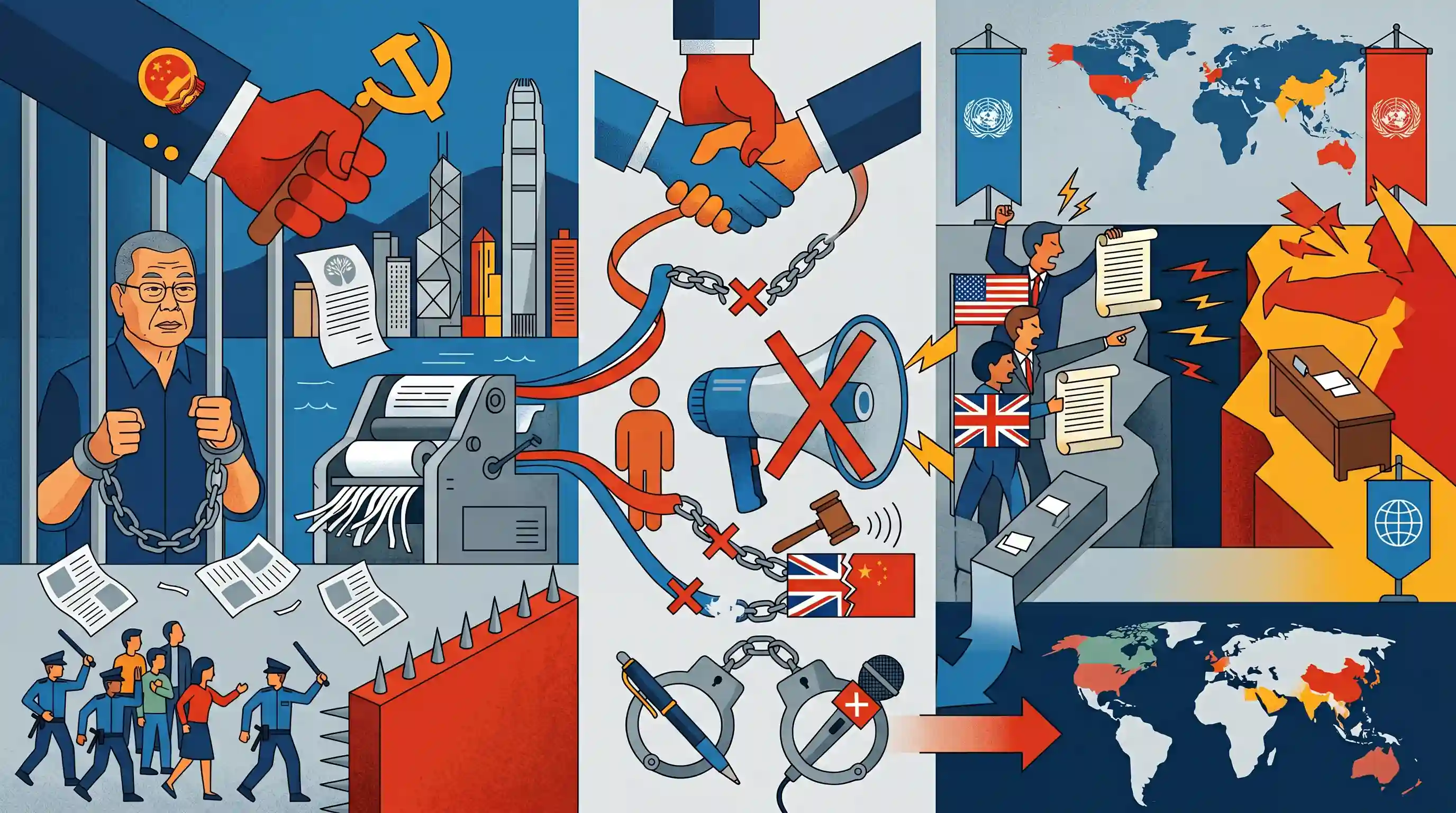
Hong Kong's pro-democracy activist and Apple Daily founder Jimmy Lai faces imminent sentencing under China's Beijing-imposed National Security Law. Convicted for alleged collusion with foreign forces and publishing seditious articles, his case highlights the severe decline of press freedom and democratic rights in Hong Kong. The prosecution has sparked significant international backlash, particularly from the U.S. and the U.K., heightening diplomatic tensions over China's tightening authoritarian grip on the territory.
Key Points
- Hong Kong pro-democracy activist and former media tycoon Jimmy Lai is set to be sentenced under a stringent Beijing-imposed National Security Law.
- Lai was convicted of conspiring to collude with foreign forces and conspiracy to publish seditious materials, carrying a maximum penalty of life imprisonment.
- The trial is perceived globally as a litmus test for the erosion of press freedom and civil liberties in Hong Kong since its handover in 1997.
- The case has strained diplomatic relations, with the U.S. and the U.K. governments calling for Lai's release and condemning China's actions.
Important Terms
National Security Law (Hong Kong)

A 2020 law imposed by Beijing on Hong Kong, criminalizing secession, subversion, terrorism, and collusion with foreign forces. It bypasses local legislatures, granting China direct security jurisdiction over the territory.
UPSC context
GS Paper II (International Relations): Impact of China's internal policies on global democratic norms and its international legal obligations.
One Country, Two Systems
A constitutional principle allowing Hong Kong and Macau to retain their own economic and legal systems (capitalism/common law) while being part of socialist China, guaranteed for 50 years post-handover.
UPSC context
GS Paper II: Comparative governance and asymmetric federalism. Relevant for understanding regional stability in the Indo-Pacific.
Apple Daily
A defunct pro-democracy Hong Kong newspaper founded by Jimmy Lai. It served as a major voice for dissent until forced to close in 2021 under the National Security Law.
UPSC context
GS Paper II (Social Justice/Human Rights): Case study on the erosion of press freedom and its impact on democratic accountability.
Jimmy Lai
Prominent media tycoon and pro-democracy activist whose conviction under security laws has become a focal point of diplomatic tension between China and Western nations like the UK and US.
UPSC context
GS Paper II: Role of individual activists in international human rights discourse and geopolitical friction between major powers.
Collusion with foreign forces
A specific offense under the Hong Kong National Security Law targeting individuals who seek foreign sanctions or support. It was a primary charge in the trial of Jimmy Lai.
UPSC context
GS Paper II (International Relations): Examines how domestic laws can be used to restrict international advocacy and diplomatic engagement.
Sedition
The legal act of inciting rebellion or discontent against state authority. Historically a colonial-era law, it is currently used in Hong Kong to prosecute journalists and activists.
UPSC context
GS Paper II (Polity): Comparison with India's Section 124A IPC; tests the limits of free speech vs. national security.
Prelims Trap
The Hong Kong National Security Law was enacted by Hong Kong's local legislature under its autonomous powers.
The NSL was directly imposed by Beijing's National People's Congress Standing Committee, deliberately bypassing Hong Kong's local legislature to crush dissent.
Static Concepts Connected
What is China's "One Country, Two Systems" policy?
- Origin: Proposed by Deng Xiaoping in the 1980s for reunification with Taiwan, later applied to Hong Kong (1997) and Macau (1999).
- Mechanism: Allows special administrative regions to retain their own capitalist economic systems and independent judiciaries while mainland China maintains a socialist system.
- Duration: Under the Sino-British Joint Declaration, Hong Kong was guaranteed this high degree of autonomy for 50 years (until 2047).
How has Sedition evolved in Indian jurisprudence compared to its global use?
- Core Concept: Sedition traditionally criminalizes speech or acts inciting hatred or disaffection against the established state.
- India's Transition: India replaced Section 124A of the IPC with BNS Section 152, shifting the legal focus from "disaffection towards government" to acts "endangering sovereignty".
- Misuse Concern: As seen in Hong Kong, broad anti-sedition laws are frequently weaponized by states to bypass standard common-law protections and target journalists.
Cross-Topic Patterns
Sedition laws: India vs Global trends
Hong Kong's use of sedition charges against media mirrors India's own constitutional debates surrounding Section 124A IPC and its recent replacement under Section 152 of the Bharatiya Nyaya Sanhita (BNS).
Magnitsky Acts and Human Rights Diplomacy
The US and UK leverage targeted human rights sanctions against Chinese officials over Hong Kong, illustrating how human rights interventions are increasingly used as tools in great power competition.

The collapse of 'One Country, Two Systems' and extraterritorial security laws are prime fodder for GS-2 IR questions on democratic decline.
Linked PYQs · 3
Linked PYQs · 3
- 2014MainsGS2
What do you understand by the concept "freedom of speech and expression"? Does it cover hate speech also ? Why do the films in India stand on a slightly different plane from other forms of expression ? Discuss.
- 2021MainsGS2
“The USA is facing an existential threat in the form of a China, that is much more challenging than the erstwhile Soviet Union.” Explain.
- 2024MainsGS2
‘The West is fostering India as an alternative to reduce dependence on China's supply chain and as a strategic ally to counter China's political and economic dominance.’ Explain this statement with examples.
