Jewar Solar Manufacturing Facility Foundation Stone in Uttar Pradesh
Source:solar-quarter ↗
Why It Matters
This project highlights Uttar Pradesh's growing dominance in attracting major green energy investments and infrastructure projects. UPPSC frequently asks factual questions on clean energy, solar cell concepts (such as PV tech), state economic targets, and the geography of key industrial developments in Noida/Jewar.
Summary
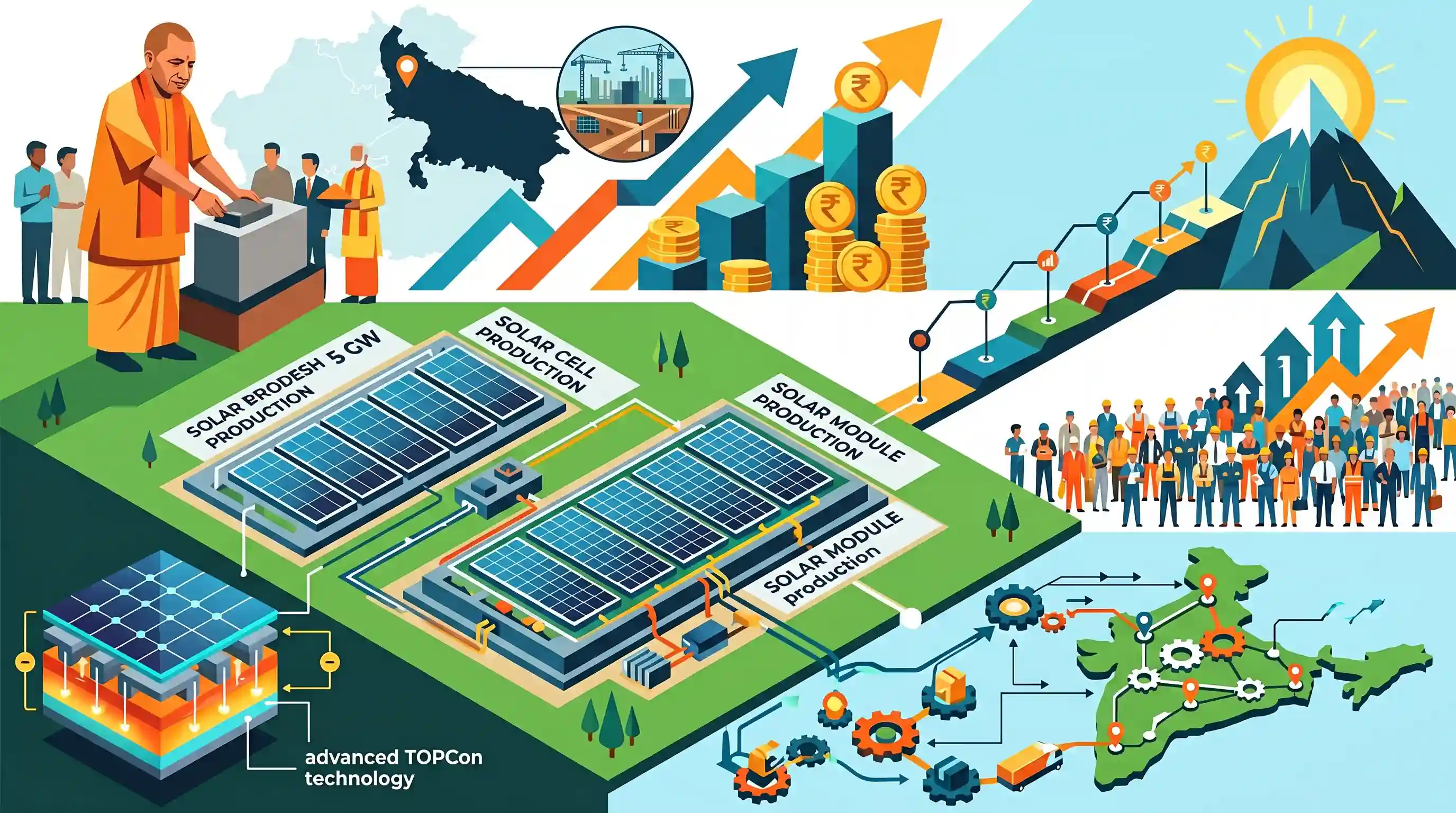
Uttar Pradesh Chief Minister Yogi Adityanath laid the foundation stone for a massive ₹8,200 crore integrated solar manufacturing facility in Jewar, Gautam Buddha Nagar. Developed by SAEL Industries Ltd. (via its subsidiary SSP6PL) across 200 acres in YEIDA Sector 8, this facility will feature a combined capacity of 5 GW solar cells and 5 GW solar modules (using advanced TOPCon technology). The project aligns with Uttar Pradesh's goal to become a USD 1 trillion economy and is expected to generate 20,000 direct and indirect jobs while driving India's domestic renewable energy manufacturing supply chain.
Key Points
- The foundation stone for SAEL's integrated solar manufacturing facility was laid by Uttar Pradesh Chief Minister Yogi Adityanath in Jewar, Gautam Buddha Nagar, UP.
- The project is being developed over 200 acres in Sector 8 of the Yamuna Expressway Industrial Development Authority (YEIDA).
- It is a 10 GW solar manufacturing ecosystem comprising an integrated 5 GW solar cell and 5 GW solar module manufacturing unit.
- Developed by SAEL Industries Ltd. through its subsidiary SAEL Solar P6 Private Limited (SSP6PL) with an investment of ₹8,200 crore.
- The facility will use advanced technologies to manufacture high-efficiency solar cells and TOPCon (Tunnel Oxide Passivated Contact) modules.
- It is projected to create 5,000 direct and 15,000 indirect jobs, thereby aiding UP's target of reaching a USD 1 trillion economy.
Important Terms
UP Solar Energy Policy

A state policy aiming to establish 22 GW of solar power capacity by 2026-27, promoting utility-scale parks, residential rooftops, solar cities like Ayodhya, and agricultural solarisation under UPNEDA.
UPSC context
GS Paper III: Infrastructure and Energy. Tests knowledge of state-level clean energy policies, renewable targets, and investment frameworks.
UP USD 1 Trillion Economy Goal
An economic vision aiming to scale Uttar Pradesh's Gross State Domestic Product to USD 1 trillion by 2029-30, driven by industrial summits, infrastructure expansion, and agricultural modernization.
UPSC context
GS Paper III: Indian Economy and Growth. Tests understanding of regional developmental models, state GDP contributions, and federal growth dynamics.
Noida International Airport Limited (NIAL)
A joint venture company of the UP Government, NOIDA, Greater Noida, and YEIDA, responsible for implementing the greenfield Noida International Airport at Jewar.
UPSC context
GS Paper III: Infrastructure and Civil Aviation. Tests knowledge of joint ventures, mega transport infrastructure, and regional economic connectivity.
Yamuna Expressway Industrial Development Authority (YEIDA)
The nodal agency established under the UP Industrial Area Development Act, 1976, responsible for systematically developing industrial, commercial, and residential infrastructure along the Yamuna Expressway corridor.
UPSC context
GS Paper III: Urbanization and Economic Infrastructure. Tests understanding of regional planning, special economic zones, and public land administration.
SAEL Industries Ltd.
A vertically integrated Indian renewable energy developer focused on solar power, waste-to-energy, and manufacturing high-efficiency solar modules, supported by domestic and international investments.
UPSC context
GS Paper III: Energy Security and Private Investment. Tests awareness of domestic solar value chains, private capital, and clean technology localization.
Prelims Trap
TOPCon solar cells utilize standard P-type silicon substrates, which are highly susceptible to light-induced degradation (LID).
TOPCon is fundamentally an N-type silicon technology (doped with phosphorus), which makes it highly resistant to Light-Induced Degradation (LID), unlike traditional P-type boron-doped PERC cells.
Static Concepts Connected
What is TOPCon technology and how does it improve solar efficiency?
- Tunnel Oxide Passivation: Integrates an ultra-thin silicon oxide tunnel layer and doped polycrystalline silicon to minimize carrier recombination and increase electron flow.
- N-type Silicon Base: Uses phosphorus-doped N-type silicon as the base substrate, making the cell highly immune to boron-oxygen-related Light-Induced Degradation (LID).
- Efficiency Edge: Delivers superior commercial power conversion efficiencies of 23-24%, outperforming conventional PERC cells which peak around 22%.
What are the key structural challenges in India's Solar PV value chain?
- Upstream Bottleneck: Despite strong domestic module assembly, India remains heavily dependent on imports (mainly from China) for essential polysilicon, ingots, and wafers.
- ALMM Framework: The Approved List of Models and Manufacturers (ALMM) mandates domestic sourcing to incentivize local production and protect against low-quality imports.
- Fiscal Protectionism: Imposes Basic Customs Duty (40% on modules, 25% on cells) to shelter domestic industries from predatory pricing and dumping practices.
Cross-Topic Patterns
Solar PLI and Supply Chain Resilience
India's domestic solar cell manufacturing expansion aims to build local supply-chain resilience, helping bypass China's monopoly on critical upstream raw materials like polysilicon and wafers.
Competitive Federalism and Green Transition
State-level policies and industrial zones like YEIDA show how competitive subnational industrial planning is crucial to achieving India's national Net Zero and Paris Agreement targets.

A comparative question on N-type (TOPCon) vs P-type solar cells alongside India's upstream wafer import vulnerabilities is likely in 2026.
Linked PYQs · 3
Linked PYQs · 3
- 2022UPPSC_PRELIMSGS1
Solar energy is converted into electric energy through
- 2016UPPSC_PRELIMSGS1
Photovoltaic cells are
- 2025UPPSC_PRELIMSGS1
Which of the following Department prepares the National Indicator Framework Progress Report related to Sustainable Development Goals in Uttar Pradesh? 1. Department of Finance 2. Department of Education 3. Department of Planning Select the correct answer from the code given below:
