Home Ministry Directive to Clear Forensic Backlogs for New Laws
Source:Indian Express ↗
Why It Matters
Forensic science modernization is critical for addressing India's low conviction rates and successfully implementing the three new criminal codes (Naveen Sanhitas). By emphasizing digital evidence, institutional autonomy for forensic labs, and e-governance (via ICJS), these reforms are highly relevant for GS Paper 2 (Governance/Criminal Justice) and GS Paper 3 (Security and Tech).
Summary
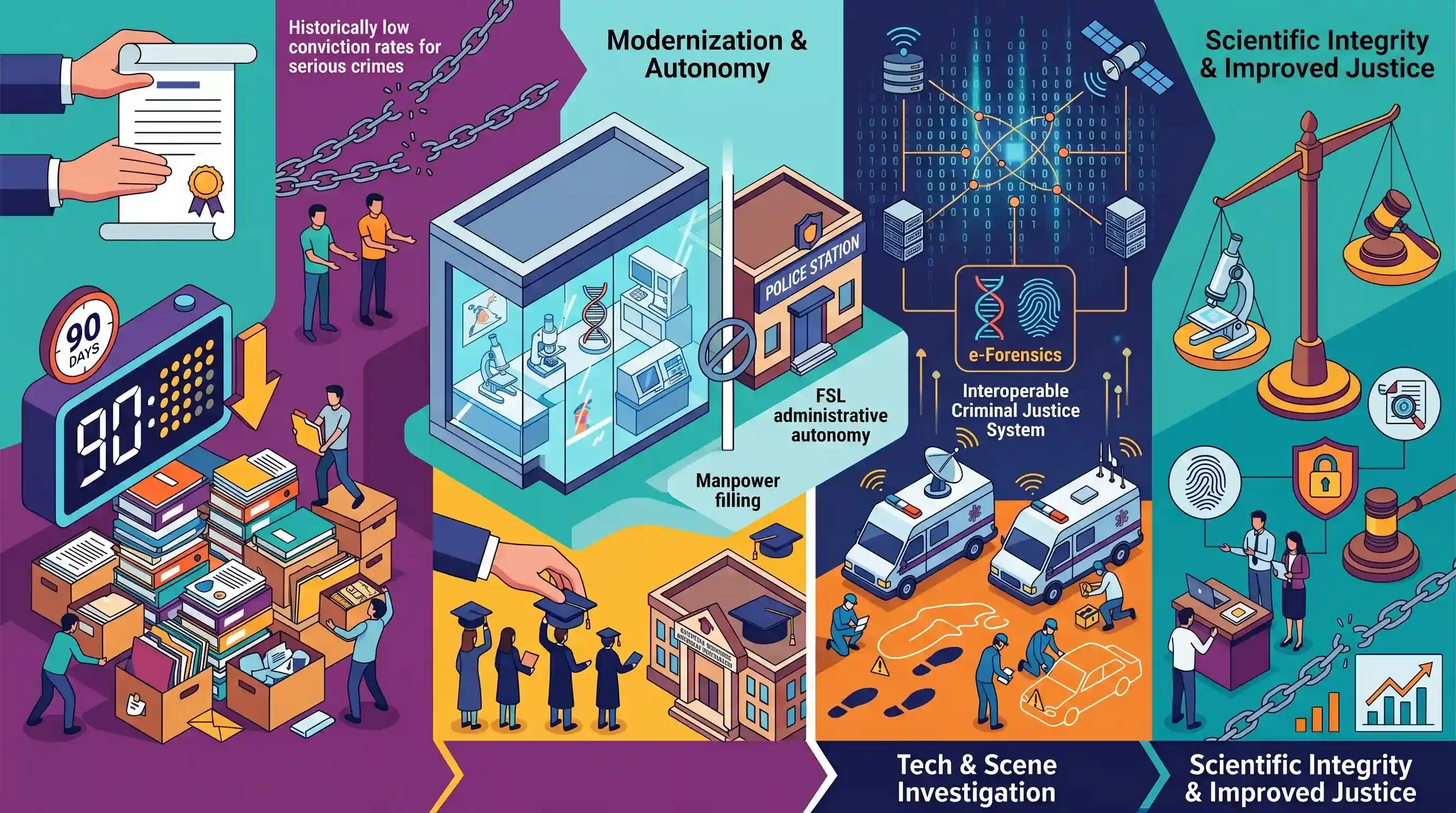
The Union Ministry of Home Affairs (MHA) has issued a 90-day ultimatum to states and Union Territories to eliminate forensic evidence backlogs, a critical measure for operationalizing the newly enacted 'Naveen Sanhitas' (new criminal laws). The comprehensive directives require states to modernize Forensic Science Laboratories (FSLs), fill manpower gaps via the National Forensic Sciences University (NFSU), and ensure administrative autonomy for FSLs by delinking them from police departments. To support a technology-driven justice model, the plan emphasizes integrating the e-Forensics module into the Interoperable Criminal Justice System (ICJS) and utilizing Mobile Forensic Vans. This systemic overhaul aims to uphold scientific integrity in investigations and address historically low conviction rates for serious crimes.
Key Points
- The Ministry of Home Affairs (MHA) has set a 90-day deadline for states and UTs to clear existing forensic backlogs.
- Directives stress modernizing Forensic Science Laboratories (FSLs), filling vacancies, and granting them administrative autonomy by separating them from police control to ensure scientific integrity.
- The overhaul is essential for the implementation of the 'Naveen Sanhitas' (India's three new criminal laws), which mandate a technology-driven approach to criminal justice and digital evidence.
- Reforms include integrating the e-Forensics module with the Interoperable Criminal Justice System (ICJS) and deploying Mobile Forensic Vans for immediate onsite evidence collection.
- The National Forensic Sciences University (NFSU) will provide specialized training, while the Directorate of Forensic Science Services (DFSS) will guide and monitor these modernization efforts.
Important Terms
Bharatiya Nyaya Sanhita (BNS)

Substantive criminal law enacted in 2023 to replace the colonial-era Indian Penal Code (IPC). It modernizes definitions of crimes, introduces 'community service,' and addresses new challenges like organized crime and terrorism.
UPSC context
GS Paper-II: Governance and Polity. Tests understanding of legal reforms, decolonization of laws, and modern criminal jurisprudence.
Bharatiya Nagarik Suraksha Sanhita (BNSS)
The primary procedural law replacing the Code of Criminal Procedure (CrPC). It mandates forensic investigation for crimes punishable by seven years or more and introduces time-bound trials and digital evidence protocols.
UPSC context
GS Paper-II: Governance; GS Paper-III: Internal Security. Focuses on procedural efficiency, police accountability, and technology-driven investigations.
Bharatiya Sakshya Adhiniyam (BSA)
Replaces the Indian Evidence Act of 1872, providing legal validity to electronic and digital records as primary evidence. It aims to modernize the admissibility standards for evidence in the digital age.
UPSC context
GS Paper-II: Governance. Relevant for topics on judicial modernization and the impact of technology on the legal system.
Inter-operable Criminal Justice System (ICJS)
A national platform integrating the five pillars of the criminal justice system: Police, e-Courts, e-Prisons, e-Forensics, and e-Prosecution. It facilitates seamless data sharing to improve investigation and trial speed.
UPSC context
GS Paper-II: E-governance; GS Paper-III: Internal Security. Tests knowledge of digital infrastructure for justice delivery.
e-Forensics module
A specialized digital module under the ICJS framework that connects forensic laboratories nationwide. It enables the online tracking of evidence, report generation, and reduction of forensic backlogs.
UPSC context
GS Paper-II: E-governance. Illustrates the use of technology to enhance investigative efficiency and scientific integrity.
National Forensic Sciences University (NFSU)
An Institution of National Importance dedicated to forensic science education and research. It provides the specialized manpower required to implement forensic mandates under the new criminal laws.
UPSC context
GS Paper-III: Internal Security and Science & Tech. Pertains to institutional capacity building and professionalizing investigative agencies.
Prelims Trap
"Under the new criminal laws, forensic investigations are legally mandatory for all cognizable offences."
Forensic investigations are legally mandatory only for offences carrying a punishment of seven years or more, not for all cognizable offences.
Static Concepts Connected
What are the core components of the Interoperable Criminal Justice System (ICJS)?
- Five Pillars: It seamlessly integrates five IT systems: Police (CCTNS), e-Forensics, e-Courts, e-Prosecution, and e-Prisons.
- Architecture: Operates on a 'one data, one entry' principle to prevent data duplication and errors across law enforcement and judicial databases.
- Implementing Agency: Implemented by the National Crime Records Bureau (NCRB) in collaboration with the National Informatics Centre (NIC).
How do major police reform panels view investigative autonomy?
- Malimath Committee: Recommended structurally separating the investigation wing from law-and-order duties to ensure specialized, high-quality, and rapid probes.
- Prakash Singh Directives: The Supreme Court (2006) explicitly mandated the separation of investigative police from law and order to insulate evidence gathering from administrative pressure.
Cross-Topic Patterns
ICJS as Digital Public Infrastructure
ICJS extends India's DPI architecture to law enforcement, moving from siloed CCTNS data to a federated, interoperable justice grid based on a 'one data, one entry' principle.
Institutional Autonomy & Evidentiary Bias
Delinking FSLs from police control parallels broader governance themes, such as the debate over CBI autonomy, aiming to secure scientific integrity against institutional and executive interference.

Expect a multi-statement question linking ICJS pillars with the 'seven-year punishment' threshold for mandatory forensics under BNSS.
Linked PYQs · 3
Linked PYQs · 3
- 2023MainsGS3
What are the internal security challenges being faced by India? Give out the role of Central Intelligence and Investigative Agencies tasked to counter such threats.
- 2024MainsGS2
e-governance is not just about the routine application of digital technology in service delivery process. It is as much about multifarious interactions for ensuring transparency and accountability. In this context evaluate the role of the 'Interactive Service Model' of e-governance.
- 2025MainsGS2
e-governance projects have a built-in bias towards technology and back-end integration than user-centric designs. Examine.
