Home Ministry Notifies Resignation of Vice President Jagdeep Dhankhar
Source:The Hindu ↗
Why It Matters
The resignation of the Vice-President creates a significant constitutional vacancy, including the pivotal role of the Chairman of the Rajya Sabha. It tests constitutional procedures regarding vacancies and transitions of power at the highest levels of the Indian Republic.
Summary
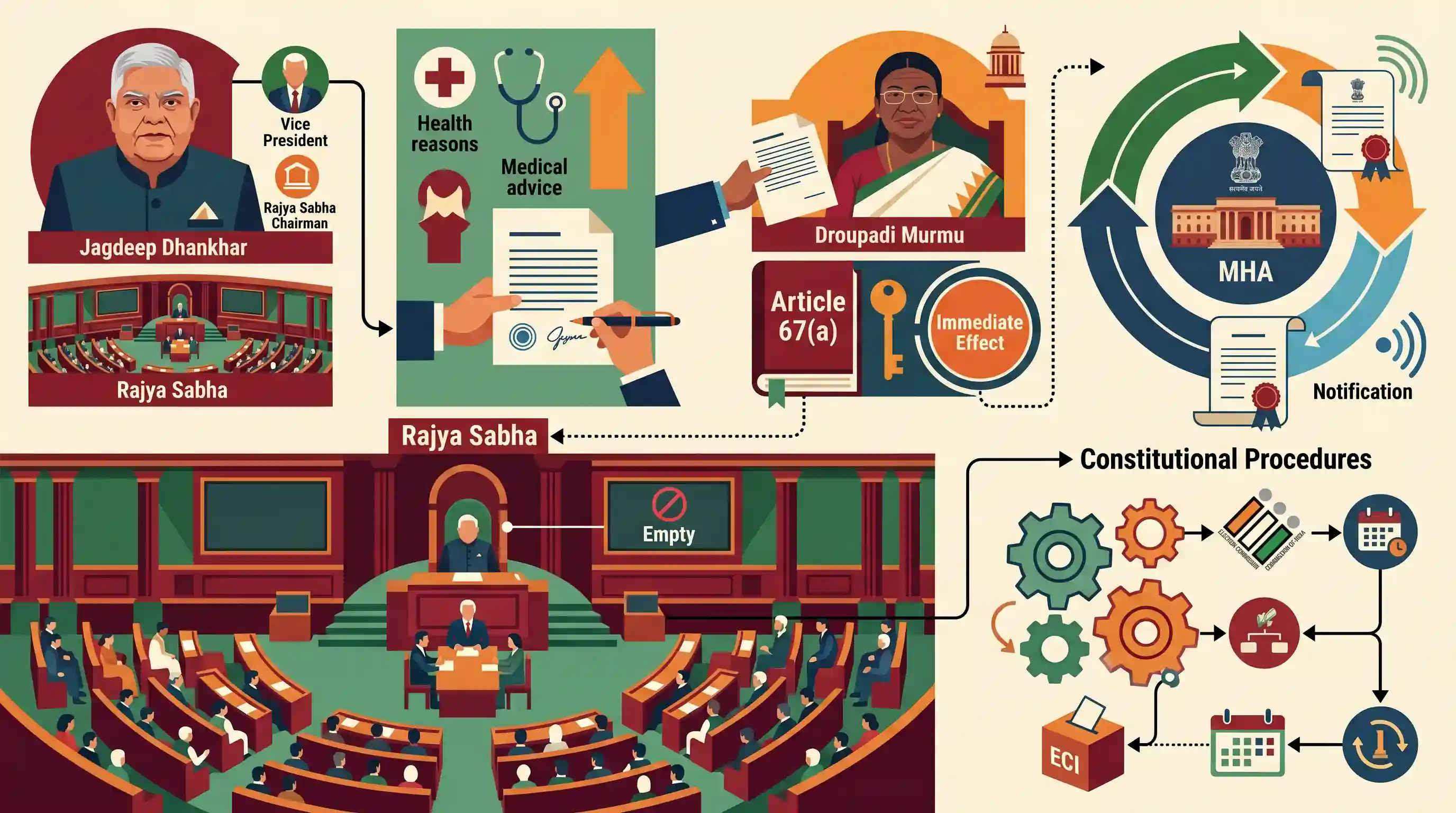
Vice-President Jagdeep Dhankhar has resigned from his post, citing health reasons and the need to adhere to medical advice. Under Article 67(a) of the Constitution, his resignation, submitted to President Droupadi Murmu, takes immediate effect. The Ministry of Home Affairs formally notified the resignation. In the Rajya Sabha, where the Vice-President serves as the ex-officio Chairman, the development was announced by the Chair. Members were informed that further constitutional procedures regarding the vacancy would be communicated in due course.
Key Points
- Vice-President Jagdeep Dhankhar has resigned from his office, citing health reasons and medical advice.
- The resignation was submitted to President Droupadi Murmu and takes immediate effect as per Article 67(a) of the Constitution.
- The Ministry of Home Affairs issued a gazette notification on July 22, 2025, confirming the resignation.
- The Rajya Sabha was formally informed of the resignation, leaving a vacancy in the office of the Chairman, which the Vice-President holds ex-officio.
Important Terms
Article 67(a) of the Constitution

A constitutional provision allowing the Vice-President of India to resign from office by submitting a written letter to the President; such resignation takes effect immediately.
UPSC context
GS Paper-II (Polity). Tests knowledge of constitutional procedures, executive vacancies, and the specific mandates governing the Vice-President's office.
Rajya Sabha
The Upper House of India's Parliament, representing States and Union Territories. It is a permanent chamber, and the Vice-President of India serves as its presiding officer.
UPSC context
GS Paper-II (Parliament). Essential for understanding bicameralism, federal representation, and the legislative role of the Vice-President as Chairman.
Ministry of Home Affairs (MHA)
The Union ministry responsible for internal security and administrative protocols. It formally notifies the public and Parliament of the resignation of high constitutional authorities.
UPSC context
GS Paper-II (Governance). Tests understanding of the administrative procedures and notifications required to formalize constitutional transitions.
Vice-President of India
The second-highest constitutional office in India, modeled on the U.S. Vice-President. The holder presides over the Rajya Sabha and discharges presidential functions during vacancies.
UPSC context
GS Paper-II (Executive). Tests the qualifications, election, powers, and resignation/removal processes of the Union Executive.
Ex-officio Chairman
A designation where a person holds a particular position automatically because they hold another specific office, such as the Vice-President serving as Chairman of the Rajya Sabha.
UPSC context
GS Paper-II (Polity). Tests precision in technical constitutional terminology and the dual responsibilities of specific Indian offices.
Prelims Trap
"An election to fill a vacancy caused by the Vice-President's resignation must be held within six months."
The Constitution mandates a strict 6-month limit for filling a President's vacancy. However, for the Vice-President, Article 68 only specifies 'as soon as possible'. Aspirants frequently conflate the two rules.
Static Concepts Connected
How is a mid-term vacancy in the Vice-President's office managed under the Constitution?
- No Acting VP: Unlike the President's office, there is no constitutional provision for an 'Acting Vice-President'. The office remains vacant until a new election.
- Election Timeline: Article 68 mandates that an election to fill a mid-term vacancy be held 'as soon as possible', with no strict numerical timeline.
- Full 5-Year Term: The newly elected Vice-President remains in office for a full five-year term from the date they enter office, not merely for the unexpired term.
What happens to the Rajya Sabha when the Vice-President resigns?
- Deputy Chairman takes over: Under Article 91(1), the Deputy Chairman of the Rajya Sabha temporarily performs the duties of the Chairman while the VP office is vacant.
- Independent Office: The Deputy Chairman is elected directly by the Rajya Sabha members. They are directly responsible to the House and are not subordinate to the Chairman.
Cross-Topic Patterns
Asymmetry in Constitutional Vacancies
UPSC often tests the contrast between the President's office (strict 6-month election deadline) and the Vice-President's office (no set deadline, just 'as soon as possible') during a mid-term vacancy.
MHA's Role in Constitutional Notifications
The Ministry of Home Affairs acts as the nodal ministry for notifying the assumption of office and resignation of key constitutional posts, including the President, Vice-President, and Governors.

Expect a multi-statement Prelims question contrasting VP and President vacancy rules, specifically targeting the lack of a 6-month deadline.
Linked PYQs · 1
Linked PYQs · 1
- 2022MainsGS2
Discuss the role of the Vice-President of India as the Chairman of the Rajya Sabha.
