Ladakh Statehood and Sixth Schedule Demands Remain Unresolved
Source:The Hindu ↗
Why It Matters
The Ladakh protests highlight critical constitutional provisions regarding regional autonomy and tribal protection. The distinction and debate between the Sixth Schedule and Article 371 are highly probable topics for Prelims and GS2 Mains. Additionally, the use of preventive detention laws like the NSA against activists brings up important fundamental rights issues.
Summary
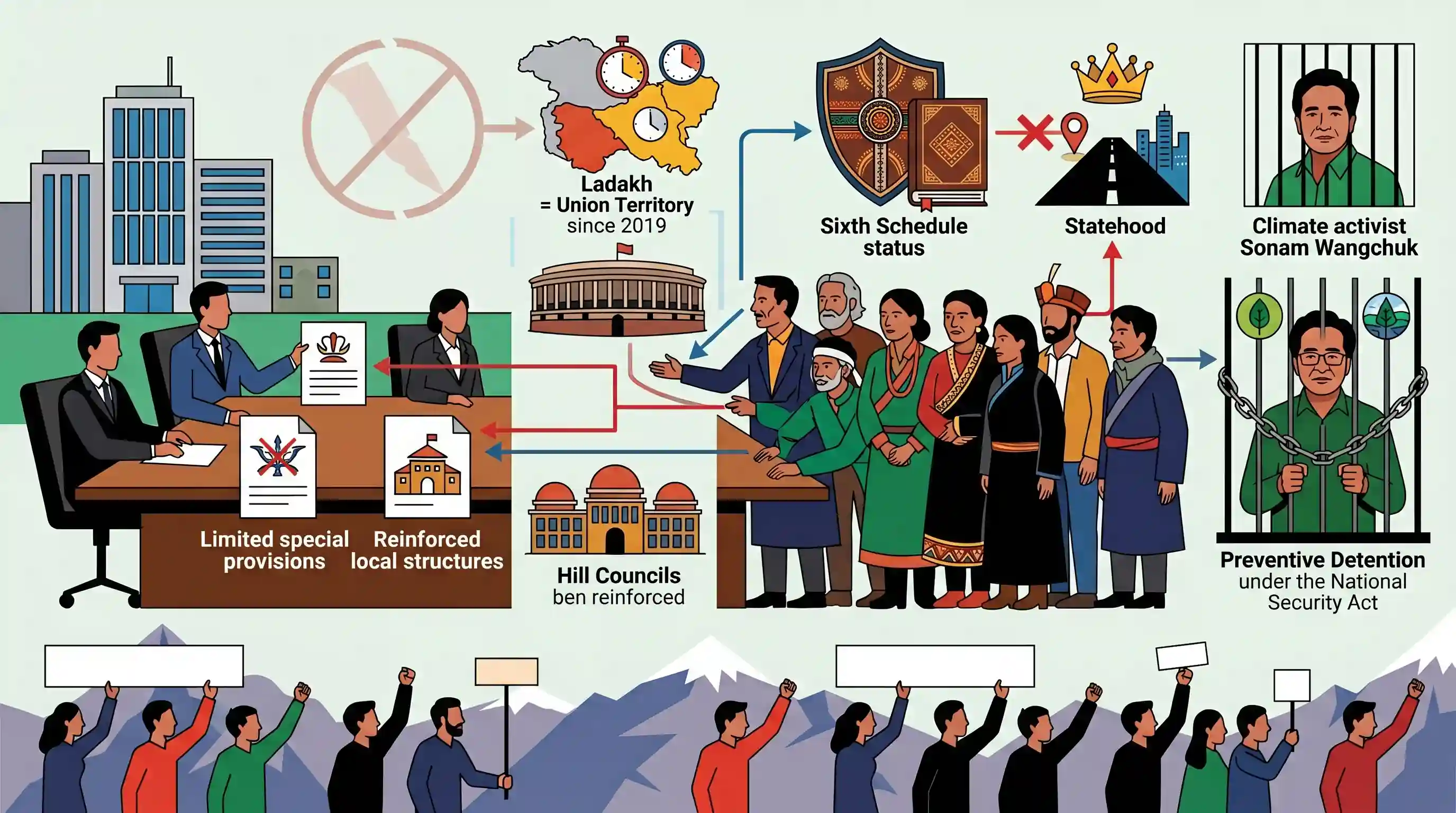
Talks between the Ministry of Home Affairs (MHA) and Ladakh civil society leaders representing the Leh Apex Body (LAB) and Kargil Democratic Alliance (KDA) remained inconclusive. The leaders pressed for Statehood, inclusion in the Sixth Schedule of the Constitution to protect tribal status, and the release of climate activist Sonam Wangchuk, who is detained under the National Security Act (NSA). The MHA declined the Sixth Schedule demand, instead offering safeguards under Article 371 and suggesting the strengthening of existing hill councils. Ladakh has witnessed ongoing protests for constitutional safeguards since becoming a Union Territory without a legislature in 2019.
Key Points
- Ladakh civil society leaders (LAB and KDA) held inconclusive talks with the MHA, demanding Statehood and inclusion in the Sixth Schedule of the Constitution.
- The MHA countered the Sixth Schedule demand by offering safeguards under Article 371 and proposing the strengthening of existing autonomous hill councils.
- Leaders also demanded the unconditional release of climate activist Sonam Wangchuk and others currently detained under the National Security Act (NSA) in Jodhpur prison.
- The constitutional status of Ladakh has remained a point of friction since it was made a Union Territory without a legislature in 2019 following the reading down of Article 370.
Important Terms
Sixth Schedule of the Constitution

Constitutional provision (Article 244(2)) granting autonomy to tribal areas through Autonomous District Councils with legislative and judicial powers.
UPSC context
GS Paper II (Polity/Federalism) — critical for understanding tribal administration and Ladakh's current political demands.
Article 371 of the Constitution
Specific clauses (371A-J) providing customized safeguards for land, jobs, and customs for various states without full legislative autonomy.
UPSC context
GS Paper II (Constitutional Provisions) — tests the 'asymmetric federalism' concept and MHA's proposed alternative for Ladakh.
National Security Act (NSA)
A 1980 preventive detention law allowing the state to detain individuals for up to 12 months without trial to maintain public order.
UPSC context
GS Paper II (Fundamental Rights) & GS Paper III (Internal Security) — examines state power vs. civil liberties (Article 22).
Leh Apex Body (LAB) and Kargil Democratic Alliance (KDA)
Political and civil society coalitions from Leh and Kargil districts jointly negotiating Ladakh's demands for statehood and constitutional protections.
UPSC context
GS Paper II (Governance/Pressure Groups) — represents regional identity politics and civil society's role in federal negotiations.
Article 370 of the Constitution
A temporary constitutional provision that granted special autonomy to J&K until its 2019 abrogation, which bifurcated the state into two Union Territories.
UPSC context
GS Paper II (Polity) — foundational context for Ladakh's reorganization and subsequent protests for democratic rights.
High-Powered Committee (HPC)
An executive body established by the Ministry of Home Affairs to negotiate with Ladakhi representatives on statehood and constitutional safeguards.
UPSC context
GS Paper II (Executive/Governance) — mechanism for executive dialogue in managing Union Territories and resolving regional conflicts.
Prelims Trap
The President can extend the Sixth Schedule to any tribal-majority Union Territory via an executive order.
False. Extending the Sixth Schedule beyond Assam, Meghalaya, Tripura, and Mizoram requires a Constitutional Amendment by Parliament. A Presidential order or MHA notification alone is insufficient.
Static Concepts Connected
How do Sixth Schedule areas differ from Fifth Schedule areas?
- Constitutional limits: Article 244(2) limits the Sixth Schedule strictly to Assam, Meghalaya, Tripura, and Mizoram. Other tribal areas fall under the Fifth Schedule.
- ADC powers: Sixth Schedule regions form Autonomous District Councils (ADCs) with actual legislative, judicial, and administrative powers.
- Advisory nature: Fifth Schedule areas rely on Tribes Advisory Councils (TACs), which only possess advisory roles to guide the Governor on tribal welfare.
What are the constitutional limits on preventive detention laws like the NSA?
- Rights exception: Under Article 22(3), preventive detainees are stripped of the right to a lawyer and the right to be produced before a magistrate within 24 hours.
- Three-month rule: Detention cannot exceed three months unless approved by an Advisory Board consisting of individuals qualified to be High Court judges.
- Maximum tenure: The National Security Act (NSA) permits a maximum detention period of 12 months for preventing actions prejudicial to national security or public order.
Cross-Topic Patterns
Autonomy demands: Sixth Schedule vs Article 371
MHA prefers offering Article 371 special provisions over Sixth Schedule status. This reflects a broader governance pattern to grant regional/customary autonomy without creating highly independent ADCs that mimic sub-states.
Climate movements and internal security laws
Detaining climate activists like Sonam Wangchuk under the NSA bridges environmental ecology with internal security, highlighting the friction between fundamental rights (Article 19) and public order exceptions.

Expect a 2026 Prelims question contrasting the legislative powers of Sixth Schedule ADCs with the special provisions under Article 371.
Linked PYQs · 3
Linked PYQs · 3
- 2015PrelimsGS1
The provisions in Fifth Schedule and Sixth Schedule in the Constitution of India are made in order to
- 2025MainsGS2
Discuss the nature of Jammu and Kashmir Legislative Assembly after the Jammu and Kashmir Reorganization Act, 2019. Briefly describe the powers and functions of the Assembly of the Union Territory of Jammu and Kashmir.
- 2016MainsGS2
To what extent is Article 370 of the Indian Constitution, bearing marginal note "Temporary provision with respect to the State of Jammu and Kashmir", temporary? Discuss the future prospects of this provision in the context of Indian polity.
