Northern Zonal Council Deliberations and Cooperative Federalism
Source:The Hindu ↗
Why It Matters
The article is highly relevant for GS2 (Polity) as it provides current examples of inter-state disputes (SYL Canal, Chandigarh asset sharing) and demonstrates the functioning of Zonal Councils (statutory bodies) in conflict resolution. It also touches upon Internal Security (GS3) regarding the government's stance on recent terror incidents.
Summary
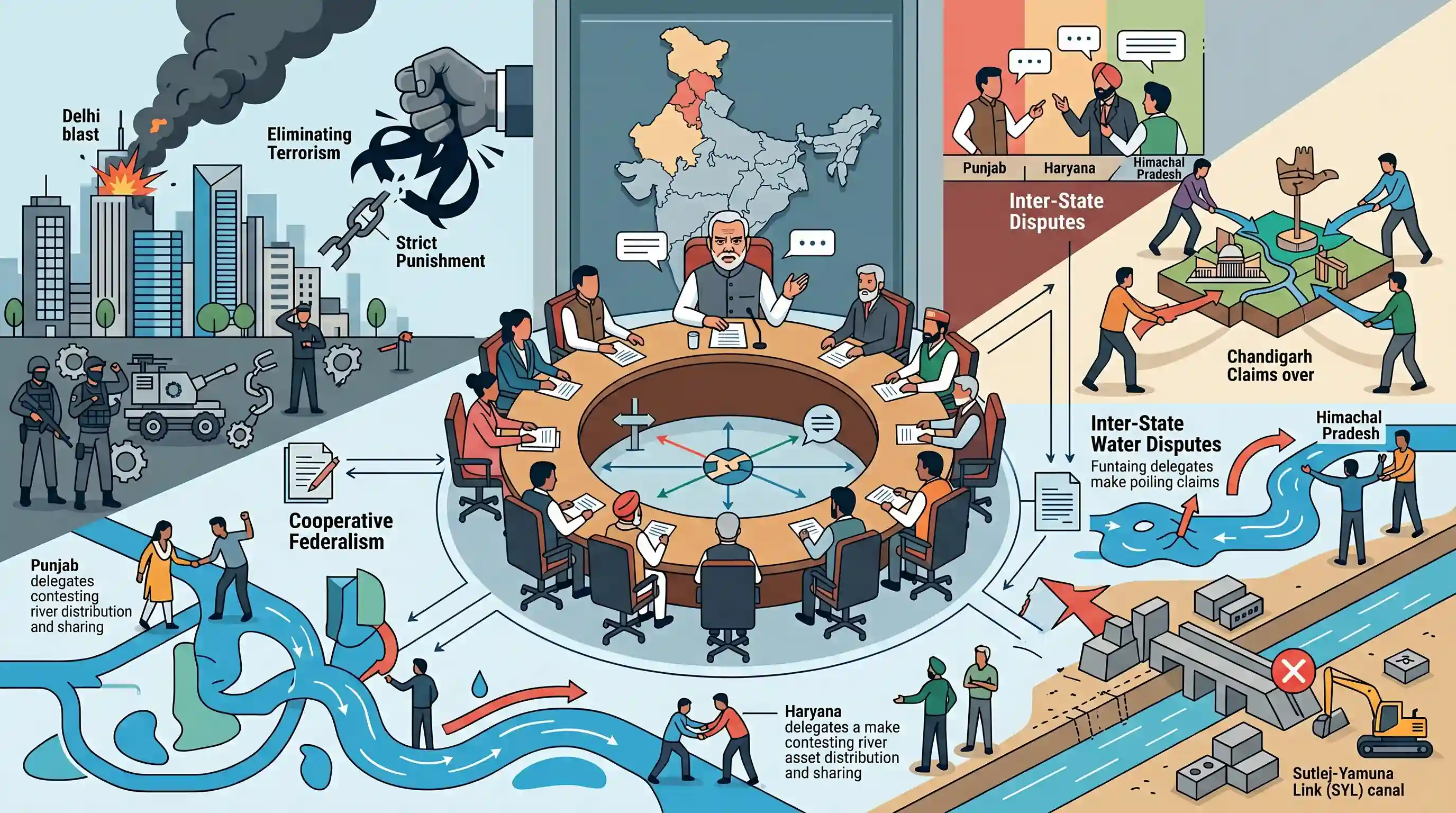
At the 32nd Northern Zonal Council meeting, Union Home Minister Amit Shah emphasized the government's resolve to eliminate terrorism, assuring strict punishment for those behind the recent Delhi blast. The forum served as a stage for pressing inter-state disputes, bringing the complexities of cooperative federalism to the forefront. Himachal Pradesh and Punjab asserted competing claims over the Union Territory of Chandigarh and the sharing of river waters and assets under the Punjab Reorganisation Act, 1966. Furthermore, Haryana raised the long-standing issue of the Sutlej-Yamuna Link (SYL) canal's non-construction. The meeting underscored the vital role of statutory bodies like Zonal Councils in mediating center-state and inter-state conflicts.
Key Points
- At the 32nd Northern Zonal Council meeting in Faridabad, Union Home Minister Amit Shah vowed strict punishment for the culprits of the recent Delhi bomb blast, emphasizing a zero-tolerance policy against terrorism.
- He underscored the significance of Zonal Councils in promoting cooperative federalism, dialogue, and policy coordination among states.
- Himachal Pradesh demanded a 7.19% share in Chandigarh's land and assets under the Punjab Reorganisation Act, 1966, alongside claiming pending dues and a permanent member seat in the Bhakra Beas Management Board (BBMB).
- Haryana raised the delayed construction of the Sutlej-Yamuna Link (SYL) canal, while Punjab reasserted its own claims over Chandigarh, river waters, and Panjab University, criticizing the centralisation of authority.
Important Terms
Northern Zonal Council (NZC)

A statutory body established under the States Reorganisation Act, 1956, chaired by the Union Home Minister to foster coordination between Northern states and UTs.
UPSC context
GS Paper II: Statutory Bodies. Tests understanding of cooperative federalism and mechanisms for resolving inter-state and Center-state disputes.
Sutlej-Yamuna Link (SYL) Canal
A proposed 214-km canal designed to share Ravi-Beas river waters between Punjab and Haryana; it remains a major point of inter-state litigation and political friction.
UPSC context
GS Paper II: Inter-State Relations. Vital for questions on water sharing disputes and the role of the judiciary in federal conflicts.
Punjab Reorganisation Act, 1966
The 1966 legislation that partitioned the erstwhile Punjab into the states of Punjab and Haryana and the Union Territory of Chandigarh on linguistic and cultural lines.
UPSC context
GS Paper II: Reorganisation of States. Tests knowledge of India's post-independence internal boundary changes and resultant administrative/asset disputes.
Bhakra Beas Management Board (BBMB)
A statutory body under the Ministry of Power that regulates the supply of water and electricity from the Bhakra-Nangal and Beas projects to Northern states.
UPSC context
GS Paper II: Statutory Bodies/Federalism. Relevant for issues regarding inter-state asset management and recent controversies over administrative appointment rules.
Panjab University
An institution established as an inter-state body corporate under the 1966 Reorganisation Act, whose control and affiliation rights are contested by Punjab, Haryana, and HP.
UPSC context
GS Paper II: Inter-State Relations. Illustrates the complexities of managing shared assets and cultural institutions following the bifurcation of states.
Prelims Trap
"Zonal Councils are constitutional bodies established under Article 263 and chaired by the Prime Minister."
Zonal Councils are statutory bodies (States Reorganisation Act, 1956) chaired by the Home Minister, unlike the Inter-State Council (Art 263) which is constitutional and PM-chaired.
Static Concepts Connected
How are Zonal Councils structured under Indian Polity?
- Statutory Origin: Created by the States Reorganisation Act of 1956, making them statutory, not constitutional bodies.
- Leadership: The Union Home Minister is the common chairman for all councils; Chief Ministers serve as Vice-Chairmen by rotation.
- Advisory Role: They act purely as advisory forums to resolve border, linguistic, and inter-state transport disputes, fostering cooperative federalism.
What constitutional mechanisms address inter-state water disputes?
- Article 262: Empowers Parliament to enact laws for the adjudication of any dispute regarding the use, distribution, or control of inter-state river waters.
- Judicial Exclusion: Parliament can explicitly restrict the Supreme Court or any other court from exercising jurisdiction over these water disputes.
- Statutory Backing: Parliament enacted the Inter-State Water Disputes Act, 1956, which provides for ad-hoc tribunals to adjudicate such conflicts.
Cross-Topic Patterns
Terrorism + Cooperative Federalism
Addressing the Delhi blast at a Zonal Council highlights how internal security and counter-terrorism mandates increasingly rely on state-level intelligence sharing and inter-state administrative cooperation.
Post-Independence Consolidation legacy
The enduring disputes over Chandigarh, BBMB seats, and SYL canal waters underscore how the Punjab Reorganisation Act of 1966 continues to generate active federal friction decades later.

Expect a 2026 prelims multi-statement question contrasting Zonal Councils vs Inter-State Councils on origin, chairmanship, and mandate.
Linked PYQs · 4
Linked PYQs · 4
- 2019MainsGS3
Indian Government has recently strengthened the anti-terrorism laws by amending the Unlawful Activities (Prevention) Act (UAPA), 1967 and the NIA Act. Analyze the changes in the context of prevailing security environment while discussing the scope and reasons for opposing the UAPA by human rights organizations.
- 2021MainsGS3
Analyse the complexity and intensity of terrorism, its causes, linkages and obnoxious nexus. Also suggest measures required to be taken to eradicate the menace of terrorism.
- 2025PrelimsGS1
With reference to India, consider the following: I. The Inter-State Council II. The National Security Council III. Zonal Councils How many of the above were established as per the provisions of the Constitution of India?
- 2024MainsGS2
What changes has the Union Government recently introduced in the domain of Centre-State relations ? Suggest measures to be adopted to build the trust between the Centre and the States and for strengthening federalism.
