Anti-Maoist Operations and Internal Security in Abujhmad
Source:The Hindu ↗
Why It Matters
Left-Wing Extremism (LWE) is a core topic in the UPSC GS3 Internal Security syllabus. This recent operation underscores the strategic importance of localized forces like the District Reserve Guards (DRG) and intelligence-led kinetic operations in dismantling insurgent strongholds like Abujhmad. Understanding the government's approach to neutralizing LWE leadership is critical for analyzing internal security trends.
Summary
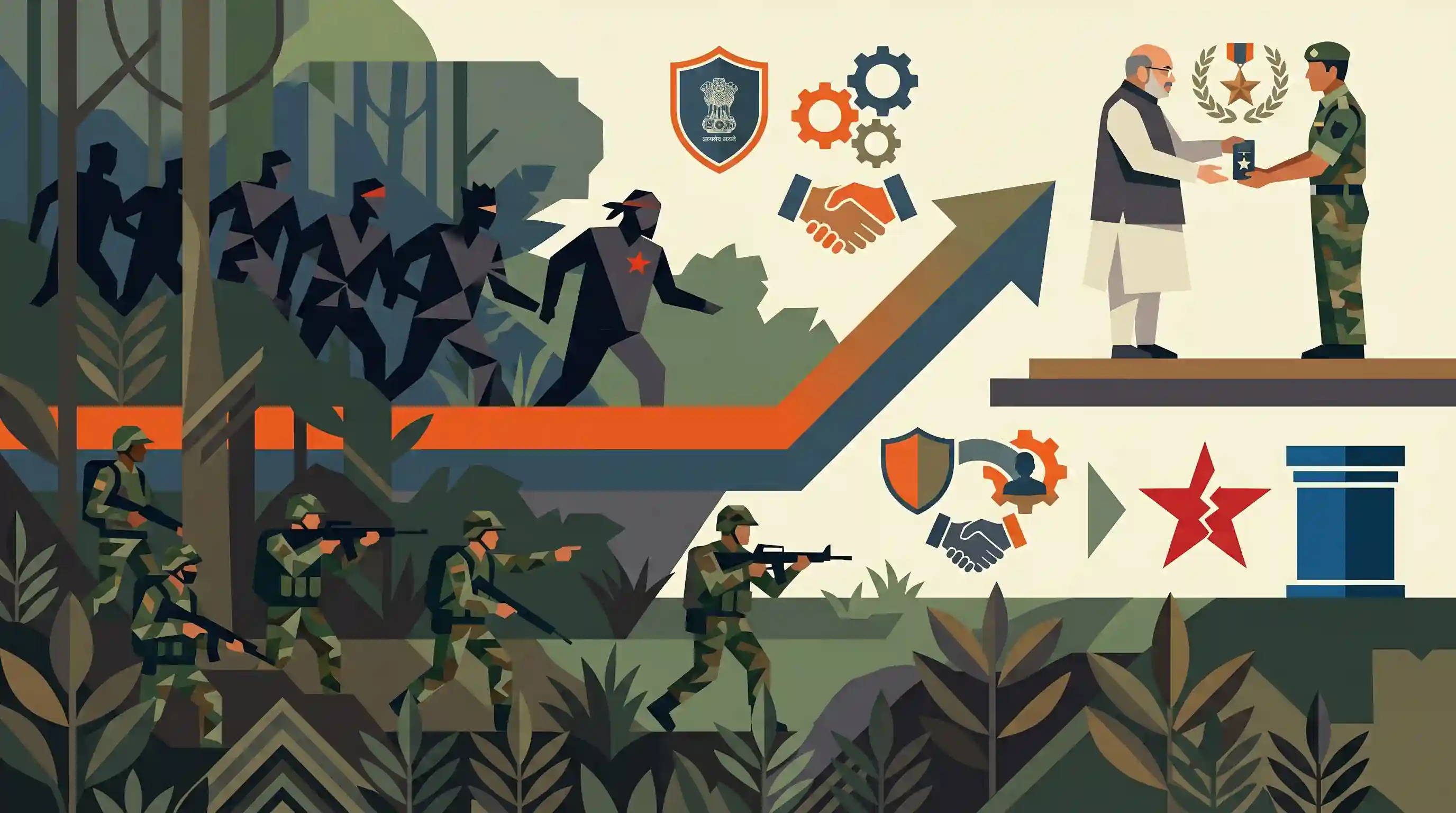
Union Home Minister Amit Shah felicitated officers of the Chhattisgarh Police and the District Reserve Guards (DRG) for a successful anti-Maoist operation in the interior Abujhmad region. The multi-day operation in the forests of Boter village culminated in the deaths of 27 Maoists, including senior CPI (Maoist) leader Basavaraju alias Gaganna. Reaffirming the Union Government's resolve to free India from Maoism, Shah praised the coordination and bravery of the local security forces. The operation marks a significant blow to Left-Wing Extremism (LWE) leadership in the Bastar area.
Key Points
- Union Home Minister Amit Shah felicitated Chhattisgarh police officers, particularly the District Reserve Guards (DRG), for a highly successful anti-Maoist operation.
- A major encounter in the forests of Boter village (Abujhmad region) between May 18-21 led to the elimination of 27 Maoists.
- Among those killed was Basavaraju alias Gaganna, a top Polit Bureau member and general secretary of the Communist Party of India (Maoist).
- Shah reiterated the central government's firm commitment to eradicating the menace of Left-Wing Extremism (LWE) from the country.
- The operation highlights the effectiveness of localized counter-insurgency units like the DRG and strong intelligence coordination in neutralizing high-value targets in deeply forested red corridors.
Important Terms
District Reserve Guard (DRG)

A specialized unit of the Chhattisgarh Police recruited primarily from local tribal youth and surrendered Maoists to utilize their knowledge of terrain and language in anti-insurgency operations.
UPSC context
GS Paper 3 (Internal Security); tests knowledge of state-level security forces and community-based counter-insurgency models.
Abujhmad
A remote, densely forested plateau in Chhattisgarh's Bastar division; historically a major Maoist stronghold and "liberated zone" due to its extreme inaccessibility and lack of administrative reach.
UPSC context
GS Paper 3 (Internal Security) and GS Paper 1 (Geography); identifies critical conflict zones and tribal regions (home to PVTGs).
Left-Wing Extremism (LWE)
An armed insurgency motivated by Maoist ideology that seeks to overthrow the state through violent revolution, typically rooted in socio-economic inequality and displacement in tribal belts.
UPSC context
GS Paper 3 (Internal Security); core topic regarding internal threats, the 'Red Corridor,' and the government's 'SAMADHAN' strategy.
CPI (Maoist)
A banned terrorist organization formed in 2004 through the merger of major Naxalite factions; it aims to establish a Maoist regime via "protracted people's war."
UPSC context
GS Paper 3 (Security); examines the ideology and evolution of banned extremist groups in India.
Counter-Insurgency (COIN)
Comprehensive military and political actions taken by a state to defeat an insurgency; in the Indian LWE context, it emphasizes a dual-track security and development approach.
UPSC context
GS Paper 3 (Internal Security); tests understanding of operational strategies and the role of police vs. central paramilitary forces.
Prelims Trap
District Reserve Guards (DRG) is a specialized CAPF unit deployed by the Union Ministry of Home Affairs.
DRG is a State Police unit of Chhattisgarh, not a Central Armed Police Force. It is uniquely raised from local tribal youth and surrendered Naxals.
Static Concepts Connected
What is the 'Clear, Hold, and Build' doctrine in counter-insurgency?
- Clear: Security forces launch intelligence-based kinetic operations to eliminate insurgents and dismantle their camps in strongholds.
- Hold: Establishing Forward Operating Bases (FOBs) and permanent security camps to physically occupy the area and prevent the return of insurgents.
- Build: Executing rapid infrastructure development (roads, telecom towers, schools, hospitals) to integrate the region and win the trust of local populations.
What are the key pillars of the SAMADHAN doctrine?
- Acronym Breakdown: It stands for Smart Leadership, Aggressive Strategy, Motivation & Training, Actionable Intelligence, Dashboard KPIs, Harnessing Tech, Action plan, and No access to financing.
- Core Objective: It represents the Ministry of Home Affairs' overarching multi-pronged strategy to eradicate LWE by combining aggressive military operations with targeted socio-economic development.
Cross-Topic Patterns
Surrender policies & Rehabilitation
The success of the DRG highlights the effectiveness of state surrender-and-rehabilitation policies, utilizing surrendered Naxals' terrain intelligence to dismantle their former networks.
Forest Rights Act vs. LWE
Effective counter-insurgency pairs kinetic operations with rigorous implementation of the Forest Rights Act (FRA) 2006 and PESA to resolve the underlying land and resource grievances that fuel Left-Wing Extremism.

Mains 2026 likely to test the 'Clear, Hold, Build' doctrine and the role of localized units like DRG in shrinking the Red Corridor.
Linked PYQs · 3
Linked PYQs · 3
- 2022MainsGS3
Naxalism is a social, economic and developmental issue manifesting as a violent internal security threat. In this context, discuss the emerging issues and suggest a multilayered strategy to tackle the menace of Naxalism.
- 2018MainsGS3
Left Wing Extremism (LWE) is showing a downward trend, but still affects many parts of the country. Briefly explain the Government of India's approach to counter the challenges posed by LWE.
- 2015MainsGS3
The persisting drives of the Government for development of large industries in backward areas have resulted in isolating the tribal population and the farmers who face multiple displacements. With Malkangiri and Naxalbari foci, discuss the corrective strategies needed to win the Left Wing Extremism (LWE) doctrine affected citizens back into the mainstream of social and economic growth.
