India foreign policy priorities and bilateral partnerships in Europe
Source:The Hindu ↗
Why It Matters
The article provides a comprehensive overview of India’s current foreign policy priorities—multi-alignment, supply chain diversification, and energy security—which are recurring themes in GS2 (International Relations) and GS3 (Economy/Environment). It touches upon key regional engagements (UAE, EU, Nordic countries) that are highly relevant for Mains questions on bilateral relations and strategic partnerships.
Summary
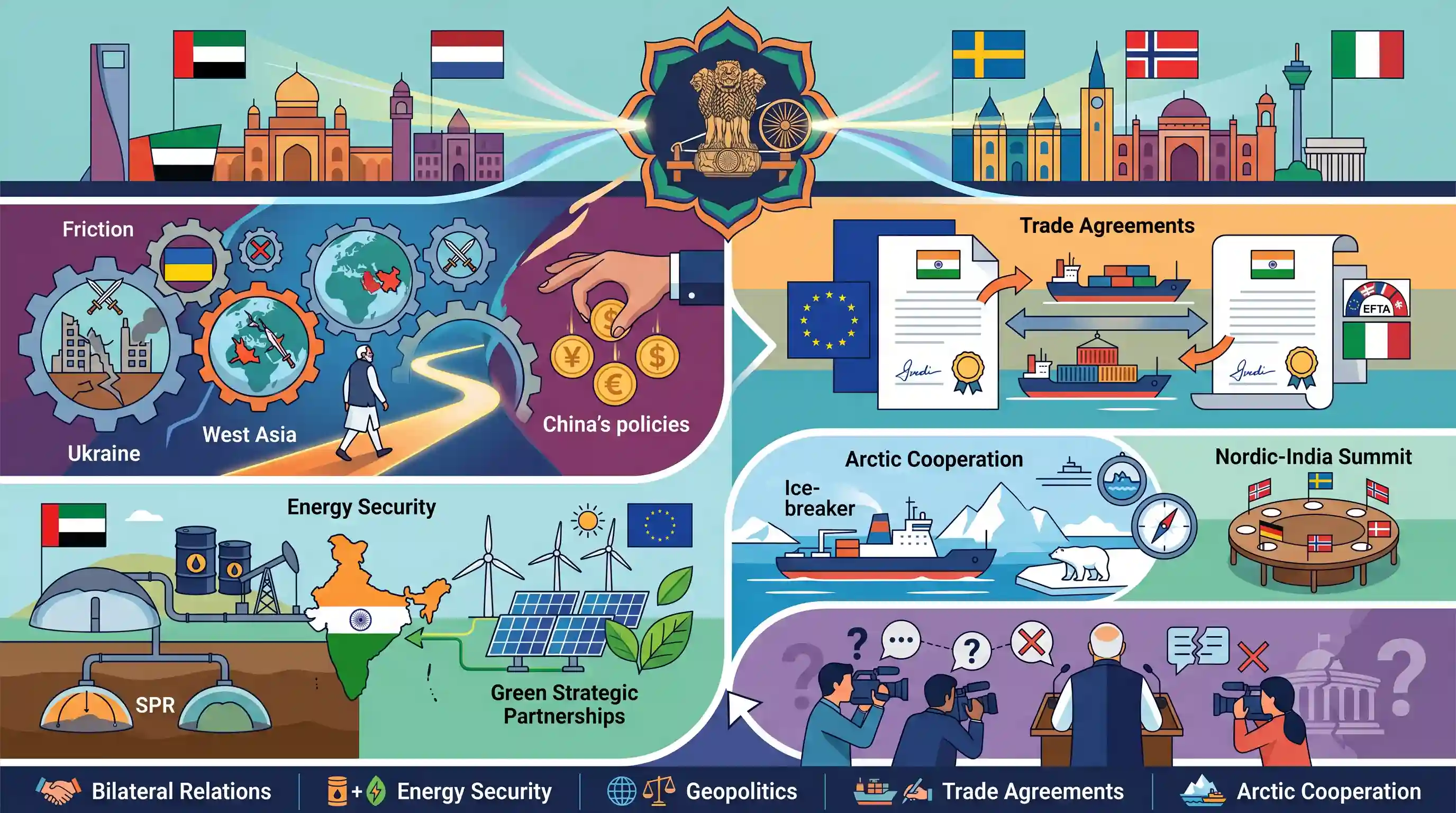
Prime Minister Narendra Modi’s five-nation diplomatic tour to the UAE and Europe (Netherlands, Sweden, Norway, and Italy) underscores a strategic push to strengthen trade, ensure energy security, and navigate complex global geopolitics. At a time of superpower friction—involving conflicts in Ukraine and West Asia, and China’s coercive economic policies—the tour aimed to solidify European ties, notably pushing forward the India-EU Free Trade Agreement and leveraging the newly implemented India-EFTA pact. The agenda also included vital energy discussions, spanning Strategic Petroleum Reserves in the UAE and 'Green Strategic Partnerships' in Europe. Furthermore, the revived Nordic-India Summit emphasized maritime and Arctic cooperation. However, the Prime Minister's reluctance to address press conferences in the Netherlands and Norway drew criticism, bringing attention to democratic perceptions abroad.
Key Points
- Prime Minister Modi's five-nation tour aimed to bolster India’s trade, technological, and strategic partnerships across the UAE and Europe.
- The diplomatic outreach seeks to advance the India-EU Free Trade Agreement and build upon the recent India-EFTA pact.
- Discussions focused on long-term Strategic Petroleum Reserves with the UAE and Green Strategic Partnerships with European nations to ensure energy security.
- The Nordic-India Summit highlighted cooperation on maritime security and scientific collaboration in the Arctic region.
- The tour reflects India’s strategy of multi-alignment, aiming to diversify supply chains away from China while navigating the geopolitical fallout of conflicts in Ukraine and West Asia.
- Modi's avoidance of open press interactions in the Netherlands and Norway raised questions about transparency and adherence to democratic norms during diplomatic visits.
Important Terms
Trade and Economic Partnership Agreement (TEPA)

A landmark free trade agreement between India and EFTA (Iceland, Liechtenstein, Norway, Switzerland) featuring a binding $100 billion investment commitment and job creation targets over 15 years.
UPSC context
GS Paper 2 (International Relations) & 3 (Economy). Tests India's shift toward including legally binding investment clauses in FTAs.
European Free Trade Association (EFTA)
An intergovernmental trade bloc consisting of Iceland, Liechtenstein, Norway, and Switzerland, operating independently of the European Union to promote free trade among its members and global partners.
UPSC context
GS Paper 2 (Bilateral/Regional Groupings). Critical for distinguishing European economic architectures and India's diversified diplomatic engagement.
India-EU Free Trade Agreement (FTA)
A comprehensive economic pact concluded in 2026 between India and the 27-member EU to liberalize trade, affecting 25% of global GDP and targeting doubled bilateral trade by 2032.
UPSC context
GS Paper 2 (International Relations). Key for analyzing market access, regulatory alignment, and strategic economic autonomy in a multipolar world.
Green Strategic Partnership
A value-driven bilateral framework (e.g., India-Denmark, India-Norway) focused on climate action, sustainable technology transfer, and achieving Paris Agreement targets through green growth and innovation.
UPSC context
GS Paper 2 & 3 (IR/Environment). Tests knowledge of India's technology-led climate diplomacy and specific sectoral cooperation with European nations.
Nordic-India Summit
A multilateral forum involving India and the five Nordic countries (Denmark, Finland, Iceland, Norway, Sweden) to collaborate on green transition, maritime security, and Arctic research.
UPSC context
GS Paper 2 (Groupings/Agreements). Represents India's "Link North" policy and collective engagement with high-innovation, sustainability-focused small states.
Strategic Petroleum Reserves (SPR)
Emergency crude oil stockpiles maintained by India to mitigate supply disruptions. The UAE’s ADNOC is the sole foreign entity permitted to store oil in these facilities.
UPSC context
GS Paper 3 (Energy Security). Crucial for understanding India's energy resilience and strategic interdependence with West Asian partners.
Arctic Council
The primary intergovernmental forum for Arctic states and indigenous groups. India, as an Observer, conducts climate research via its 'Himadri' station in Svalbard, Norway.
UPSC context
GS Paper 2 & 3 (IR/Environment). Important for analyzing the intersection of global climate change, maritime routes, and India's polar research interests.
Prelims Trap
The India-EU Free Trade Agreement guarantees a legally binding $100 billion European investment in India.
The $100 billion legally binding investment commitment is under the India-EFTA TEPA, not the EU FTA. Furthermore, EFTA members (Iceland, Liechtenstein, Norway, Switzerland) are not EU members.
Static Concepts Connected
Where are India's Strategic Petroleum Reserves (SPRs) located?
- Phase I Locations: Constructed by ISPRL at Visakhapatnam (Andhra Pradesh), Mangaluru (Karnataka), and Padur (Karnataka) with a total capacity of 5.33 MMT.
- Phase II Expansion: Approved for Chandikhol (Odisha) and Padur (Karnataka) on a public-private partnership (PPP) model to add 6.5 MMT capacity.
- Strategic Purpose: To provide energy security for roughly 9.5 days (Phase I) in case of global supply disruptions, supplementing commercial refinery storage.
How does the European Free Trade Association (EFTA) differ from the EU?
- Membership: EFTA has only 4 members: Iceland, Liechtenstein, Norway, and Switzerland. None of them are EU member states.
- Customs Union: EFTA is a free trade area but not a customs union; its members set their own external tariffs, unlike the EU.
- Single Market: Most EFTA states participate in the EU Single Market via the EEA agreement, but they do not participate in EU political integration.
Cross-Topic Patterns
Arctic Governance + Climate Change
The Nordic-India summit’s Arctic focus ties directly into India’s Arctic Policy (2022) and its Observer status at the Arctic Council, linking climate science to the geopolitics of the Northern Sea Route.
Trade Deals + Non-Trade Barriers (NTBs)
European nations increasingly push for labor, gender, and climate standards in FTAs (like the pending EU FTA). India's resistance to these non-trade barriers is a recurring mains theme.

Multi-statement question likely on the India-EFTA TEPA vs India-EU FTA, focusing on the unique $100B binding investment clause.
Linked PYQs · 4
Linked PYQs · 4
- 2017MainsGS2
The question of India's Energy Security constitutes the most important part of India's economic progress. Analyze India's energy policy cooperation with West Asian countries.
- 2018MainsGS1
Why is India taking keen interest in resources of Arctic Region?
- 2023MainsGS2
‘The expansion and strengthening of NATO and a stronger US-Europe strategic partnership works well for India.’ What is your opinion about this statement ? Give reasons and examples to support your answer.
- 2011MainsGS2
As regards the increasing rates of melting of Arctic Sea ice, the interests of the Arctic Council nations may not coincide with those of the wider world." Explain.
