Shifting global education trends prompt policy rethink for students
Source:The Hindu ↗
Why It Matters
Understanding the dynamics of international student migration and the inadequacies of India's higher education and research sectors is crucial for addressing issues of 'brain drain' and formulating policies to build a robust domestic knowledge economy.
Summary
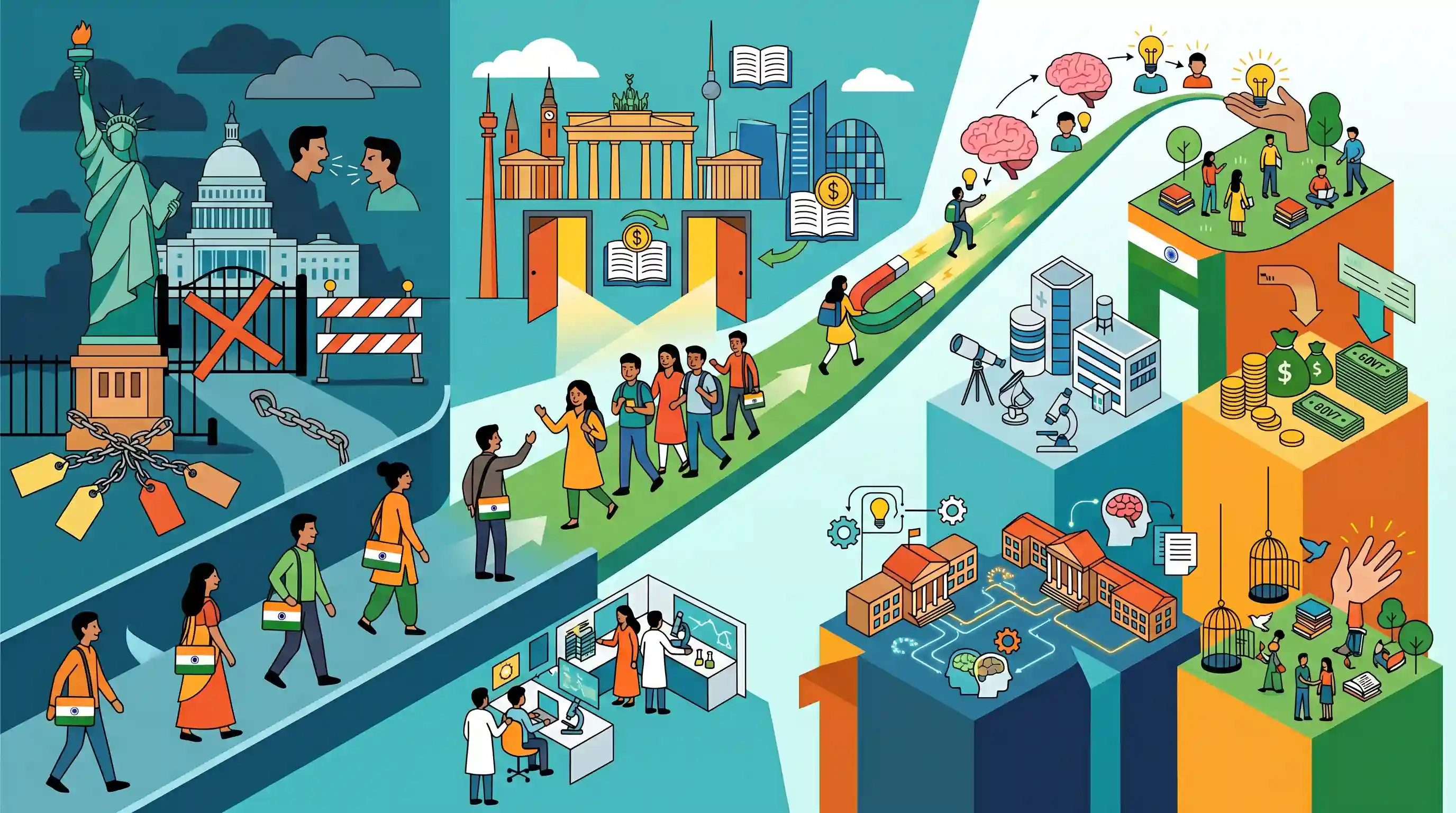
The shifting global landscape of higher education is causing Indian students to reconsider the US as a premier destination, pivoting instead towards more welcoming and affordable European nations like Germany. Restrictive US immigration policies, potential cuts to the OPT program, and an increasingly tense political environment are contributing to this trend. While this scenario presents an opportunity for India to attract academic talent and researchers back home, doing so requires addressing domestic challenges. India needs to enhance its research infrastructure, increase government and private funding, foster inter-institutional collaboration, and cultivate an atmosphere of academic freedom and liberal values to genuinely benefit from reverse brain drain.
Key Points
- Indian students are increasingly seeking alternatives to US universities due to concerns over visa revocations, potential cancellation of the Optional Practical Training (OPT) program, and political climate.
- European countries like Germany are attracting more Indian students by offering lower costs and flexibility for students to self-fund through work.
- To attract and retain talent in India, returning students must be incentivized by more than just a desire to serve the motherland; they require solid professional opportunities and research funding.
- India's research ecosystem struggles with inadequate infrastructure, insufficient private and public funding, and a lack of cross-disciplinary collaboration.
- Recreating a conducive environment for high-end research in India also requires systemic changes to ensure academic freedom, reduce hierarchical norms, and promote liberal values.
Important Terms
Optional Practical Training (OPT)

A US program allowing F-1 visa students to work for 12 months (36 for STEM) in their field of study post-graduation.
UPSC context
GS Paper II (International Relations - Indian Diaspora) and GS Paper III (Economy - Employment). Tests understanding of migration policies.
Reverse Brain Drain
The return of highly skilled professionals and researchers to their home country after being educated or employed abroad, often driven by domestic growth.
UPSC context
GS Paper II (Social Justice - Education) and GS Paper III (Human Resources). Relevant for questions on human capital and diaspora engagement.
Brain Drain
The emigration of highly trained or intelligent people from a particular country to another, leading to a loss of skilled human capital.
UPSC context
GS Paper II (Social Justice). Tests knowledge of the socio-economic impacts of migration on developing nations.
Gross Expenditure on R&D (GERD)
The total expenditure on R&D performed within a country during a specific period. India's GERD is currently approximately 0.64% to 0.7% of GDP.
UPSC context
GS Paper III (Science and Tech/Economy). Tests data-backed understanding of India's innovation challenges and budgetary priorities.
Academic Freedom
The liberty for students and faculty to teach, study, and pursue research without unreasonable interference or fear of censorship.
UPSC context
GS Paper II (Social Justice - Education) and GS Paper IV (Ethics). Important for discussions on institutional autonomy and research quality.
Brain Circulation
A modern migration model where knowledge and talent flow dynamically between countries rather than one-way, fostering global innovation networks.
UPSC context
GS Paper II (International Relations - Diaspora). Relevant for nuanced discussions on globalization and the 'brain drain vs brain gain' debate.
Prelims Trap
"India's Gross Expenditure on R&D (GERD) is primarily driven by private sector investments."
In India, the government contributes the lion's share of R&D funding, unlike advanced economies where the private sector drives 70%+ of R&D.
Static Concepts Connected
What are the major Indian schemes to promote reverse brain drain?
- VAJRA Scheme: Brings overseas scientists and academicians (including NRIs and OCIs) to India for collaborative research in public institutions.
- Ramanujan Fellowships: Attracts highly skilled Indian researchers working abroad to return and take up scientific research positions in India.
- Ramalingaswami Fellowship: A targeted re-entry scheme specifically for Indian scientists working overseas in life sciences and biotechnology.
How does India's R&D funding landscape compare globally?
- GERD Stagnation: India's Gross Expenditure on R&D has remained stagnant at around 0.65% of GDP for the past decade, far below the US (2.5%) or Israel (5%).
- Low Private Share: The private sector contributes only about 36% to Indian R&D, whereas in developed countries, it drives over 70% of research investments.
Cross-Topic Patterns
Migration + Demographic Dividend
The student shift towards Germany aligns with Europe's aging population, which increasingly relies on India's demographic dividend for skilled STEM labor amidst rising US protectionism.
Higher Ed + Forex Drain
Outward student mobility heavily depletes forex reserves, making the NEP 2020 push for internationalization (allowing foreign university campuses in India) crucial for economic retention.

Expect a GS3 Mains question linking low private sector R&D funding with India's inability to leverage the global reverse brain drain.
Linked PYQs · 3
Linked PYQs · 3
- 2015MainsGS2
The quality of higher education in India requires major improvements to make it internationally competitive. Do you think that the entry of foreign educational institutions would help improve the quality of higher and technical education in the country? Discuss.
- 2014MainsGS2
Should the premier institutes like IITs/IIMs. be allowed to retain premier status, allowed more academic independence in designing courses and also decide mode/criteria of selection of students. Discuss in light of the growing challenges.
- 2023MainsGS2
Indian diaspora has scaled new heights in the West. Describe its economic and political benefits for India.
