विपक्षी दल ने अमेरिकी व्यापार समझौते पर सरकारी समन्वय की आलोचना की
स्रोत:द हिंदू ↗
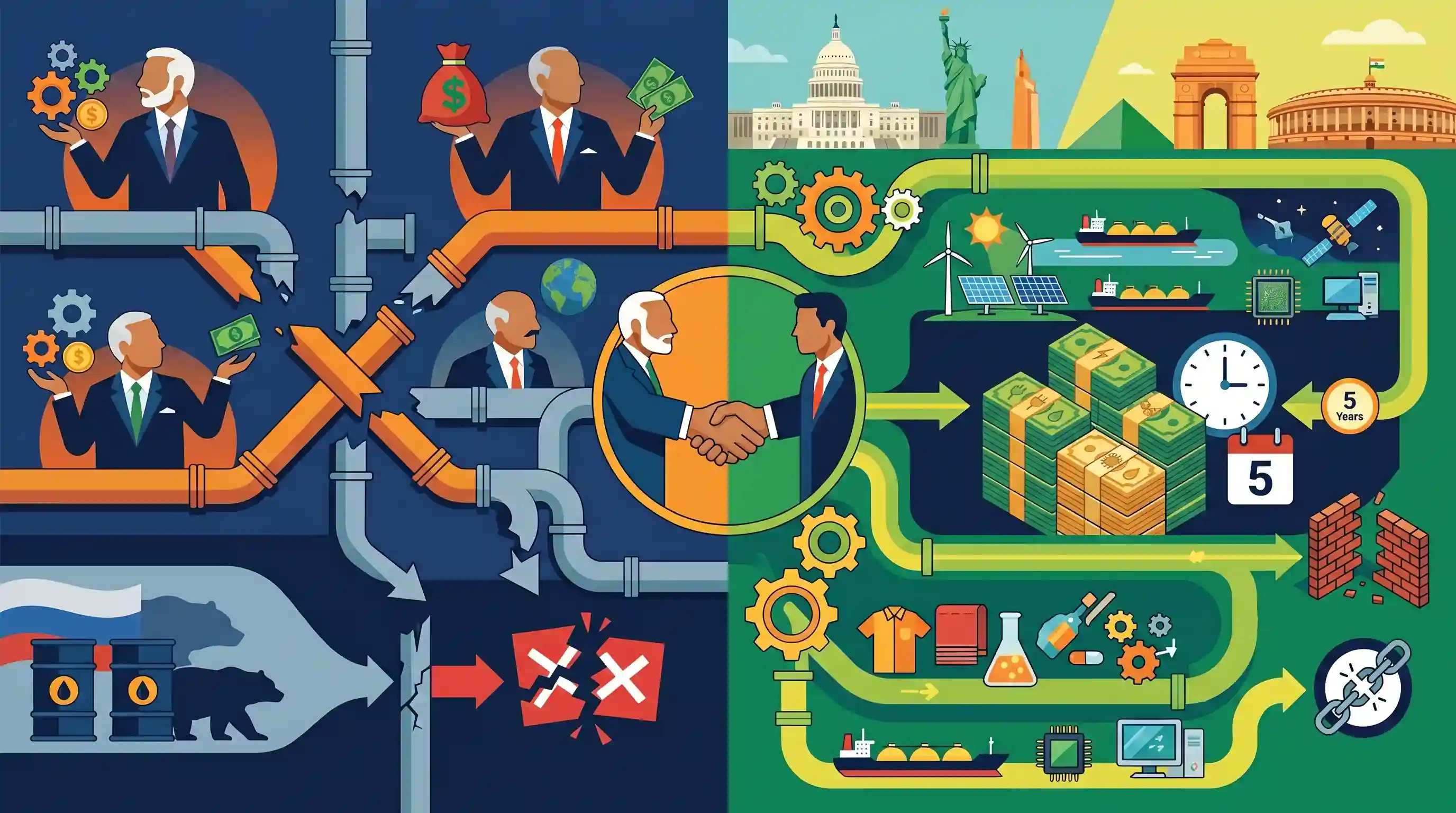
क्यों मायने रखता है
The article sheds light on India's delicate balancing act between maintaining strategic autonomy (buying Russian oil) and deepening bilateral trade and energy ties with the United States. It also raises questions about structural efficiency and coordination ('whole of government' approach) in Indian policymaking and diplomacy.
सारांश
The Congress party has criticized the ruling government's approach to the India-U.S. trade deal and Russian oil imports, describing it as a disjointed 'hole in government' rather than a unified 'whole of government' strategy. This follows apparent evasions by key ministers, including Commerce Minister Piyush Goyal and External Affairs Minister S. Jaishankar, regarding their portfolios. The context is a newly announced bilateral trade framework wherein India intends to procure $500 billion of U.S. energy and technology products over five years. In exchange, the U.S. will lower tariffs on Indian goods to 18% and remove punitive tariffs previously levied due to India's purchase of Russian oil.
मुख्य बिंदु
- The Congress party criticized the Indian government for lacking inter-ministerial coordination over the India-U.S. trade deal and Russian oil imports, calling it a 'hole in government' rather than a 'whole of government' approach.
- The critique followed reported incidents where the Commerce Minister and External Affairs Minister deflected questions about their respective domains.
- A framework for an India-U.S. bilateral trade agreement states India's intent to purchase $500 billion worth of U.S. products, including energy, aircraft, and technology, over five years.
- In return, the U.S. agreed to reduce tariffs on Indian goods to 18%, and President Donald Trump issued an executive order lifting a 25% punitive tariff previously imposed on India for buying Russian oil.
महत्वपूर्ण शब्द
Whole-of-Government Approach

A collaborative strategy where multiple government ministries and agencies coordinate across departmental boundaries to achieve unified policy goals and eliminate 'silos' in public administration.
UPSC context
Relevant for GS Paper 2 (Governance) regarding inter-ministerial coordination, administrative efficiency, and integrated policy execution.
India-U.S. Strategic Trade Framework
A 2026 bilateral arrangement where India commits to $500 billion in U.S. purchases (energy/tech) over five years in exchange for reduced tariffs on Indian exports.
UPSC context
GS Paper 2 (International Relations) testing bilateral agreements and trade diplomacy between India and its largest trading partner.
Strategic Autonomy
The doctrine where a nation makes independent foreign policy and security decisions based on national interest, without being coerced by external powers or alliances.
UPSC context
Core GS Paper 2 concept regarding India's balancing act between Russia and Western powers like the U.S.
Punitive Tariffs
Extra duties imposed on imports to penalize a country's specific policy or action, often used as political leverage in trade negotiations.
UPSC context
GS Paper 3 (Economy) and GS Paper 2 (International Relations) regarding trade wars and economic coercion.
Energy Security
The continuous availability of energy in varied forms, in sufficient quantities, and at affordable prices to support national economic development.
UPSC context
GS Paper 3 (Economy/Resources) concerning India's oil diversification and the geopolitical risks of energy imports.
प्रारंभिक ट्रैप
"The US levied the 25% tariff on Indian goods as a WTO-authorized countervailing duty."
This was a unilateral secondary sanction/punitive action by the US executive branch over Russian oil, completely bypassing WTO dispute mechanisms.
संबंधित अवधारणाएँ
How do unilateral 'Secondary Sanctions' function in international trade?
- Primary vs Secondary: Primary sanctions block direct trade with the target; secondary sanctions penalize third-party nations (like India) that continue trading with the target (Russia).
- Extraterritoriality: They enforce domestic laws (like US CAATSA) globally, using access to the domestic market or global financial system as leverage against non-compliant foreign entities.
What defines a 'Whole-of-Government' approach in public administration?
- Core Philosophy: Joint activities performed by diverse ministries to provide a unified solution to complex policy challenges, actively dismantling traditional departmental silos.
- Indian Context: Critical for intersecting issues—like the trade-geopolitics nexus—where Commerce, External Affairs, and Energy ministries must synchronize to prevent contradictory foreign policy messaging.
अंतर-विषय पैटर्न
Strategic Autonomy via Trade Agreements
Balancing Russian discounted oil with a massive $500B US energy/tech procurement illustrates India's multi-alignment strategy, shifting from traditional non-alignment to highly transactional geopolitical hedging.
Bypassing WTO Multilateralism
Unilateral punitive tariffs and negotiated bilateral tariff ceilings (like the 18% cap) reflect the ongoing erosion of multilateral WTO dispute resolution in favor of direct bilateral leverage.

Secondary sanctions vs. WTO trade remedies, coupled with India-US energy diplomacy, is a highly probable 2026 Prelims/Mains theme.
संबद्ध PYQ · 3
संबद्ध PYQ · 3
- 2025MainsGS2
"Energy security constitutes the dominant kingpin of India's foreign policy, and is linked with India's overarching influence in Middle Eastern countries.” How would you integrate energy security with India's foreign policy trajectories in the coming years?
- 2025MainsGS2
"The reform process in the United Nations remains unresolved, because of the delicate imbalance of East and West and entanglement of the USA vs. Russo-Chinese alliance.” Examine and critically evaluate the East-West policy confrontations in this regard.
- 2022MainsGS2
The Gati-Shakti Yojana needs meticulous coordination between the government and the private sector to achieve the goal of connectivity. Discuss.
