Political Transition and Security Challenges in Bangladesh
Source:The Hindu ↗
Why It Matters
A stable political centre in Bangladesh is crucial for India to secure its eastern borders, curb cross-border extremism, and successfully implement its neighborhood-first diplomatic initiatives.
Summary
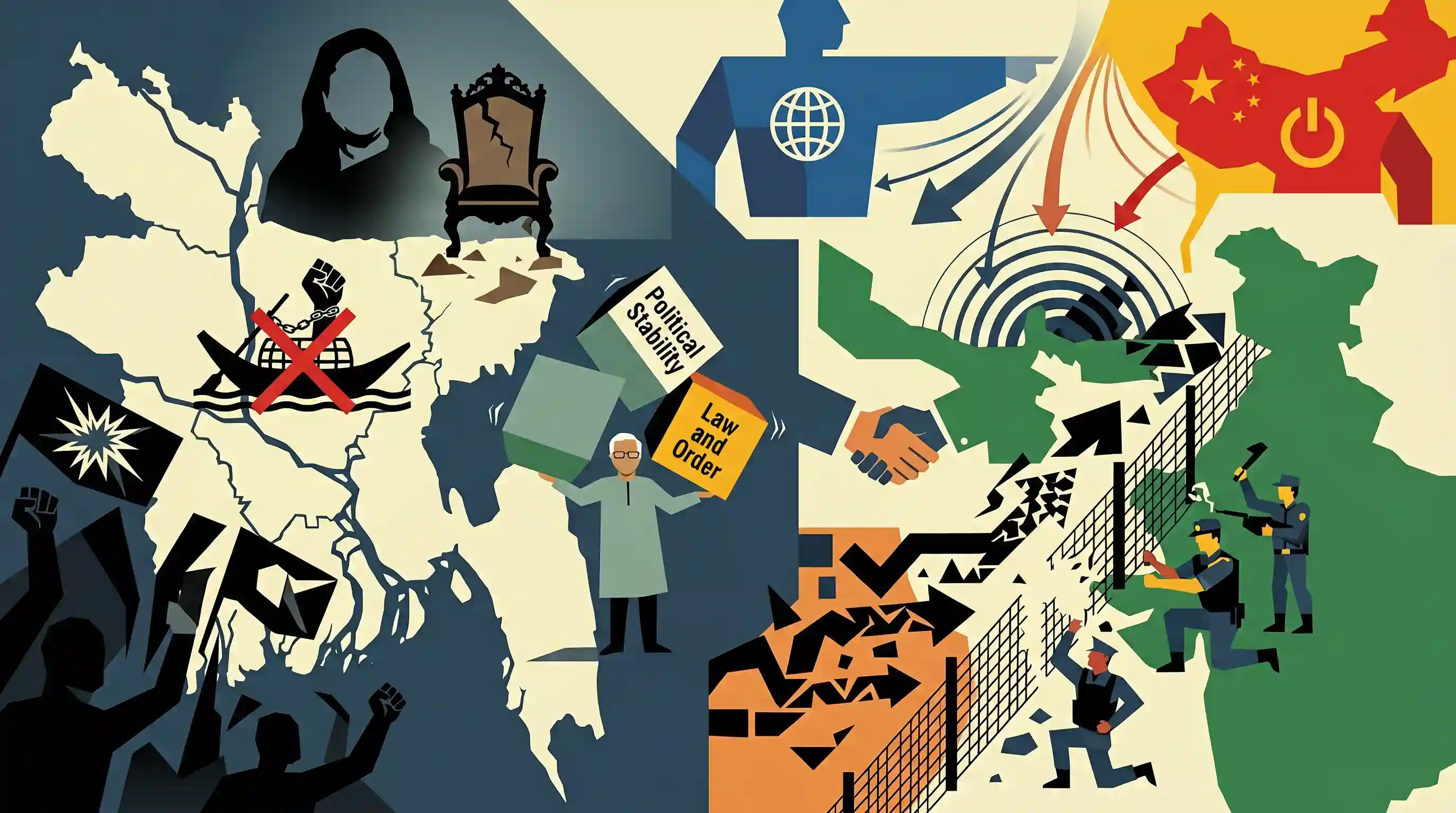
The editorial examines the political transition in Bangladesh following the death of former PM Khaleda Zia. With the Awami League banned and extremist forces like the JMB re-emerging ahead of the 2026 elections, the interim government led by Muhammad Yunus is struggling to maintain a stable political centre. This growing instability in Dhaka threatens regional peace and poses significant diplomatic and border security challenges for India's neighborhood-first policy.
Key Points
- The death of former Bangladesh PM Khaleda Zia marks the end of a pivotal political era defined by her long-standing rivalry with Sheikh Hasina.
- Bangladesh's upcoming February 2026 elections face legitimacy concerns after the Muhammad Yunus-led interim government banned the Awami League.
- The resurgence of banned extremist factions like Jama'atul Mujahideen Bangladesh and the political alliance of Jamaat-e-Islami with the National Citizen Party pose severe domestic and regional security risks.
- Tarique Rahman's return to lead the BNP offers an opportunity for a moderate political centre, which is essential to prevent Bangladesh's instability from spilling over into India's borders.
Important Terms
Bangladesh Nationalist Party (BNP)

Major centre-right political party founded in 1978, promoting 'Bangladeshi nationalism'. Following the 2024 transition, it secured a landslide victory in the 2026 elections, replacing the interim administration.
UPSC context
GS-II: Neighborhood Relations. Tests understanding of how regime shifts impact India's 'Neighborhood First' policy and security cooperation.
Awami League
Historically secular party led by Sheikh Hasina; oustered in August 2024. Formally banned from the 2026 elections, its absence marks a significant shift from the traditionally pro-India stance of the Dhaka government.
UPSC context
GS-II: India-Bangladesh Relations. Examines the impact of losing a strategic partner on regional connectivity and security.
Jamaat-e-Islami (Bangladesh)
Bangladesh's largest Islamist party. Banned under the Hasina regime, its status was restored by the 2024 interim government. In 2026, it emerged as the country’s main parliamentary opposition.
UPSC context
GS-II/III: Regional Stability/Security. Tests knowledge of religious political forces and their influence on cross-border extremism.
Jama'atul Mujahideen Bangladesh (JMB)
Proscribed extremist group seeking to establish Islamic rule via violence. Linked to several terror acts in India, its reported revival in 2026 poses direct threats to West Bengal and Northeast security.
UPSC context
GS-III: Internal Security. Tests awareness of non-state actors and challenges in managing porous international borders.
National Citizen Party (NCP)
A new political entity emerging from the 2024 student-led "July Uprising." Allied with Islamist forces in the 2026 elections, it represents the formalization of protest-led activism into the political mainstream.
UPSC context
GS-II: International Relations. Analyzes the role of civil society and student movements in reshaping South Asian political landscapes.
Prelims Trap
"BIMSTEC, headquartered in Kathmandu alongside SAARC, is India's primary vehicle for regional integration."
BIMSTEC's Secretariat is located in Dhaka, Bangladesh. Aspirants often confuse it with SAARC, which is headquartered in Kathmandu. Dhaka's instability directly hampers BIMSTEC's functioning.
Static Concepts Connected
What are the primary challenges of guarding the Indo-Bangladesh border?
- Riverine terrain: Over 1,116 km of the border is riverine. Shifting river courses and seasonal floods make physical fencing nearly impossible.
- Porous nature: High population density right up to the zero-line and shared socio-cultural ties complicate strict regulation and facilitate illegal migration.
- Organized smuggling: Dense settlements and geographic continuity make it highly vulnerable to cattle smuggling, arms trafficking, and the movement of counterfeit currency.
How does BIMSTEC structurally and strategically differ from SAARC?
- Geographic focus: BIMSTEC bridges South Asia and South-East Asia (including Myanmar and Thailand), whereas SAARC is an exclusively South Asian grouping.
- Pakistan's absence: BIMSTEC excludes Pakistan. This allows India to pursue regional connectivity and integration without the bilateral blockades that paralyzed SAARC.
- Sectoral approach: BIMSTEC operates through specific lead-country sectors (e.g., India leads security and energy) rather than SAARC's broader, consensus-hampered mandate.
Cross-Topic Patterns
Bangladesh extremism & NE Insurgency
The resurgence of JMB and the banning of the Awami League threatens to reopen cross-border sanctuaries for North-East insurgent groups, reversing a decade of bilateral internal security gains.
BIMSTEC paralysis hits Act East
Domestic turmoil in Dhaka directly stalls BIMSTEC administrative functions. This hinders India's regional connectivity projects and acts as a bottleneck for the broader Act East policy.

Indo-Bangladesh border management + BIMSTEC's utility likely to form a compound Mains question assessing neighborhood instability in 2026.
Linked PYQs · 4
Linked PYQs · 4
- 2022MainsGS2
Do you think that BIMSTEC is a parallel organisation like the SAARC ? What are the similarities and dissimilarities between the two ? How are Indian foreign policy objectives realized by forming this new organisation?
- 2015MainsGS2
Project 'Mausam' is considered a unique foreign policy initiative of the Indian Government to improve relationship with its neighbours. Does the project have a strategic dimension? Discuss.
- 2016MainsGS2
Increasing cross-border terrorist attacks in India and growing interference in the internal affairs of several member-states by Pakistan are not conducive for the future of SAARC (South Asian Association for Regional Cooperation)." Explain with suitable examples.
- 2021MainsGS3
Analyse the complexity and intensity of terrorism, its causes, linkages and obnoxious nexus. Also suggest measures required to be taken to eradicate the menace of terrorism.
