Indian HIV strains show resistance to global antibody treatments
Source:The Hindu ↗
Why It Matters
Evaluates candidates' understanding of cutting-edge biotechnology (such as monoclonal and broadly neutralising antibodies) and highlights how the genetic diversity of pathogens impacts public health management, necessitating indigenous R&D tailored to local viral variants.
Summary
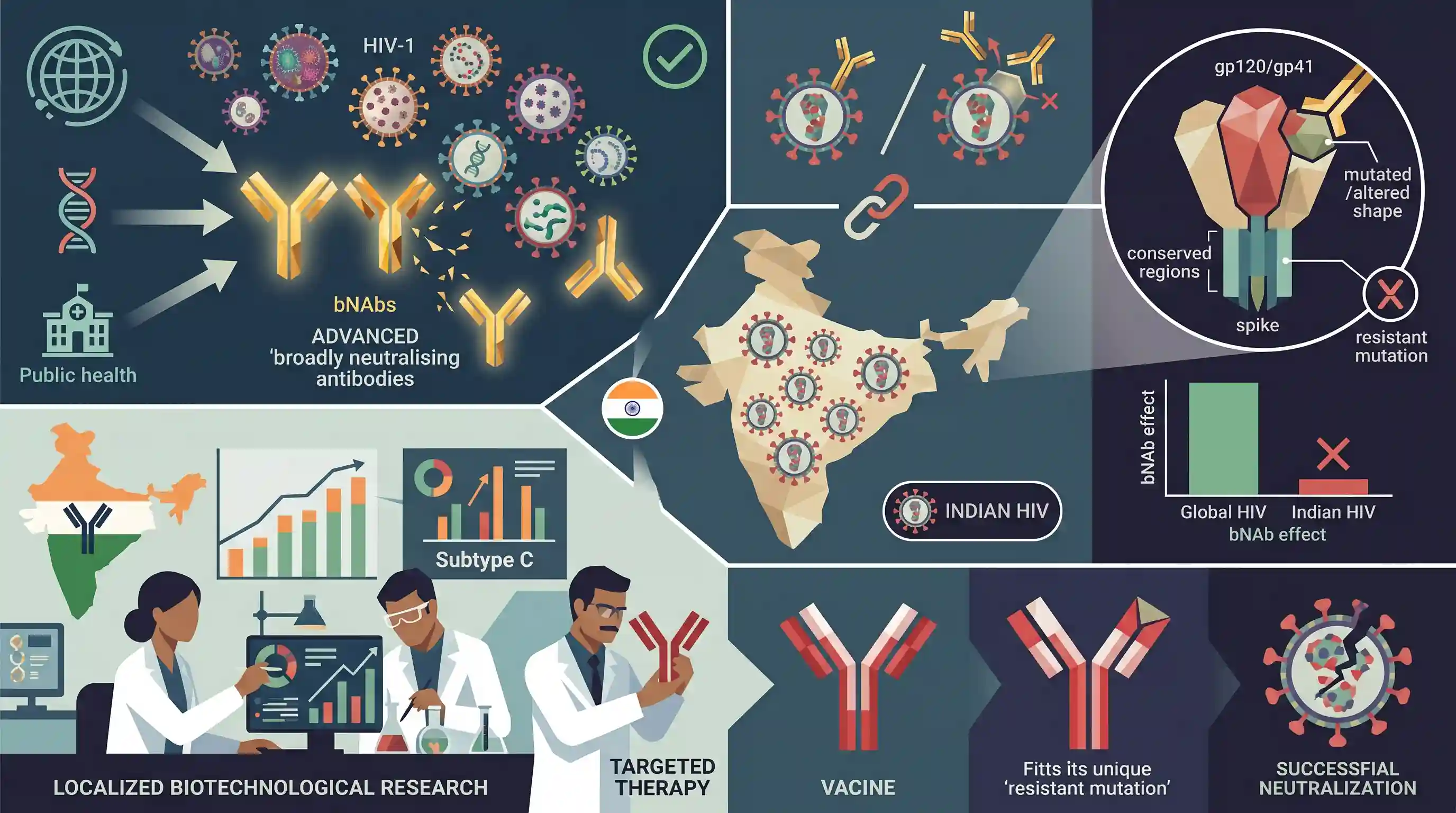
Recent research indicates that HIV strains prevalent in India (predominantly HIV-1 Subtype C) exhibit significant resistance to several advanced broadly neutralising antibodies (bNAbs) currently being developed globally. While bNAbs are a promising class of therapeutics designed to neutralize multiple strains of the rapidly mutating virus by targeting its conserved regions, the resistance seen in Indian variants poses a challenge to the local efficacy of these emerging global treatments. This underscores the critical need for localized biotechnological research to develop targeted vaccines and antibody therapies suited to regional viral subtypes.
Key Points
- Broadly Neutralising Antibodies (bNAbs) are a highly researched class of antibodies capable of targeting conserved regions of the rapidly mutating HIV virus, offering a potential path for advanced treatments and vaccines.
- Recent studies indicate that the HIV-1 Subtype C, which is the predominant strain circulating in India, demonstrates significant resistance to some of the top-tier bNAbs currently in global clinical trials.
- This resistance poses a major challenge, suggesting that emerging global antibody therapies and potential HIV vaccines may have reduced efficacy for the Indian population.
- The findings underscore the critical need for indigenous medical research to identify region-specific bNAbs and to tailor immunotherapies to the viral subtypes prevalent in India.
Prelims Trap
Broadly Neutralising Antibodies (bNAbs) are effective because they specifically target the rapidly mutating regions of the HIV virus.
False. bNAbs are revolutionary precisely because they target the 'conserved' (non-mutating) regions of a rapidly mutating virus, overcoming the virus's ability to evade standard immunity.
Static Concepts Connected
Why is HIV highly prone to mutations and difficult to vaccinate against?
- Retroviral nature: It uses reverse transcriptase to replicate, an enzyme that lacks proofreading ability, causing exceptionally high genetic mutation rates.
- Antigenic variation: Constant alterations in viral surface proteins cause 'viral escape', allowing the virus to easily evade the host's standard neutralizing antibodies.
- Viral latency: The virus integrates its DNA into the host genome and can remain dormant, hiding entirely from the immune system.
How do broadly neutralising antibodies (bNAbs) differ from traditional active immunity?
- Active Immunity: Vaccines stimulate the host immune system to produce its own antibodies over time, creating long-lasting immunological memory.
- Passive Immunity: Therapies using bNAbs involve the direct infusion of lab-developed monoclonal antibodies, providing immediate but temporary protection without creating memory cells.
Cross-Topic Patterns
Genomic Surveillance & Indigenous R&D
The inadequacy of global bNAbs against Indian HIV Subtype C mirrors India's push for indigenous genomic mapping (like INSACOG) to tailor biotechnology and health interventions locally rather than relying on global imports.
Monoclonal Antibodies in Prelims
Monoclonal antibodies are a recurring UPSC theme. HIV bNAbs expand this static concept beyond cancer and COVID-19 to chronic viral management and targeted passive immunotherapy.

Expect a 2026 prelims question contrasting bNAbs (which target conserved viral regions) with standard antibodies, linked to viral mutations.
Linked PYQs · 4
Linked PYQs · 4
- 2024PrelimsGS1
With reference to monoclonal antibodies, often mentioned in news, consider the following statements : I. They are man-made proteins. II. They stimulate immunological function due to their ability to bind to specific antigens. III. They are used in treating viral infections like that of Nipah virus. Which of the statements given above are correct?
- 2025PrelimsGS1
With reference to monoclonal antibodies, often mentioned in news, consider the following statements : I. They are man-made proteins. II. They stimulate immunological function due to their ability to bind to specific antigens. III. They are used in treating viral infections like that of Nipah virus. Which of the statements given above are correct?
- 2021PrelimsGS1
With reference to recent developments regarding 'Recombinant Vector Vaccines', consider the following statements : 1. Genetic engineering is applied in the development of these vaccines. 2. Bacteria and viruses are used as vectors. Which of the statements given above is/are correct?
- 2021MainsGS3
What are the research and developmental achievements in applied biotechnology? How will these achievements help to uplift the poorer sections of the society?
