Mumbai Kabutarkhanas Closures Driven by Urban Health Hazards
Source:Indian Express ↗
Why It Matters
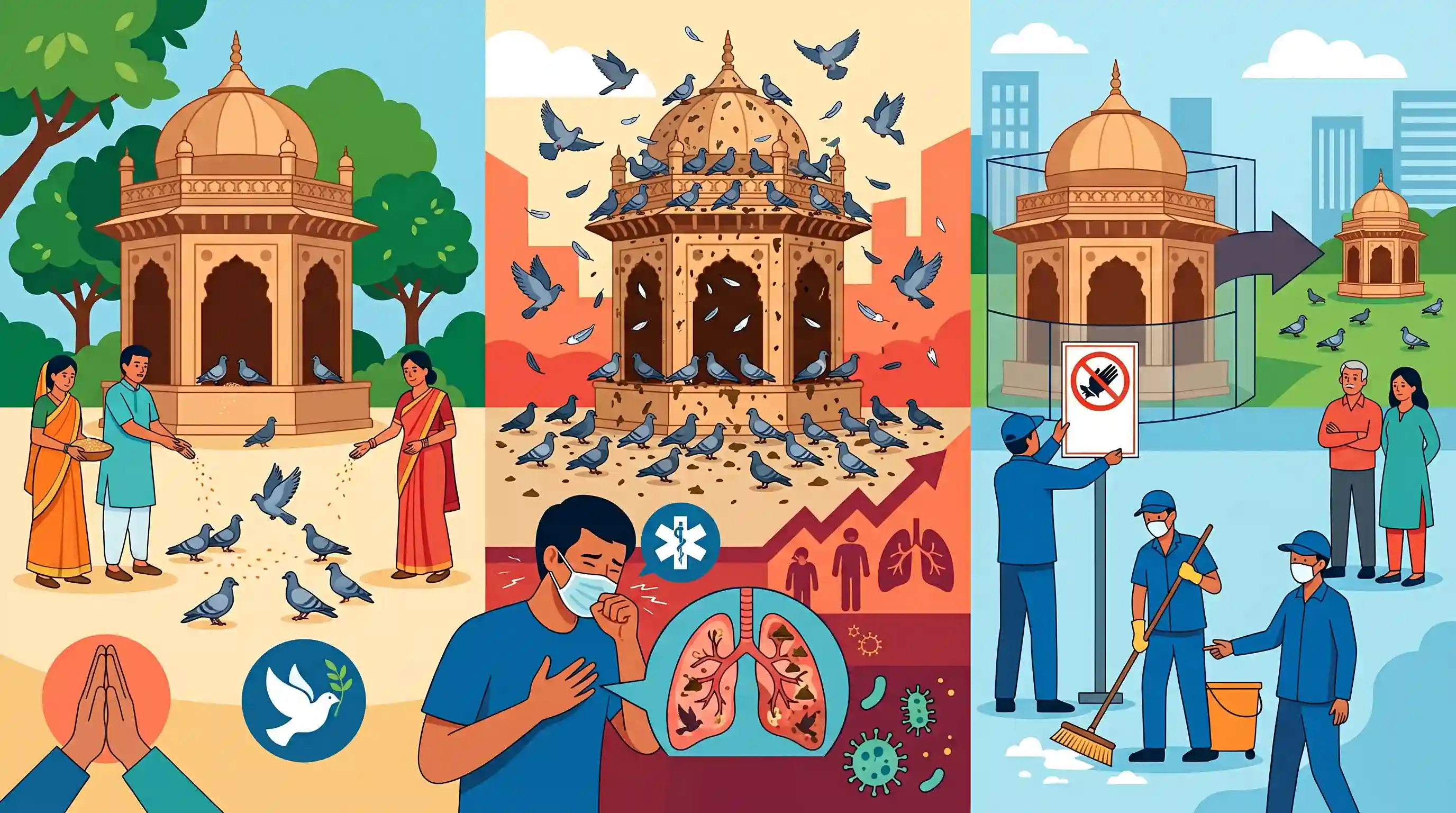
This article serves as an excellent case study at the intersection of GS-1 (Cultural traditions vs. Urbanization issues), GS-3 (Public Health and Urban Ecology), and GS-4 (Ethics of civic governance vs. religious sentiments). The conflict between the traditional Jain philosophy of Jivdaya and the emerging respiratory health crisis (Hypersensitivity Pneumonitis) from urban pigeon overpopulation highlights the complex challenges of managing modern metropolises.
Summary
Mumbai's historical Kabutarkhanas, originally established by Jain and Gujarati communities as symbols of compassion (Jivdaya) and non-violence, are increasingly facing closures and relocations. While rooted in sacred tradition, the massive overpopulation of pigeons at these feeding spots has morphed into a severe urban public health hazard. Pigeon droppings and feathers are strongly linked to rising cases of severe respiratory diseases such as Hypersensitivity Pneumonitis (HP) or "pigeon breeder's lung." Consequently, civic authorities like the BMC and local residents are prioritizing public health and urban sanitation over cultural practices, highlighting the complex tension between traditional urban ecology and modern public health challenges in a growing metropolis.
Key Points
- Mumbai's Kabutarkhanas (pigeon-feeding spots) were historically established by Jain and Gujarati merchant communities, reflecting the philosophy of Jivdaya (compassion for living beings) and Ahimsa.
- The unchecked feeding has led to a massive overpopulation of pigeons, turning them into an urban ecological hazard and invasive pests that damage structures and create unhygienic conditions.
- Public health is the primary concern driving the shutdown of these spots, as pigeon droppings and feathers are directly linked to severe respiratory ailments like Hypersensitivity Pneumonitis (HP) and asthma.
- Civic authorities, including the BMC, alongside local residents, are increasingly prioritizing urban sanitation and public health, leading to the relocation, closure, or penalization of feeding at traditional Kabutarkhanas.
Important Terms
Kabutarkhanas

Historical designated spots or ornate structures in Mumbai for feeding pigeons, originally established by Jain and Gujarati merchants as acts of charity and spiritual merit.
UPSC context
GS Paper I: Indian Culture and Urbanization; specifically the evolution of community-led charity and heritage structures in metropolitan India.
Jivdaya
A core Jain tenet meaning 'compassion for all living beings,' emphasizing non-violence (Ahimsa) through active protection and feeding of animals and birds.
UPSC context
GS Paper IV: Ethics and GS Paper I: Ancient Indian Philosophy; relevant for non-violence and ethical treatment of animals.
Hypersensitivity Pneumonitis (HP)
An inflammatory lung disease, also called 'Bird Fancier’s Lung,' caused by an immune overreaction to inhaled organic dust from bird droppings and feathers.
UPSC context
GS Paper II: Health and GS Paper III: Environment; tests understanding of zoonotic threats and urban public health challenges.
Brihanmumbai Municipal Corporation (BMC)
The primary local governing authority of Mumbai, responsible for city infrastructure, public health, and urban planning; currently enforcing pigeon-feeding bans.
UPSC context
GS Paper II: Governance; specifically Urban Local Bodies (ULBs) and their role in regulating public order and health.
Urban Ecology
The study of the relationship between living organisms and their environment within an urban setting, focusing on human-wildlife conflicts and sustainability.
UPSC context
GS Paper III: Environment and Disaster Management; addresses the balance between biodiversity conservation and urban hazard mitigation.
Prelims Trap
"Hypersensitivity Pneumonitis (HP) is a viral zoonotic disease transmitted directly by urban pigeons."
HP is not a viral or bacterial infection. It is an immune-mediated allergic lung disease (extrinsic allergic alveolitis) caused by chronic inhalation of antigens found in pigeon droppings and feathers.
Static Concepts Connected
How does the Constitution balance religious practices with public health?
- Article 25 (1): Guarantees the freedom of conscience and the right to freely profess, practice, and propagate religion.
- The Health Caveat: This fundamental right is not absolute; it is explicitly subject to "public order, morality, and health."
- State Intervention: The State retains the power to regulate secular activities associated with religious practices or restrict traditions that pose severe health hazards.
How does artificial feeding disrupt urban bird ecology?
- Resource Monopolization: Concentrated artificial feeding creates unnatural abundance, allowing aggressive species (like rock pigeons) to dominate.
- Species Displacement: The dominant species outcompete native or smaller urban birds for food and nesting spaces, forcing them out of their ecological niches.
- Unchecked Population Growth: Continuous food supply bypasses natural carrying capacity limits, triggering a population explosion that transforms local birds into invasive pests.
Cross-Topic Patterns
Tradition vs. Public Health (Article 25)
Just as Jallikattu sparked animal rights debates, Kabutarkhana closures highlight the Article 25 constitutional caveat: religious/cultural practices (like Jivdaya) can be legally restricted by the State on grounds of "public health."
Acidic droppings and heritage monument decay
Similar to the yellowing of the Taj Mahal from acid rain, the highly acidic nature of pigeon droppings accelerates the bio-deterioration of urban infrastructure and historical monuments in metropolitan areas.

Expect a Prelims question matching emerging urban health hazards (like Hypersensitivity Pneumonitis) to their environmental vectors.
Linked PYQs · 3
Linked PYQs · 3
- 2023PrelimsGS1
"Souls are not only the property of animal and plant life, but also of rocks, running water and many other natural objects not looked on as living by other religious sects." The above statement reflects one of the core beliefs of which one of the following religious sects of ancient India?
- 2013MainsGS1
Discuss the various social problems which originated out of the speedy process of urbanization in India.
- 2022MainsGS3
The increase in life expectancy in the country has led to newer health challenges in the community. What are those challenges and what steps need to be taken to meet them?
