Evolution of cattle protection debates in modern Indian history
Source:Indian Express ↗
Why It Matters
The article provides crucial historical context for one of India's most persistent socio-political fault lines. Understanding the evolution of the cow protection movement—from Gandhi's stance on Hindu-Muslim unity to the Constituent Assembly debates and modern political mobilization—is vital for answering Mains questions on communalism, secularism, and the Constitution (GS1 and GS2).
Summary
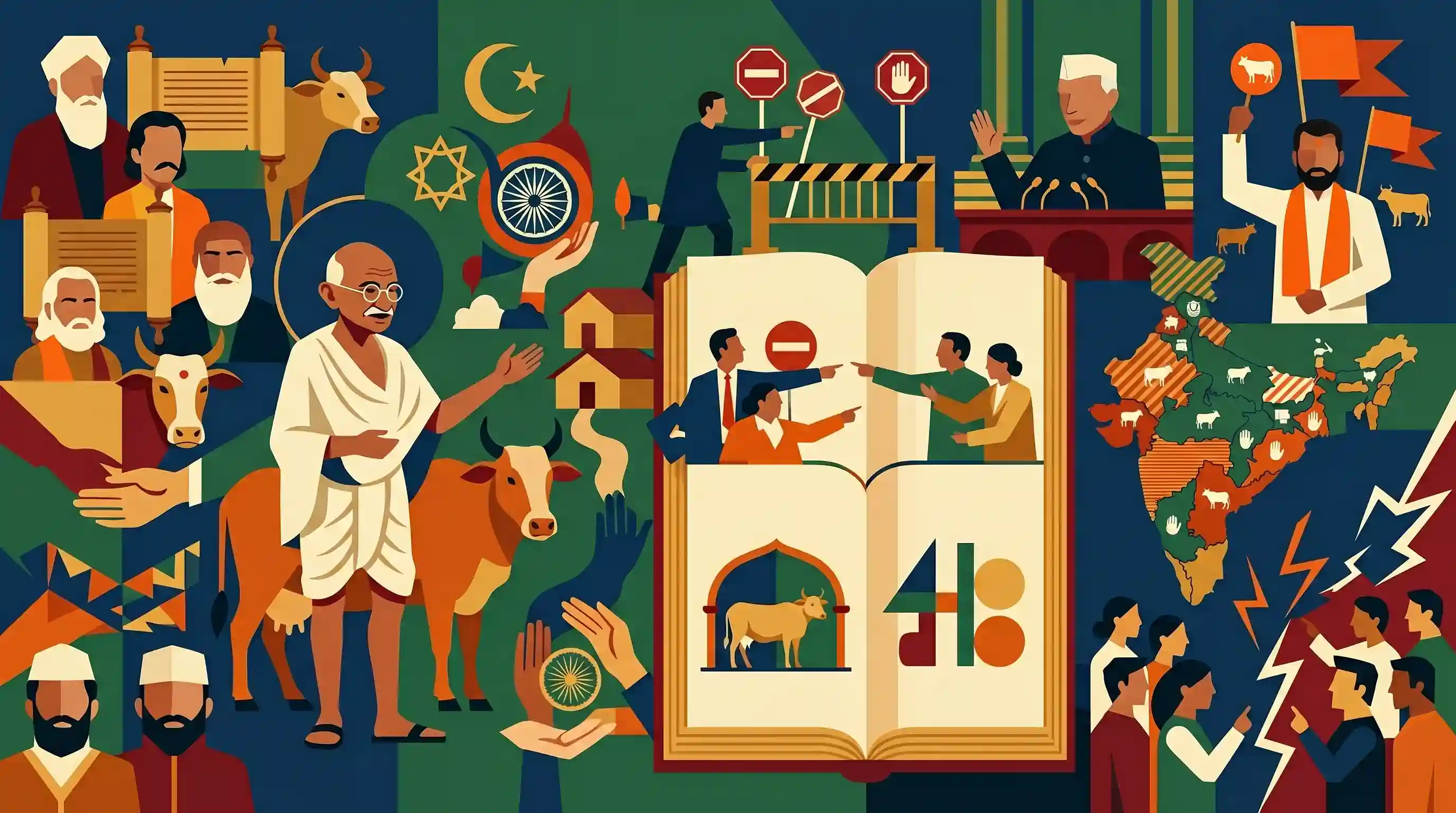
The political debate over cow slaughter in India possesses deep historical and communal roots, extending back to the late 19th-century movements led by the Arya Samaj. While Mahatma Gandhi favored voluntary cow protection to preserve Hindu-Muslim unity, post-independence Hindu conservatives pushed heavily for a constitutional ban. This resulted in a compromise within the Constituent Assembly, placing cow protection under Article 48 of the Directive Principles of State Policy. Despite early resistance from leaders like Jawaharlal Nehru to national bans, cow protection has remained a potent tool for political mobilization, particularly championed by the BJP and the Sangh Parivar, leading to widespread state-level legislations and ongoing societal friction.
Key Points
- The cow protection movement, heavily popularized by the Arya Samaj in the late 19th century, served as a tool for forging a horizontal Hindu consciousness across caste divides, while frequently sparking communal riots.
- During the freedom struggle, Mahatma Gandhi advocated for 'gau seva' (cow service) but strongly opposed legislative bans on cow slaughter, prioritizing Hindu-Muslim unity during the Khilafat movement over forceful coercion.
- In the Constituent Assembly, Hindu conservatives lobbied to make cow protection a Fundamental Right, but resistance led to a compromise where it was enshrined in Article 48 under the Directive Principles of State Policy, framed around agriculture and animal husbandry.
- Post-independence, Jawaharlal Nehru resisted national anti-cow slaughter bills, even threatening to resign, arguing that it was a state subject and against the secular fabric of the nation.
- The BJP and Sangh Parivar have utilized cow protection as a cornerstone of their political mobilization and cultural nationalism, resulting in stringent state-level anti-slaughter laws and controversies involving vigilante groups.
Important Terms
Article 48 of the Constitution

A Directive Principle (Part IV) directing the State to organize agriculture and animal husbandry on scientific lines and prohibit the slaughter of cows, calves, and other milch and draught cattle.
UPSC context
GS Paper II (Polity). Essential for understanding the constitutional basis of cattle slaughter laws and the compromise between religious and economic arguments.
Directive Principles of State Policy (DPSP)
Non-justiciable guidelines in Part IV (Articles 36-51) that the State must strive to follow to ensure social, economic, and political justice and establish a welfare state.
UPSC context
GS Paper II (Polity). Tests knowledge of the ‘Instrument of Instructions’ for governance and its relationship with Fundamental Rights.
Arya Samaj
A 19th-century Hindu reform movement founded by Swami Dayanand Saraswati; it pioneered the modern cow protection movement in the 1880s through 'Gaurakshini Sabhas.'
UPSC context
GS Paper I (Modern History). Relevant for socio-religious reform movements and the origins of communal politics in colonial India.
Constituent Assembly
The sovereign body (1946–1950) that drafted the Indian Constitution, where intense debates occurred over whether to include a cattle slaughter ban in Fundamental Rights or DPSP.
UPSC context
GS Paper II (Polity). Critical for understanding the intent of the framers and the evolution of secularism in the Indian context.
Prevention of Cruelty to Animals Act, 1960
A central law aimed at preventing unnecessary pain or suffering to animals; it established the Animal Welfare Board of India to oversee humane treatment and transport.
UPSC context
GS Paper II (Governance/Environment). Important for regulatory frameworks regarding animal welfare and its clash with traditional or commercial practices.
Bharatiya Jana Sangh (BJS)
A right-wing political party (precursor to the BJP) founded in 1951; it was a leading force in the 1966 anti-cow slaughter protests outside the Indian Parliament.
UPSC context
GS Paper I (Post-independence Consolidation). Relevant for the study of the rise of political parties and major ideological movements in India.
Prelims Trap
Article 48 directs the State to prohibit cow slaughter to protect religious and cultural heritage.
Article 48 frames the prohibition of cow slaughter strictly on economic and scientific grounds (agriculture and animal husbandry), not on religious, cultural, or traditional sentiments.
Static Concepts Connected
How does the Indian Constitution address cattle slaughter?
- Article 48 (DPSP): Directs the state to organize agriculture on scientific lines and take steps to prohibit the slaughter of cows, calves, and milch/draught cattle.
- State List: 'Preservation, protection and improvement of stock' is Entry 15 of the State List, meaning only state legislatures can enact anti-slaughter laws, not the Centre.
- Article 19(1)(g): The Supreme Court has upheld bans on slaughtering economically 'useful' cattle as a reasonable restriction on the fundamental right to practice any trade or profession.
What was the political impact of Arya Samaj's cow protection movement?
- Horizontal Mobilization: Cow Protection Societies (Gaurakshini Sabhas) in the 1880s helped forge a unified Hindu consciousness, attempting to bridge rigid caste divides under a shared cultural symbol.
- Communal Tensions: The aggressive push for bans sharply escalated religious divides and directly contributed to widespread communal riots across Northern India, notably in 1893.
Cross-Topic Patterns
Gandhian Secularism vs State Coercion
Gandhi favored voluntary 'gau seva' and opposed legal bans, linking cow protection to Hindu-Muslim unity (Khilafat) rather than state-imposed majoritarianism or legislative coercion.
Article 48 vs Article 19(1)(g)
Judicial history (like the 1958 Quareshi case) resolves conflicts between DPSP (cow protection) and Fundamental Rights (butchers' right to trade) by applying the doctrine of 'bovine economics', not religious sentiment.

A multi-statement Prelims question will likely test the exact scientific/agricultural rationale of Article 48 against State List Entry 15.
Linked PYQs · 4
Linked PYQs · 4
- 2018MainsGS1
Throw light on the significance of the thoughts of Mahatma Gandhi in the present times.
- 2017MainsGS1
Distinguish between religiousness/religiosity and communalism giving one example of how the former has got transformed into the latter in independent India.
- 2018MainsGS1
Communalism arises either due to power struggle or relative deprivation.' Argue by giving suitable illustrations.
- 2020PrelimsGS1
Which part of the Constitution of India declares the ideal of Welfare State?
