Official language policy pushes Hindi in science and judiciary
Source:Indian Express ↗
Why It Matters
The ongoing government push to vernacularize technical education, the judiciary, and police administration represents a significant shift in governance. Understanding the Constitutional balance of the official language (Part XVII), Eighth Schedule languages, and linguistic federalism is highly relevant for GS2 Polity and GS1 Indian Society.
Summary
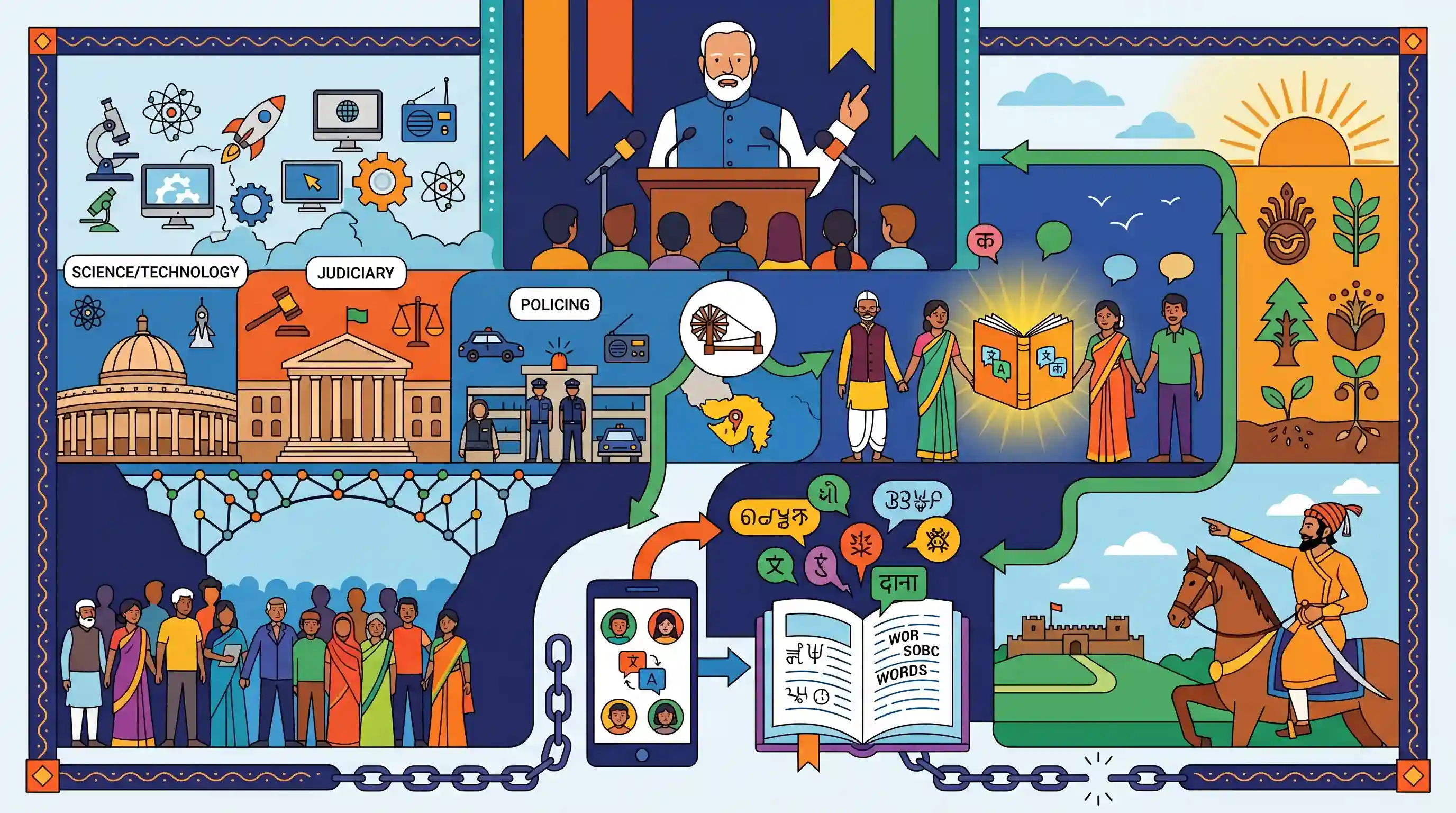
Addressing the 5th Akhil Bharatiya Rajbhasha Sammelan on Hindi Diwas, Union Home Minister Amit Shah strongly advocated for the use of Hindi in fields like science, technology, the judiciary, and policing to bridge the gap between institutions and the citizenry. Addressing linguistic sensitivities, he clarified that Hindi is a 'friend' to other regional languages and they have developed together without conflict. Shah praised non-Hindi states like Gujarat for historically spearheading the Hindi movement through leaders like Mahatma Gandhi. He called for Hindi to become more conversational by absorbing vocabulary from other Indian languages. Furthermore, he launched the 'Bahubhashi Anuvad Sarthi' translation app and the 'Hindi Shabd Sindhu' dictionary, linking the promotion of indigenous languages ('Swa-bhasha') directly to national pride and decolonization, echoing Chhatrapati Shivaji Maharaj's ideals.
Key Points
- Union Home Minister Amit Shah advocated for establishing Hindi as the medium for science, technology, the judiciary, and the police to foster a better connection with the public.
- He emphasized that Hindi is a 'friend' (sakhi) to other Indian languages rather than a competitor, attempting to assuage fears of Hindi imposition.
- Highlighted the contributions of prominent figures from non-Hindi speaking states (like Gujarat's Mahatma Gandhi and Sardar Patel) in accepting and propagating Hindi.
- Suggested that Hindi should flexibly borrow words from other Indian languages—rather than strictly from Sanskrit—to remain conversational and accessible.
- Highlighted two digital initiatives for language promotion: 'Bahubhashi Anuvad Sarthi' (a translation app) and 'Hindi Shabd Sindhu' (a dictionary aiming to be the world's largest by 2029).
- Drew parallels with Chhatrapati Shivaji Maharaj's principles of Swaraj (self-rule), Swadharma (own religion), and Swa-bhasha (own language) as pillars of national pride.
Important Terms
Bahubhashi Anuvad Sarthi

An AI-driven translation platform developed by the Department of Official Language and C-DAC to facilitate seamless translation between Hindi and 15 other Eighth Schedule languages.
UPSC context
GS II: Governance/E-governance. Tests knowledge of digital tools for linguistic inclusivity and official language implementation.
Hindi Shabd Sindhu
An expansive digital Hindi dictionary aimed at standardizing terminology and incorporating vocabulary from regional languages to make Hindi a flexible, "composite" medium of expression.
UPSC context
GS I & II: Indian Culture/Governance. Relevant for discussions on composite culture and decolonization of language in administration.
Akhil Bharatiya Rajbhasha Sammelan
A national-level conference organized by the Ministry of Home Affairs to promote Hindi's use in governance and facilitate dialogue between Hindi and regional languages.
UPSC context
GS II: Governance. Tests awareness of institutional mechanisms for implementing the Official Language Policy and national integration.
Article 351
A constitutional directive (Part XVII) mandating the Union to promote the spread and development of Hindi as a medium for India's composite culture.
UPSC context
GS II: Polity. Crucial for understanding the Union's constitutional duty toward linguistic development and federal language harmony.
Department of Official Language
A specialized department under the Ministry of Home Affairs responsible for implementing constitutional and legal provisions regarding Hindi as the official language.
UPSC context
GS II: Governance. Important for understanding the executive machinery that regulates official communication and Rajbhasha compliance.
Official Languages Act, 1963
Legislation providing for the continued use of English for official Union purposes and Parliamentary business alongside Hindi beyond the initial 15-year constitutional period.
UPSC context
GS II: Polity. Fundamental to the "bilingualism" policy that balances Hindi promotion with the concerns of non-Hindi states.
Prelims Trap
"The Governor of a state can authorize High Courts to deliver judgments and decrees in Hindi with the President's prior consent."
Under Article 348(2), while Hindi can be authorized for High Court proceedings, all judgments, decrees, and orders passed must legally continue to be in English.
Static Concepts Connected
What is the Constitutional mandate for language in the Higher Judiciary?
- Article 348(1): States that proceedings in the Supreme Court and all High Courts must be conducted in English until Parliament enacts a law otherwise.
- Article 348(2): Allows the Governor, with the President's consent, to authorize Hindi or regional languages for HC proceedings, but judgments must remain in English.
What does Article 351 mandate regarding the development of Hindi?
- Union's Duty: It directs the Union government to promote the spread of Hindi so it serves as a medium of expression for India's composite culture.
- Vocabulary Source: The Constitution explicitly directs Hindi to secure its vocabulary primarily from Sanskrit and secondarily from other Indian languages listed in the Eighth Schedule.
Cross-Topic Patterns
NEP 2020 + Legal/Technical Education
Shah's push for Hindi in science and the judiciary directly aligns with NEP 2020's mandate to offer technical, medical, and legal education in mother tongues to bridge cognitive and linguistic gaps.
Language Politics + Eighth Schedule
Promoting Hindi as a 'friend' addresses historical anti-Hindi agitations. This connects to frequent state demands to include more regional dialects in the Eighth Schedule and formally recognize new Classical Languages.

Expect a Prelims question contrasting Article 348 (English in Higher Judiciary) with Article 351 (Directive to develop Hindi).
Linked PYQs · 5
Linked PYQs · 5
- 2024PrelimsGS1
The Constitution (71st Amendment) Act, 1992 amends the Eighth Schedule to the Constitution to include which of the following languages? 1. Konkani 2. Manipuri 3. Nepali 4. Maithili Select the correct answer using the code given below:
- 2020MainsGS2
National Education Policy 2020 is in conformity with the Sustainable Development Goal-4 (2030). It intends to restructure and reorient education system in India. Critically examine the statement.
- 2016MainsGS1
Has the formation of linguistic States strengthened the cause of Indian Unity?
- 2019MainsGS1
Many voices had strengthened and enriched the nationalist movement during the Gandhian phase. Elaborate.
- 2018MainsGS1
Throw light on the significance of the thoughts of Mahatma Gandhi in the present times.
