Himalayan melting glaciers and India macroeconomic GDP risks
Source:Indian Express ↗
આ શા માટે મહત્વનું છે
This article connects environmental degradation of the Himalayas directly to macroeconomic stability and GDP security in India, providing valuable dimensions for questions on climate change impacts and disaster management in Mains GS3.
સારાંશ
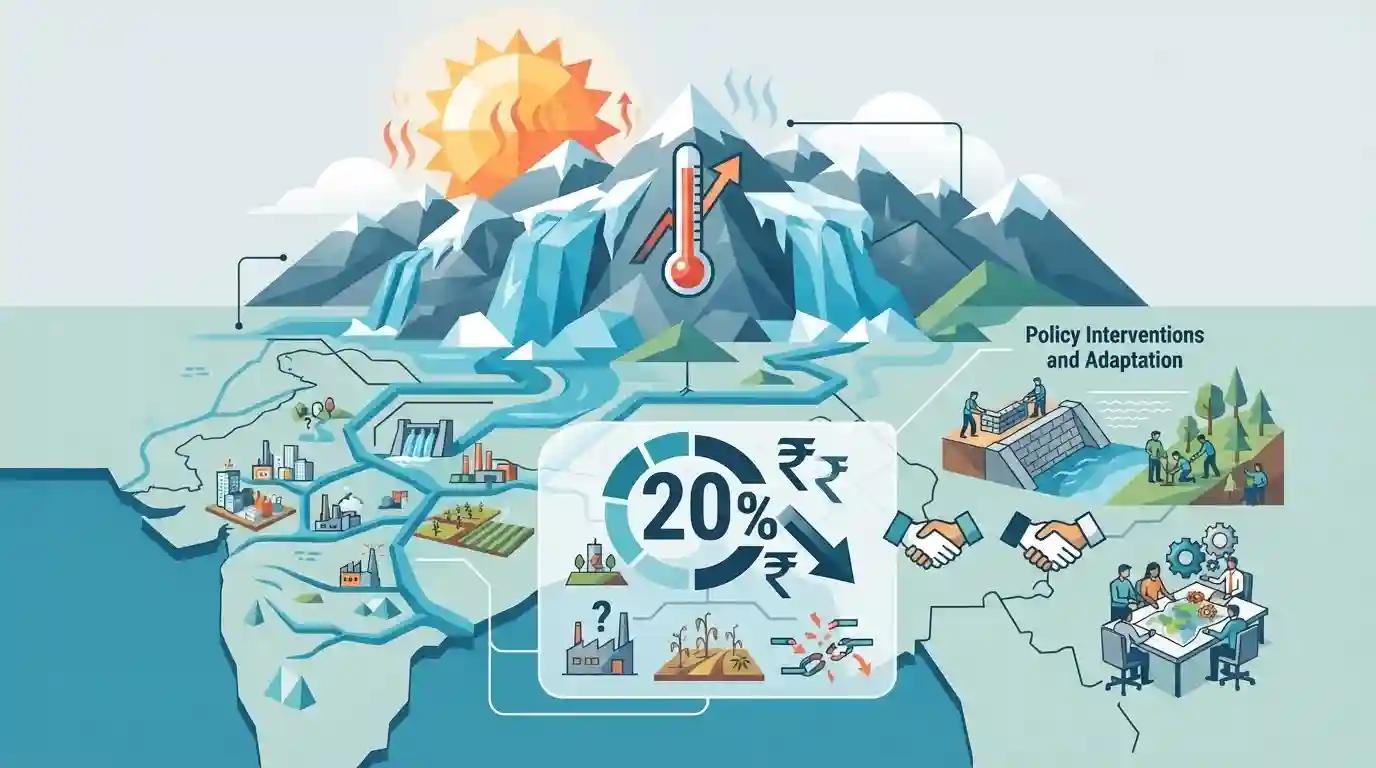
The article highlights the alarming rate at which Himalayan glaciers are melting, warning that nearly 20% of India's GDP is at risk due to ensuing climate vulnerabilities, water insecurity, and economic disruptions. It emphasizes the need for urgent policy interventions, climate adaptation strategies, and regional cooperation to safeguard the vulnerable Hindu Kush Himalaya region.
મુખ્ય મુદ્દા
- Melting of Himalayan glaciers poses a severe threat to India's water security, agriculture, and hydrological stability.
- Studies and climate assessments indicate that up to 20% of India's GDP could face systemic risks from climate-induced disruptions linked to glacier melt and extreme weather events.
- Accelerated global warming, black carbon deposition, and changing monsoon patterns are compounding the vulnerability of the Hindu Kush Himalaya region.
- Protecting high-altitude ecosystems requires a dual approach of aggressive global emission mitigation and localized climate-resilient economic planning.
મહત્વપૂર્ણ શબ્દો
Intergovernmental Panel on Climate Change (IPCC)

An international body established by the WMO and UNEP in 1988 to assess comprehensive scientific, technical, and socioeconomic information regarding climate change, its risks, and adaptation strategies.
UPSC context
GS Paper III (Environment & Ecology); tested on international bodies, global climate governance, and scientific assessments of climate change.
પ્રિલિમ્સ ટ્રેપ
Nearly 20% of India's GDP is at risk due to Himalayan melting glaciers.
Aspirants often assume 100% of India's GDP or all river basins originate uniformly from the Himalayas, whereas peninsular rivers rely entirely on monsoon rainfall.
સંલગ્ન સ્થિર ખ્યાલો
What are Glacial Lake Outburst Floods (GLOFs) and what factors trigger them?
- Mechanism: Moraine dam failure triggered by earthquakes, avalanches, or rapid ice melting holding large volumes of glacial meltwater.
- Recent Precedent: Sikkim's South Lhonak lake outburst in 2023 highlighted extreme vulnerability of cascade hydropower projects in the Himalayas.
- Mitigation Framework: NDMA guidelines mandate early warning systems, hazard zonation mapping, and strict regulation of construction in high-risk zones.
આંતર-વિષય પેટર્ન
Himalayan Melt + Agricultural Distress Linkages
Rapid glacier retreat threatens northern river basins while simultaneously altering monsoon dynamics, directly impacting agricultural productivity, rural distress, and rural credit offtake.
Disaster Management Act + Climate Adaptation
Fragile geology and retreating glaciers drive GLOFs and flash floods, necessitating a paradigm shift from disaster relief to proactive climate-resilient infrastructure.

Himalayan cryosphere vulnerability and GLOFs likely to feature in GS Paper 3 Environment as an analytical question on economic costs.
સંલગ્ન PYQ · 2
સંલગ્ન PYQ · 2
- 2017MainsGS3
'Climate change' is a global problem. How India will be affected by climate change? How Himalayan and coastal states of India will be affected by climate change?
- 2023MainsGS3
The Intergovernmental Panel on Climate Change (IPCC) has predicted a global sea level rise of about one metre by AD 2100. What would be its impact in India and the other countries in the Indian Ocean region?
