Himalayan Geological Vulnerabilities And Mitigation Strategies
Source:vajiramandravi ↗
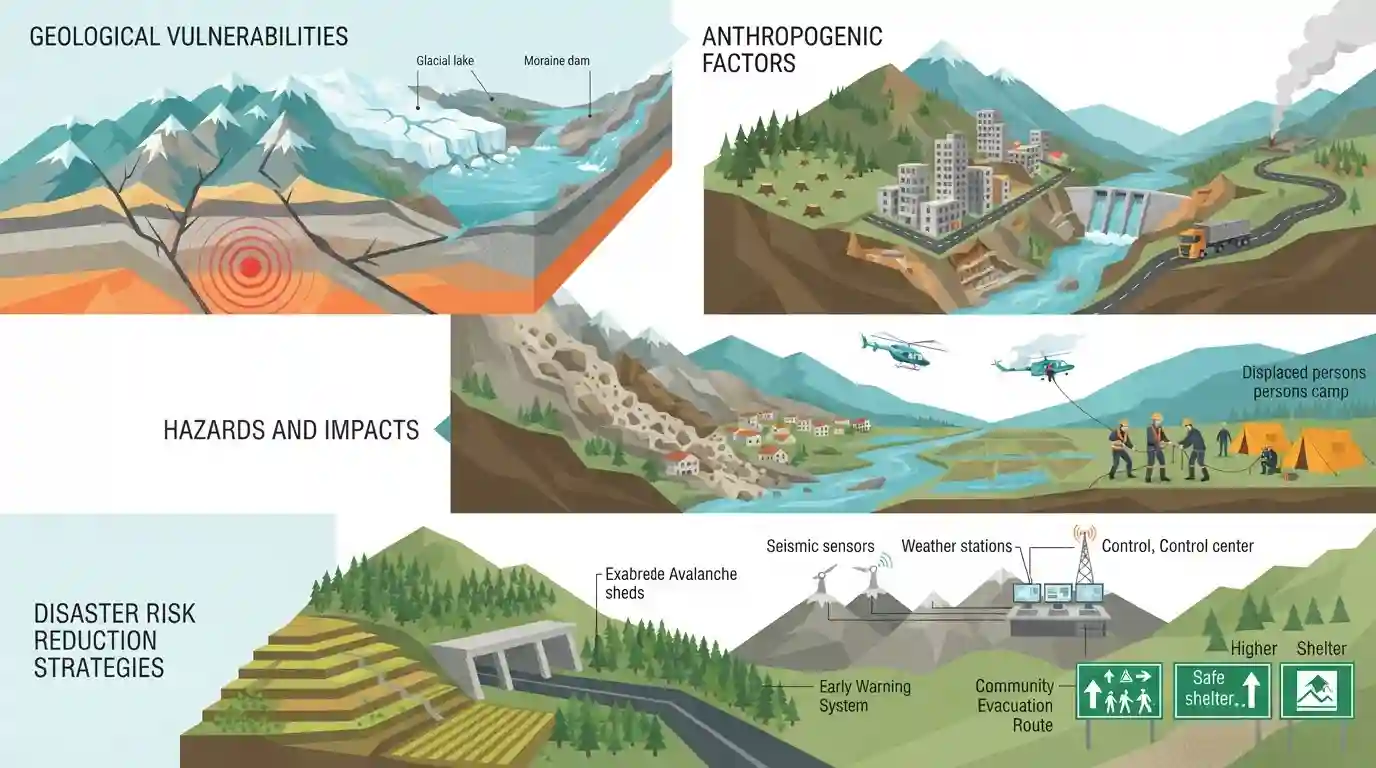
Why It Matters
Crucial for understanding disaster vulnerability, ecological fragility, and mitigation policies in mountain ecosystems, especially for Himalayan states like Uttarakhand.
Summary
An overview of the hazards and disaster management challenges specific to the Himalayan region, examining geological vulnerabilities, anthropogenic factors, and key strategies for disaster risk reduction.
Key Points
- The Himalayan region is highly vulnerable to natural hazards like earthquakes, landslides, flash floods, and glacial lake outburst floods (GLOFs).
- Fragile geology, young tectonic activity, steep slopes, and heavy monsoonal rainfall compound disaster risks.
- Anthropogenic pressures such as unplanned infrastructure development, deforestation, and unscientific tourism exacerbate these hazards.
- Effective disaster management requires robust early warning systems, slope stabilization techniques, sustainable land-use planning, and community capacity building.
Important Terms
National Disaster Management Authority (NDMA)

The apex statutory body of India responsible for laying down policies, plans, and guidelines for disaster management and coordinating response mechanisms across the country.
UPSC context
Important for UKPSC Paper III (Disaster Management, institutional framework, and mitigation policies for vulnerable regions like the Himalayas).
Static Concepts Connected
What are the major structural and non-structural measures for landslide mitigation in fragile Himalayan regions?
- Structural Measures: Structural measures include soil nailing, gabion walls, wire mesh anchoring, and slope terracing to stabilize unstable rock and soil masses.
- Non-Structural Measures: Non-structural measures involve hazard zonation mapping, early warning systems, land-use zoning regulations, and community-based disaster management training.
- Monitoring Tech: Advanced remote sensing tools like InSAR enable continuous surface displacement monitoring along critical pilgrim and trade corridors.
Cross-Topic Patterns
Border Infrastructure vs. Eco-Fragility
Himalayan road-widening projects test the balance between strategic border infrastructure and ecological fragility under the Uttarakhand Disaster Management Act.
Cryosphere Melting & GLOF Risk Governance
GLOFs link high-altitude cryosphere monitoring with downstream river basins, tying climate change adaptation to trans-boundary basin governance.

Expect a multi-statement question combining NDMA guidelines for Himalayas with specific state-level bodies like ULMMC and GLOF warning tech.
Linked PYQs · 2
Linked PYQs · 2
- 2025UKPSC_PRELIMSGS1
Which of the following is the correct order of the following physiographic regions of Uttarakhand from south to north direction?
- 2025UKPSC_PRELIMSGS1
Which of the following parts of Himalaya is situated between Main Boundary Thrust and Main Central Thrust ?
