Demand to ban highly hazardous pesticides in Himachal Pradesh
Source:tribuneindia ↗
Why It Matters
This issue bridges environmental conservation, public health, state-level horticultural policies (apple spray schedules), and central regulatory mechanisms (Insecticides Act, 1968, and CIBRC). It highlights the conflict between agrochemical retail availability and official horticultural recommendations in ecologically sensitive zones like the Himalayas.
Summary
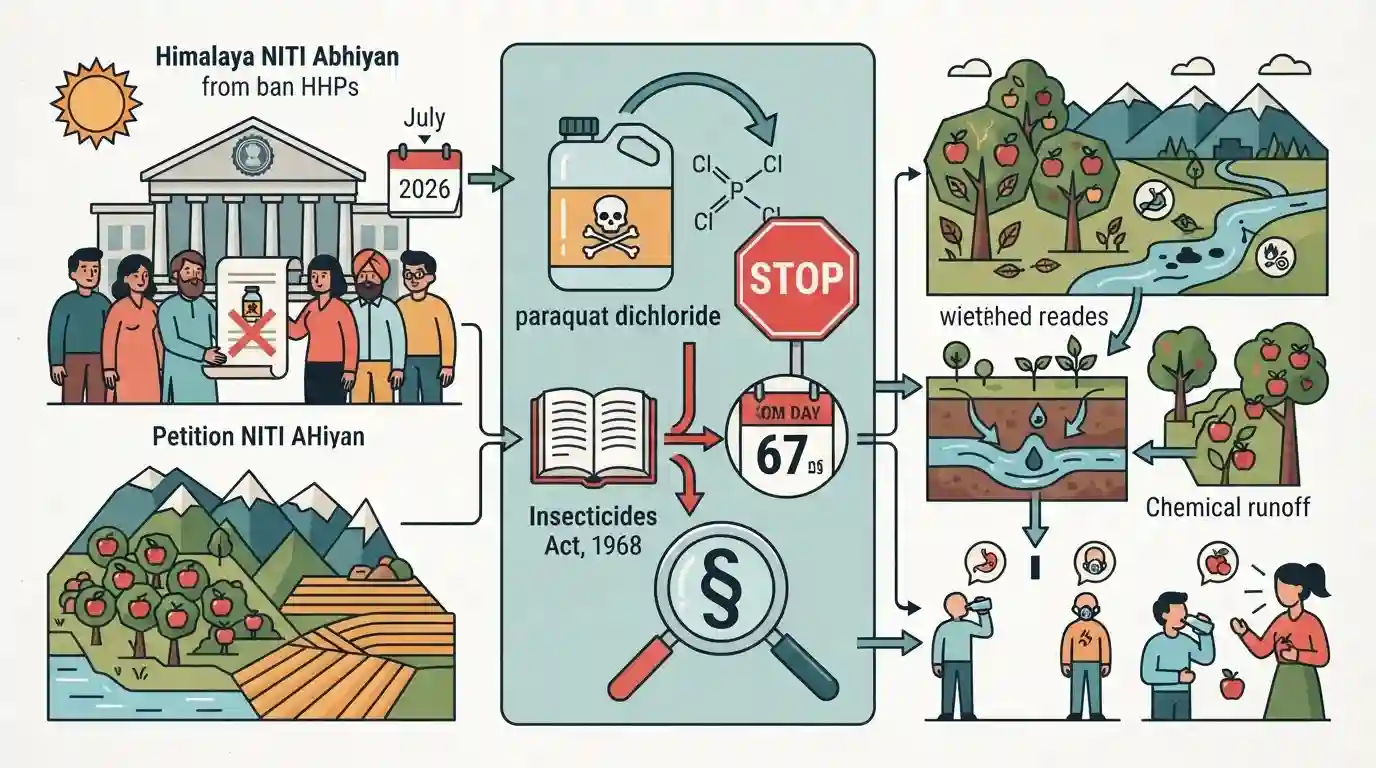
The Himalaya NITI Abhiyan has petitioned Himachal Pradesh Chief Minister Sukhvinder Singh Sukhu to ban the sale and use of highly hazardous pesticides (HHPs), specifically targeting the toxic herbicide paraquat dichloride. This follows a July 2026 draft notification from the Union Ministry of Agriculture recommending a nationwide ban. The organization has urged the state to invoke Section 27 of the Insecticides Act, 1968, to temporarily suspend retail sales of paraquat dichloride for 60 days, and called for the phase-out of other harmful agrochemicals like glyphosate, monocrotophos, chlorpyrifos, zinc phosphide, and carbofuran. Although these chemicals are not recommended in the state’s apple spray schedules, they remain commercially accessible due to a lack of retail restrictions.
Key Points
- Himalaya NITI Abhiyan has urged the Himachal Pradesh government to immediately halt the sale and use of highly hazardous pesticides (HHPs), especially paraquat dichloride.
- The representation follows a draft gazette notification from the Union Ministry of Agriculture proposing a nationwide ban on paraquat dichloride due to its extreme acute toxicity and fatal poisoning risk.
- The advocacy group requested the state to invoke Section 27 of the Insecticides Act, 1968, which empowers governments to suspend the sale and distribution of a toxic insecticide for a temporary period (60 days).
- The group also urged the state to lobby the Central Insecticides Board and Registration Committee (CIBRC) to expedite the phase-out of other HHPs, including monocrotophos, chlorpyrifos, glyphosate, zinc phosphide, and carbofuran.
- While Himachal's Directorate of Horticulture clarified that toxic pesticides are excluded from the official apple spray schedule, these chemicals remain freely available in retail markets, exposing a critical regulatory gap.
Important Terms
Insecticides Act, 1968

The principal Indian law regulating the import, manufacture, sale, transport, distribution, and use of pesticides and agrochemicals to prevent health hazards to humans and animals.
UPSC context
Vital for GS-3 (Agriculture & Environment) focusing on pesticide regulation, farm safety, and ecological conservation.
Section 27 of the Insecticides Act, 1968
A statutory provision empowering State and Central governments to temporarily ban the sale and use of a hazardous insecticide for up to 60 days to protect public safety.
UPSC context
Relevant for GS-2 (Polity) and GS-3 (Environmental Regulation) concerning state interventions and federalism in chemical safety.
Paraquat Dichloride
A highly toxic, non-selective contact herbicide lacking a specific antidote. The Centre proposed a nationwide ban in July 2026 due to severe occupational health and poisoning risks.
UPSC context
Important for GS-3 (Agriculture and Science & Tech) regarding hazardous agrochemicals, public health, and sustainable farming practices.
Himalaya NITI Abhiyan
A grassroots civil society organization in Himachal Pradesh campaigning for sustainable, mountain-specific development policies that balance ecological conservation with local livelihood protection.
UPSC context
Relevant for GS-3 (Environment) and GS-2 (Role of Civil Society) regarding sustainable Himalayan ecology and development.
Central Insecticides Board and Registration Committee (CIBRC)
A statutory body under the Ministry of Agriculture and Farmers Welfare responsible for advising on pesticide safety and regulating the registration of agrochemicals in India.
UPSC context
Crucial for GS-3 (Agriculture) to understand the institutional regulatory framework for chemical pesticides and agricultural safety.
Prelims Trap
Only the Central Government is empowered to suspend the sale or distribution of hazardous pesticides under the Insecticides Act, 1968.
Both Central and State Governments have the statutory power to temporarily prohibit the sale or use of an insecticide for up to 60 days under Section 27 of the Insecticides Act, 1968.
Static Concepts Connected
What is the statutory framework governing the Central Insecticides Board (CIB)?
- Statutory Status: It is a statutory body established under Section 4 of the Insecticides Act, 1968 to advise the government on technical matters.
- Nodal Ministry: It operates under the Ministry of Agriculture & Farmers Welfare, despite having overlapping mandates with environment and health.
- Leadership: The Board is chaired ex-officio by the Director General of Health Services (DGHS), reflecting the deep public health implications of agrochemicals.
What makes Paraquat Dichloride and Carbofuran highly restricted agrochemicals?
- Paraquat Dichloride: Paraquat is a fast-acting, non-selective contact herbicide known for extreme acute toxicity and completely lacking a specific medical antidote.
- Carbofuran: Carbofuran is a highly toxic carbamate pesticide (HHP). It is notorious for severe environmental risks, groundwater contamination, and accidental wildlife deaths.
- Regulatory Body: The Registration Committee (RC) evaluates the safety and efficacy of these chemicals, regulating their import, manufacture, and sale in India.
Cross-Topic Patterns
Pesticide poisoning in wildlife conservation
Pesticides like carbofuran and zinc phosphide are frequently implicated in the retaliatory poisoning of tigers and leopards, linking agricultural chemical regulations directly to wildlife conservation and anti-poaching challenges.
Chemical phase-outs and ZBNF adoption
The push to ban HHPs aligns with state transitions to Subhash Palekar Natural Farming (SPNF), such as Himachal's PK3Y scheme, which completely restricts chemical inputs in favor of biological formulations.

Expect a multi-statement Prelims question testing the CIBRC's structure (DGHS chairmanship) paired with state powers to ban pesticides.
Linked PYQs · 3
Linked PYQs · 3
- 2014HPAS_PRELIMSGS1
Which one of the following agricultural practices is eco-friendly ?
- 2023HPAS_PRELIMSGS1
Consider the following Acts and Policy : (1) Water (Prevention and Control of Pollution) Act (2) Water Cess Act (3) The National Water Policy (4) Air (Prevention and Control of Pollution) Act With reference to the Acts and Policy mentioned above, in terms of their starting year, which one of the following is the correct ascending order? Choose the correct answer from the options given below :
- 2024HPAS_PRELIMSGS1
Arrange the following Institutes of India from North to South : (1) National Bureau of Animal Genetic Resources (2) National Bureau of Plant Genetic Resources (3) National Bureau of Fish Genetic Resources (4) National Bureau of Agricultural Insect Resources Choose the correct answer from the options given below :
